



 Chat with AI
Exam 22: Frontiers in Microeconomics

Exam 1: Ten Principles of Economics220 Questions
Exam 2: Thinking Like an Economist284 Questions
Exam 3: Interdependence and the Gains From Trade192 Questions
Exam 4: The Market Forces of Supply and Demand277 Questions
Exam 5: Elasticity and Its Application222 Questions
Exam 6: Supply, Demand, and Government Policies321 Questions
Exam 7: Consumers, Producers, and the Efficiency of Markets218 Questions
Exam 8: Applications: The Costs of Taxation203 Questions
Exam 9: Application: International Trade214 Questions
Exam 10: Externalities204 Questions
Exam 11: Public Goods and Common Resources182 Questions
Exam 12: The Design of the Tax System225 Questions
Exam 13: The Costs of Production261 Questions
Exam 14: Firms in Competitive Markets243 Questions
Exam 15: Monopoly231 Questions
Exam 16: Monopolistic Competition246 Questions
Exam 17: Oligopoly204 Questions
Exam 18: The Markets for the Factors of Production232 Questions
Exam 19: Earnings and Discrimination230 Questions
Exam 20: Income Inequality and Poverty194 Questions
Exam 21: The Theory of Consumer Choice209 Questions
Exam 22: Frontiers in Microeconomics185 Questions
Exam 23: Measuring a Nations Income231 Questions
Exam 24: Measuring the Cost of Living214 Questions
Exam 25: Production and Growth187 Questions
Exam 26: Saving, Investment, and the Financial System225 Questions
Exam 27: Tools of Finance198 Questions
Exam 28: Unemployment and Its Natural Rate361 Questions
Exam 29: The Monetary System210 Questions
Exam 30: Money Growth and Inflation201 Questions
Exam 31: Open-Economy Macroeconomics: Basic Concepts194 Questions
Exam 32: A Macroeconomic Theory of the Open Economy188 Questions
Exam 33: Aggregate Demand and Aggregate Supply189 Questions
Exam 34: The Influence of Monetary and Fiscal Policy on Aggregate Demand207 Questions
Exam 35: The Short-Run Tradeoff Between Inflation and Unemployment223 Questions
Exam 36: Six Debates Over Macroeconomic Policy154 Questions
Select questions type


According to the median voter theorem, majority rule will produce an outcome that is inconsistent with transitive preferences.
(True/False)
4.8/5  (86)
(86) An example of an information asymmetry is when a worker knows more than his employer about his work effort.
(True/False)
4.7/5 (82)
(82) Table 22-8
The citizens of Mayville are having a severe budget shortage and are faced with eliminating athletics from the town high school. The town administrator has determined that the town can afford to maintain one sport. Exactly one of the three choices will prevail, and the choice will be made by way of pairwise voting, with the majority determining the outcome on each vote. The preferences of the voters are summarized in the table below.
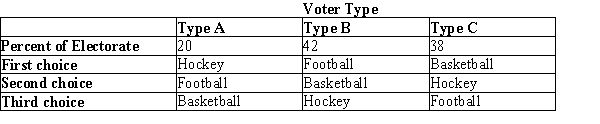 -Refer to Table 22-8. If the town administrator asks voters to choose first between basketball and football and then between the winner of the first vote and hockey, which sport will win the final vote?
 (Short Answer)
4.8/5 (68)
(68) Table 22-1
Three friends-Stephanie, Stella, and Lydia-are deciding where to go together for vacation. They all agree that they should go to one of the three places: Italy, Spain, or Hawaii. They also agree that they will have two pairwise votes to determine where to go on vacation, with the majority determining the outcome on each vote. The first, second, and third choices for each person are as indicated in the following table.
Stephanie Stella Lydia First choice Italy Spain Hawaii Second choice Spain Hawaii Italy Third choice Hawaii Italy Spain
-Refer to Table 22-1. If the first vote pits Italy against Spain and the second vote pits Hawaii against the winner of the first vote, then the outcome is as follows:
(Multiple Choice)
4.8/5 (78)
(78) 
Filters
- Essay(0)
- Multiple Choice(0)
- Short Answer(0)
- True False(0)
- Matching(0)