



 Chat with AI
Exam 22: Frontiers in Microeconomics

Exam 1: Ten Principles of Economics220 Questions
Exam 2: Thinking Like an Economist284 Questions
Exam 3: Interdependence and the Gains From Trade192 Questions
Exam 4: The Market Forces of Supply and Demand277 Questions
Exam 5: Elasticity and Its Application222 Questions
Exam 6: Supply, Demand, and Government Policies321 Questions
Exam 7: Consumers, Producers, and the Efficiency of Markets218 Questions
Exam 8: Applications: The Costs of Taxation203 Questions
Exam 9: Application: International Trade214 Questions
Exam 10: Externalities204 Questions
Exam 11: Public Goods and Common Resources182 Questions
Exam 12: The Design of the Tax System225 Questions
Exam 13: The Costs of Production261 Questions
Exam 14: Firms in Competitive Markets243 Questions
Exam 15: Monopoly231 Questions
Exam 16: Monopolistic Competition246 Questions
Exam 17: Oligopoly204 Questions
Exam 18: The Markets for the Factors of Production232 Questions
Exam 19: Earnings and Discrimination230 Questions
Exam 20: Income Inequality and Poverty194 Questions
Exam 21: The Theory of Consumer Choice209 Questions
Exam 22: Frontiers in Microeconomics185 Questions
Exam 23: Measuring a Nations Income231 Questions
Exam 24: Measuring the Cost of Living214 Questions
Exam 25: Production and Growth187 Questions
Exam 26: Saving, Investment, and the Financial System225 Questions
Exam 27: Tools of Finance198 Questions
Exam 28: Unemployment and Its Natural Rate361 Questions
Exam 29: The Monetary System210 Questions
Exam 30: Money Growth and Inflation201 Questions
Exam 31: Open-Economy Macroeconomics: Basic Concepts194 Questions
Exam 32: A Macroeconomic Theory of the Open Economy188 Questions
Exam 33: Aggregate Demand and Aggregate Supply189 Questions
Exam 34: The Influence of Monetary and Fiscal Policy on Aggregate Demand207 Questions
Exam 35: The Short-Run Tradeoff Between Inflation and Unemployment223 Questions
Exam 36: Six Debates Over Macroeconomic Policy154 Questions
Select questions type


Table 22-8
The citizens of Mayville are having a severe budget shortage and are faced with eliminating athletics from the town high school. The town administrator has determined that the town can afford to maintain one sport. Exactly one of the three choices will prevail, and the choice will be made by way of pairwise voting, with the majority determining the outcome on each vote. The preferences of the voters are summarized in the table below.
 -Refer to Table 22-8. If the town administrator asks voters to choose first between hockey and basketball and then between the winner of the first vote and football, which sport will win the final vote?
 (Short Answer)
4.9/5  (78)
(78) Explain what is meant by "asymmetric information." Identify and explain the two basic types of problems that arise when there is asymmetric information.
(Essay)
4.8/5 (94)
(94) Table 22-4
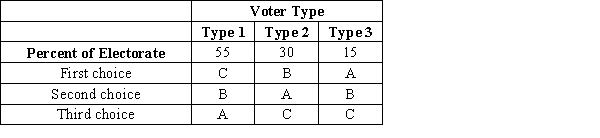 -Refer to Table 22-4. The table shows the preferences of three types of voters over three possible outcomes: A, B, and C. The table also shows the percentage of voters of each type. Based on this information, which voter type is the median voter?
 (Multiple Choice)
4.7/5 (86)
(86) Table 22-3
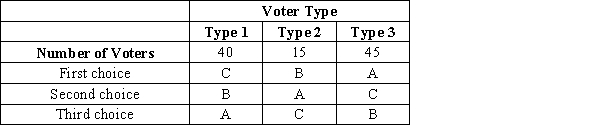 -Refer to Table 22-3. The table shows the preferences of 100 voters over three possible outcomes: A, B, and C. Which of the following statements is true?
 (Multiple Choice)
4.9/5 (79)
(79) Lindsay and Tim are playing the ultimatum game starting with $100. Based on the coin toss, Lindsay is the player to propose a division of the $100. If Lindsay acts as economic theory assumes, she should propose that
(Short Answer)
4.8/5 (89)
(89) Pete owns a small store. He has noticed that when he is not at the store monitoring his employees, his revenue goes down. What are two changes Pete could make to wages he pays his employees to correct this problem?
(Essay)
4.7/5 (81)
(81) The fact that someone with information about a significant number of illnesses in their family history is likely to purchase health insurance is an example of
(Multiple Choice)
4.7/5 (85)
(85) In a moral hazard problem, the agent is unable to perfectly monitor the principal's behavior so the principal applies less effort than the agent considers desirable.
(True/False)
4.8/5 (88)
(88) When the buyer knows less than the seller about the characteristics of the good being sold, there is
(Multiple Choice)
4.7/5 (74)
(74) Table 22-2
Three longtime friends-Stephanie, Stella, and Lydia-are deciding how they will spend their Sunday afternoon. They all agree that they should do one of the three things: go to a play, play baseball, or go to a soccer game. They also agree that they will have two pairwise votes to determine how to spend their afternoon, with the majority determining the outcome on each vote. The first, second, and third choices for each person are as indicated in the following table.
Stephanie Stella Lydia First choice soccer game baseball play Second choice baseball play soccer game Third choice play soccer game baseball
-Refer to Table 22-2. If (1) the first vote pits "soccer game" against "baseball," and (2) the second vote pits "play" against the winner of the first vote, then
(Multiple Choice)
4.7/5 (89)
(89) As an alternative to pairwise majority voting, each voter could be asked to rank the possible outcomes, giving 1 point to her lowest choice, 2 points to her second-lowest choice, 3 points to her third-lowest choice, and so on. This voting method is called
(Multiple Choice)
4.9/5 (88)
(88) An action taken by an informed party to reveal private information to an uninformed party is called
(Short Answer)
4.9/5 (88)
(88) A travel agency offers a money-back guarantee for vacationers taking their first cruise in case they do not enjoy the experience. This guarantee is an example of
(Short Answer)
4.9/5 (64)
(64) Table 22-5
The following table shows the number of voters preferring various amounts of spending to develop a river to make it more attractive for canoeing and kayaking.
Number of Voters Preferred Spending (Millions of dollars) 1 \ 0.0 4 \ 0.5 20 \ 1.0 22 \ 1.5 25 \ 2.0 35 \ 2.5 15 \ 3.0
-Refer to Table 22-5. The city council is considering two alternative ballots. The first would allow voters to choose between $1.5 million and $2 million. The second would allow voters to select between $2 million and $2.5 million. If the first ballot is used,
(Multiple Choice)
4.8/5 (73)
(73) Brandon is considering buying a used car but he first downloads a report from the internet that shows the history of accidents and major repairs conducted on the car. This action is called
(Short Answer)
5.0/5 (87)
(87) 
Filters
- Essay(0)
- Multiple Choice(0)
- Short Answer(0)
- True False(0)
- Matching(0)