



 Chat with AI
Exam 27: Tools of Finance

Exam 1: Ten Principles of Economics220 Questions
Exam 2: Thinking Like an Economist284 Questions
Exam 3: Interdependence and the Gains From Trade192 Questions
Exam 4: The Market Forces of Supply and Demand277 Questions
Exam 5: Elasticity and Its Application222 Questions
Exam 6: Supply, Demand, and Government Policies321 Questions
Exam 7: Consumers, Producers, and the Efficiency of Markets218 Questions
Exam 8: Applications: The Costs of Taxation203 Questions
Exam 9: Application: International Trade214 Questions
Exam 10: Externalities204 Questions
Exam 11: Public Goods and Common Resources182 Questions
Exam 12: The Design of the Tax System225 Questions
Exam 13: The Costs of Production261 Questions
Exam 14: Firms in Competitive Markets243 Questions
Exam 15: Monopoly231 Questions
Exam 16: Monopolistic Competition246 Questions
Exam 17: Oligopoly204 Questions
Exam 18: The Markets for the Factors of Production232 Questions
Exam 19: Earnings and Discrimination230 Questions
Exam 20: Income Inequality and Poverty194 Questions
Exam 21: The Theory of Consumer Choice209 Questions
Exam 22: Frontiers in Microeconomics185 Questions
Exam 23: Measuring a Nations Income231 Questions
Exam 24: Measuring the Cost of Living214 Questions
Exam 25: Production and Growth187 Questions
Exam 26: Saving, Investment, and the Financial System225 Questions
Exam 27: Tools of Finance198 Questions
Exam 28: Unemployment and Its Natural Rate361 Questions
Exam 29: The Monetary System210 Questions
Exam 30: Money Growth and Inflation201 Questions
Exam 31: Open-Economy Macroeconomics: Basic Concepts194 Questions
Exam 32: A Macroeconomic Theory of the Open Economy188 Questions
Exam 33: Aggregate Demand and Aggregate Supply189 Questions
Exam 34: The Influence of Monetary and Fiscal Policy on Aggregate Demand207 Questions
Exam 35: The Short-Run Tradeoff Between Inflation and Unemployment223 Questions
Exam 36: Six Debates Over Macroeconomic Policy154 Questions
Select questions type


In the 1990s, several stocks had very, very high price to earnings ratios. These stocks appeared overvalued to many observers. What might the people who bought them have been thinking?
(Essay)
4.8/5  (79)
(79) A person who is risk averse will like gaining $1,000 more than they will dislike losing $1,000.
(True/False)
4.9/5 (63)
(63) List three different ways that a risk-averse person can reduce financial risk.
(Essay)
4.8/5 (89)
(89) The present value of a payment of $500 to be made two years from today is greater if the interest rate is 7% than if it is 6%.
(True/False)
4.9/5 (77)
(77) Suppose your bank account pays a 4% interest rate. You are considering purchasing a share of stock in ABC Corporation for $500. The stock will pay you a $10 dividend at the end of years 1, 2, and 3. You expect to be able to sell the stock at the end of year 3 for $550. Is ABC a good investment? Provide evidence to support your answer.
(Essay)
4.7/5 (94)
(94) Risk-averse individuals like good things more than they dislike comparable bad things.
(True/False)
4.7/5 (79)
(79) The nation of Zambonia experiences the same rate of population growth every year. If the population of Zambonia doubles every 35 years, then what is the approximate annual rate of population growth?
(Essay)
4.8/5 (81)
(81) Should a person who is risk averse hold a portfolio with no stock and only bonds?
Explain.
(Essay)
4.8/5 (83)
(83) Write the formula for finding the future value of $1,000 today in 10 years if the interest rate is 4 percent.
(Short Answer)
4.8/5 (99)
(99) A company has an investment project that will cost $2 million today and yield a payoff of $3 million in 5 years. What interest rate represents the cutoff between profitability and nonprofitability for this project?
(Essay)
4.8/5 (85)
(85) Until recently, shares of stock accounted for 40 percent of Jimmy's savings. A few days ago, Jimmy sold some bonds and bought some additional shares of stock. Now shares of stock account for 70 percent of Jimmy's savings. How did this change affect Jimmy's expected retun on his savings? How did it affect the risks he faces?
(Essay)
4.8/5 (76)
(76) A judge requires Hoa to make a payment to Jordan. The judge says that Hoa can pay her either $10,000 today or $11,500 two years from today. Of the following interest rates, which is the highest one at which Hoa would be better off paying the money today?
(Multiple Choice)
4.8/5 (79)
(79) The fact that we observe a trade-off between risk and return is puzzling to economists, because that observation conflicts with the notion that most people are risk averse.
(True/False)
4.9/5 (89)
(89) Suppose you are deciding whether to buy a particular bond. If you buy the bond and hold it for 4 years, then at that time you will receive a payment of $10,000. If the interest rate is 6 percent, you will buy the bond if its price today is no greater than
(Multiple Choice)
4.8/5 (83)
(83) Which of the following is correct concerning stock market irrationality?
(Multiple Choice)
4.8/5 (83)
(83) Describe the shape of the utility function of a risk averse person.
(Short Answer)
4.9/5 (89)
(89) Al, Ralph, and Stan are all intending to retire. Each currently has $1 million in his retirement account. Al will earn 16% interest and retire in two years. Ralph will earn 8% interest and retire in four years. Stan will earn 4% interest and retire in eight years. Who will have the largest sum when he retires?
(Multiple Choice)
4.9/5 (82)
(82) Demonstrate that whether you would prefer to have $225 today or wait five years for $300 depends on the interest rate. Show your work.
(Essay)
4.9/5 (73)
(73) Figure 27-1
The following figure shows a utility function for Ren. 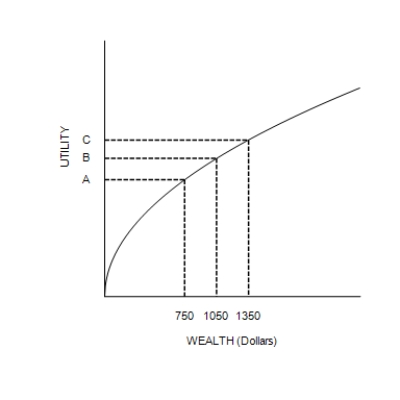 -Refer to Figure 27-1. Suppose Ren begins with $1,050 in wealth. Starting from there,
 (Multiple Choice)
4.8/5 (80)
(80) 
Filters
- Essay(0)
- Multiple Choice(0)
- Short Answer(0)
- True False(0)
- Matching(0)