



 Chat with AI
Exam 27: Tools of Finance

Exam 1: Ten Principles of Economics220 Questions
Exam 2: Thinking Like an Economist284 Questions
Exam 3: Interdependence and the Gains From Trade192 Questions
Exam 4: The Market Forces of Supply and Demand277 Questions
Exam 5: Elasticity and Its Application222 Questions
Exam 6: Supply, Demand, and Government Policies321 Questions
Exam 7: Consumers, Producers, and the Efficiency of Markets218 Questions
Exam 8: Applications: The Costs of Taxation203 Questions
Exam 9: Application: International Trade214 Questions
Exam 10: Externalities204 Questions
Exam 11: Public Goods and Common Resources182 Questions
Exam 12: The Design of the Tax System225 Questions
Exam 13: The Costs of Production261 Questions
Exam 14: Firms in Competitive Markets243 Questions
Exam 15: Monopoly231 Questions
Exam 16: Monopolistic Competition246 Questions
Exam 17: Oligopoly204 Questions
Exam 18: The Markets for the Factors of Production232 Questions
Exam 19: Earnings and Discrimination230 Questions
Exam 20: Income Inequality and Poverty194 Questions
Exam 21: The Theory of Consumer Choice209 Questions
Exam 22: Frontiers in Microeconomics185 Questions
Exam 23: Measuring a Nations Income231 Questions
Exam 24: Measuring the Cost of Living214 Questions
Exam 25: Production and Growth187 Questions
Exam 26: Saving, Investment, and the Financial System225 Questions
Exam 27: Tools of Finance198 Questions
Exam 28: Unemployment and Its Natural Rate361 Questions
Exam 29: The Monetary System210 Questions
Exam 30: Money Growth and Inflation201 Questions
Exam 31: Open-Economy Macroeconomics: Basic Concepts194 Questions
Exam 32: A Macroeconomic Theory of the Open Economy188 Questions
Exam 33: Aggregate Demand and Aggregate Supply189 Questions
Exam 34: The Influence of Monetary and Fiscal Policy on Aggregate Demand207 Questions
Exam 35: The Short-Run Tradeoff Between Inflation and Unemployment223 Questions
Exam 36: Six Debates Over Macroeconomic Policy154 Questions
Select questions type


Mixster Concrete Company is considering buying a new cement truck. The owners and their accountants decide that this is the profitable thing to do. Before they can buy the truck, the interest rate and price of trucks change. In which case do these changes both make them less likely to buy the truck?
(Multiple Choice)
4.8/5  (93)
(93) Table 27-1
W ealth (Dollars) Utility 50,000 3,000 51,000 3,140 52,000 3,266 53,000 3,373
-Refer to Table 27-1. If Kevin's current wealth is $51,000, then
(Multiple Choice)
4.7/5 (82)
(82) Assuming the interest rate is 6 percent, which of the following has the greatest present value?
(Multiple Choice)
4.8/5 (69)
(69) Available evidence indicates that stock prices, even if not exactly a random walk, are very close to a random walk.
(True/False)
4.8/5 (79)
(79) Figure 27-3
The following figure shows a utility function for Dexter. 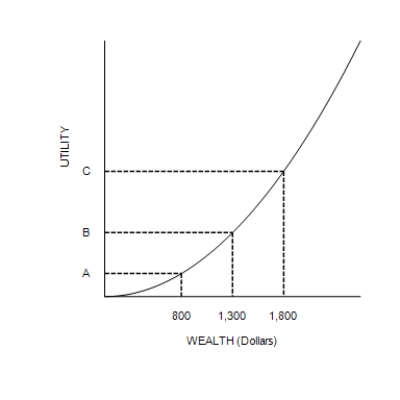 -Refer to Figure 27-3. Suppose the vertical distance between the points (0, A) and (0, B) is 12. If his wealth increased from $1,300 to $1,800, then
 (Multiple Choice)
4.8/5 (72)
(72) The rule of 70 applies to a growing savings account but not to a growing economy.
(True/False)
4.7/5 (76)
(76) Kevin recently received an inheritance, and he is planning to invest the inheritance in one of four stock portfolios. Which of these portfolios would you expect to have the highest average annual rate of return?
(Multiple Choice)
4.7/5 (93)
(93) Russell holds stocks in four companies. If he adds stocks of several more companies he will decrease
(Multiple Choice)
4.9/5 (75)
(75) You are a financial advisor and a client tells you he is concerned about the amount of risk in his portfolio. Assuming your client hasn't already done them, what two things can you suggest to reduce your client's risk? What additional information about reducing risk should you provide?
(Essay)
4.7/5 (86)
(86) At about what number of companies does the reduction in risk from adding stocks of more companies to a portfolio do little to reduce risk?
(Essay)
4.8/5 (71)
(71) Figure 27-1
The following figure shows a utility function for Ren. 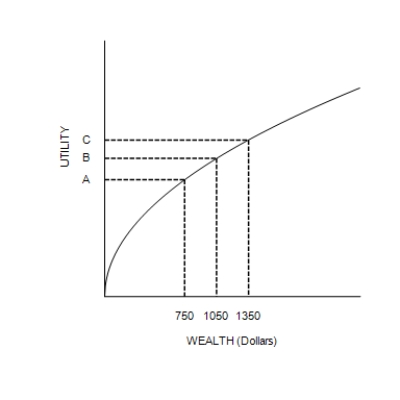 -Refer to Figure 27-1. From the appearance of the utility function, we know that
 (Multiple Choice)
4.9/5 (76)
(76) Scenario 27-1
Lisa has a utility function
where W is Lisa's wealth in millions of dollars and U is the utility she obtains.
-Refer to Scenario 27-1. Suppose Lisa is faced with a choice between two options. With option A Lisa receives a guaranteed $9 million. With option B Lisa faces a lottery that pays $16 million with probability P and pays $4 million with probability (1-P). Given Lisa's utility function, how high does P need to be before Lisa will prefer option B?
(Essay)
4.8/5 (87)
(87) Figure 27-4 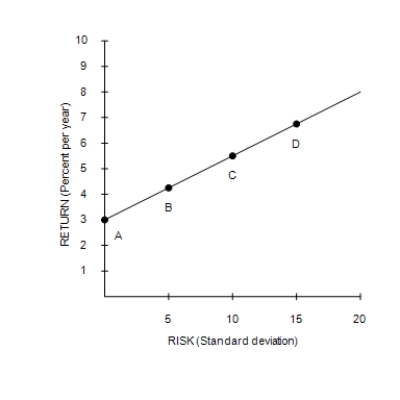 -Which of the following is a source of market risk?
 (Multiple Choice)
4.8/5 (89)
(89) Which of the following actions best illustrates adverse selection?
(Multiple Choice)
4.7/5 (82)
(82) On a graph with utility on the vertical axis and wealth on the horizontal axis, diminishing marginal utility of wealth implies that the utility function is
(Multiple Choice)
5.0/5 (82)
(82) A payment of $10,000 is to be made in the future. The interest rate 3%. Is this payment worth more if it is paid in 5 years or 10 years? How much more is it worth?
(Essay)
4.8/5 (70)
(70) Increasing the number of corporations whose stocks are in your portfolio reduces market risk.
(True/False)
4.8/5 (84)
(84) Rashad is risk averse and has $3,000 with which to make a financial investment. He has three options. Option A is a risk-free government bond that pays 5 percent interest each year for two years. Option B is a low-risk stock that analysts expect to be worth about $3,307.50 in two years. Option C is a high-risk stock that is expected to be worth about $3,646.52 in four years. Rashad should choose
(Multiple Choice)
4.7/5 (78)
(78) If the interest rate is 5 percent, then what is the present value of $2,000 to be received in three years?
(Short Answer)
4.7/5 (73)
(73) 
Filters
- Essay(0)
- Multiple Choice(0)
- Short Answer(0)
- True False(0)
- Matching(0)