



 Chat with AI
Exam 27: Tools of Finance

Exam 1: Ten Principles of Economics220 Questions
Exam 2: Thinking Like an Economist284 Questions
Exam 3: Interdependence and the Gains From Trade192 Questions
Exam 4: The Market Forces of Supply and Demand277 Questions
Exam 5: Elasticity and Its Application222 Questions
Exam 6: Supply, Demand, and Government Policies321 Questions
Exam 7: Consumers, Producers, and the Efficiency of Markets218 Questions
Exam 8: Applications: The Costs of Taxation203 Questions
Exam 9: Application: International Trade214 Questions
Exam 10: Externalities204 Questions
Exam 11: Public Goods and Common Resources182 Questions
Exam 12: The Design of the Tax System225 Questions
Exam 13: The Costs of Production261 Questions
Exam 14: Firms in Competitive Markets243 Questions
Exam 15: Monopoly231 Questions
Exam 16: Monopolistic Competition246 Questions
Exam 17: Oligopoly204 Questions
Exam 18: The Markets for the Factors of Production232 Questions
Exam 19: Earnings and Discrimination230 Questions
Exam 20: Income Inequality and Poverty194 Questions
Exam 21: The Theory of Consumer Choice209 Questions
Exam 22: Frontiers in Microeconomics185 Questions
Exam 23: Measuring a Nations Income231 Questions
Exam 24: Measuring the Cost of Living214 Questions
Exam 25: Production and Growth187 Questions
Exam 26: Saving, Investment, and the Financial System225 Questions
Exam 27: Tools of Finance198 Questions
Exam 28: Unemployment and Its Natural Rate361 Questions
Exam 29: The Monetary System210 Questions
Exam 30: Money Growth and Inflation201 Questions
Exam 31: Open-Economy Macroeconomics: Basic Concepts194 Questions
Exam 32: A Macroeconomic Theory of the Open Economy188 Questions
Exam 33: Aggregate Demand and Aggregate Supply189 Questions
Exam 34: The Influence of Monetary and Fiscal Policy on Aggregate Demand207 Questions
Exam 35: The Short-Run Tradeoff Between Inflation and Unemployment223 Questions
Exam 36: Six Debates Over Macroeconomic Policy154 Questions
Select questions type


Write the formula for finding the future value in n years of $x today.
(Short Answer)
4.8/5  (76)
(76) According to the efficient markets hypothesis, the number of people who think a stock is overvalued exactly balances the number of people who think a stock is undervalued.
(True/False)
4.8/5 (70)
(70) From the standpoint of the economy as a whole, the role of insurance is not to eliminate the risks inherent in life. Then what is its purpose?
(Essay)
4.8/5 (85)
(85) If a person had increasing marginal utility, then the decline in utility from losing $1,000 would be greater than the increase in utility from gaining $1,000.
(True/False)
4.9/5 (80)
(80) Alivia deposited $3,000 into an account two years ago. The first year she earned 6 percent interest; the second year she earned 5 percent. How much money does Alivia have in her account today?
(Multiple Choice)
5.0/5 (92)
(92) You are tearing down a building and find $1 in change that someone lost when working on the building 140 years ago. If, instead of being careless with the $1 in change, this person had deposited it into a bank and earned 2 percent interest every year for 140 years, how much would be in the account today according to the rule of 70?
(Multiple Choice)
4.9/5 (79)
(79) Figure 27-3
The following figure shows a utility function for Dexter. 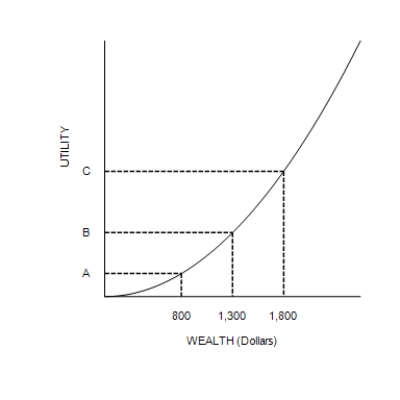 -Refer to Figure 27-3. From the appearance of the utility function, we know that
 (Multiple Choice)
4.9/5 (73)
(73) Fundamental analysis shows that Johnson's Lumber Corporation's stock is overvalued.
(Multiple Choice)
4.7/5 (73)
(73) Figure 27-3
The following figure shows a utility function for Dexter.
-Refer to Figure 27-3. From the appearance of the graph, we know that
-Refer to Figure 27-3. From the appearance of the graph, we know that (Multiple Choice)
4.9/5 (80)
(80) Kayla faces risks and she pays a fee to ABC Company; in return, ABC Company agrees to accept some or all of Kayla's risks. ABC Company is
(Multiple Choice)
4.8/5 (77)
(77) Actively managed mutual funds usually fail to outperform index funds, and this fact provides evidence in favor of the efficient markets hypothesis.
(True/False)
4.8/5 (82)
(82) The value of a stock depends on the ability of the company to generate dividends and the expected price of the stock when the stockholder sells her shares.
(True/False)
4.9/5 (92)
(92) Suppose you place $500 into a savings account that will pay you 6% interest per year. What will be the future value of the savings account in 15 years?
(Short Answer)
4.8/5 (76)
(76) Which of the following is the correct expression for finding the present value of a $500 payment two years from today if the interest rate is 6 percent?
(Multiple Choice)
4.8/5 (76)
(76) Suppose interest of 5% each year for two years can be earned on $1,000 saved today with no risk. What is the least amount a person would need to have a 50% chance of winning to be willing to face a 50% chance of losing $1,000 today and be considered risk averse?
(Multiple Choice)
4.8/5 (74)
(74) Rory has purchased a product from an insurance company that requires the insurance company to pay him $5,000 each year, and he will continue to receive these payments until he dies. This series of payments is called
(Multiple Choice)
4.8/5 (74)
(74) People who are risk averse dislike bad outcomes more than they like comparable good outcomes.
(True/False)
4.8/5 (76)
(76) A firm has three different investment options. Option A will give the firm $10 million at the end of one year, $10 million at the end of two years, and $10 million at the end of three years. Option B will give the firm $15 million at the end of one year, $10 million at the end of two years, and $5 million at the end of three years. Option C will give the firm $30 million at the end of one year, and nothing thereafter. Which of these options has the highest present value?
(Multiple Choice)
5.0/5 (81)
(81) 
Filters
- Essay(0)
- Multiple Choice(0)
- Short Answer(0)
- True False(0)
- Matching(0)