



 Chat with AI
Exam 27: Tools of Finance

Exam 1: Ten Principles of Economics220 Questions
Exam 2: Thinking Like an Economist284 Questions
Exam 3: Interdependence and the Gains From Trade192 Questions
Exam 4: The Market Forces of Supply and Demand277 Questions
Exam 5: Elasticity and Its Application222 Questions
Exam 6: Supply, Demand, and Government Policies321 Questions
Exam 7: Consumers, Producers, and the Efficiency of Markets218 Questions
Exam 8: Applications: The Costs of Taxation203 Questions
Exam 9: Application: International Trade214 Questions
Exam 10: Externalities204 Questions
Exam 11: Public Goods and Common Resources182 Questions
Exam 12: The Design of the Tax System225 Questions
Exam 13: The Costs of Production261 Questions
Exam 14: Firms in Competitive Markets243 Questions
Exam 15: Monopoly231 Questions
Exam 16: Monopolistic Competition246 Questions
Exam 17: Oligopoly204 Questions
Exam 18: The Markets for the Factors of Production232 Questions
Exam 19: Earnings and Discrimination230 Questions
Exam 20: Income Inequality and Poverty194 Questions
Exam 21: The Theory of Consumer Choice209 Questions
Exam 22: Frontiers in Microeconomics185 Questions
Exam 23: Measuring a Nations Income231 Questions
Exam 24: Measuring the Cost of Living214 Questions
Exam 25: Production and Growth187 Questions
Exam 26: Saving, Investment, and the Financial System225 Questions
Exam 27: Tools of Finance198 Questions
Exam 28: Unemployment and Its Natural Rate361 Questions
Exam 29: The Monetary System210 Questions
Exam 30: Money Growth and Inflation201 Questions
Exam 31: Open-Economy Macroeconomics: Basic Concepts194 Questions
Exam 32: A Macroeconomic Theory of the Open Economy188 Questions
Exam 33: Aggregate Demand and Aggregate Supply189 Questions
Exam 34: The Influence of Monetary and Fiscal Policy on Aggregate Demand207 Questions
Exam 35: The Short-Run Tradeoff Between Inflation and Unemployment223 Questions
Exam 36: Six Debates Over Macroeconomic Policy154 Questions
Select questions type


Figure 27-2
The following figure shows a utility function for Alex. 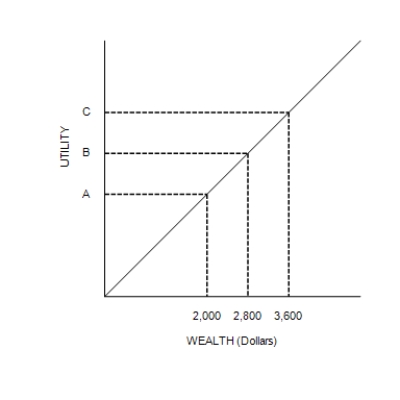 -Refer to Figure 27-2. From the appearance of Alex's utility function, we know that
 (Multiple Choice)
5.0/5  (82)
(82) Suppose that interest rates unexpectedly rise and that FineLine Corporation announces that revenues from last quarter were down but not as much as the public had anticipated they would be down. According to the efficient markets hypothesis, which of the following makes the price of FineLine Corporation Stock fall?
(Multiple Choice)
4.9/5 (91)
(91) In the 15 years ending February 2016, most active portfolio managers failed to beat the market.
(True/False)
4.8/5 (83)
(83) A University of Iowa basketball standout is offered a choice of contracts by the New York Liberty. The first one gives her $100,000 one year from today and $100,000 two years from today. The second one gives her $132,000 one year from today and $66,000 two years from today. As her agent, you must compute the present value of each contract. Which of the following interest rates is the lowest one at which the present value of the second contract exceeds that of the first?
(Multiple Choice)
4.9/5 (61)
(61) Suppose you win a small lottery and you are given the following choice: You can receive (1) an immediate payment of $5,000 or (2) two annual payments, each in the amount of $2,700, with the first payment coming one year from now, and the second payment coming two years from now. You would choose to take the two annual payments if the interest rate is
(Multiple Choice)
4.8/5 (86)
(86) Figure 27-1
The following figure shows a utility function for Ren. 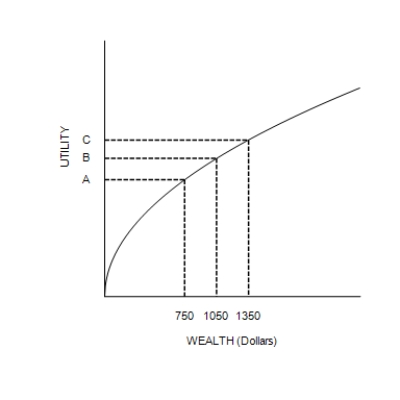 -Refer to Figure 27-1. Suppose Ren begins with $1,050 in wealth. Which of the following coin-flip bets would he definitely not be willing to accept?
 (Multiple Choice)
4.8/5 (87)
(87) Adverse selection is illustrated by people who take greater risks after they purchase insurance.
(True/False)
4.8/5 (77)
(77) Historically the return on stocks has been higher than the return on bonds. In part this reflects the higher risk from holding stock.
(True/False)
4.8/5 (88)
(88) Scenario 27-2
Suppose Dave has a utility function
where W is his wealth in millions of dollars and U is the utility he obtains.
-Refer to Scenario 27-2. Suppose Dave is faced with a choice between two options. With option A Dave receives a guaranteed $2 million. With option B Dave faces a lottery that pays $10 million with probability P and pays $0 with probability (1-P). Given Dave's utility function, how high does P need to be before he will prefer option B over option A?
(Essay)
4.8/5 (84)
(84) Suppose Dave drives more recklessly when he has car insurance than when he does not have car insurance. This is an example of the moral hazard problem associated with insurance.
(True/False)
4.8/5 (76)
(76) Your boss asks you to do fundamental analysis of a corporation. What value is she asking for and how would you estimate this value?
(Essay)
4.9/5 (70)
(70) The market for insurance is one example of reducing risk by using diversification.
(True/False)
4.9/5 (81)
(81) On the Internet you find the following offers for opening an online account. Which of them is the best offer if you have $2,000 to save for two years?
(Multiple Choice)
4.9/5 (78)
(78) The concept of present value helps explain why the quantity of loanable funds demanded decreases when the interest rate increases.
(True/False)
4.9/5 (79)
(79) Scenario 27-2
Suppose Dave has a utility function
where W is his wealth in millions of dollars and U is the utility he obtains.
-Refer to Scenario 27-2. Suppose Dave is faced with a choice between two options. With option A Dave receives a guaranteed $2 million. With option B Dave faces a lottery that pays $0 with probability 0.8 and pays $10 million with probability 0.2. Given Dave's utility function, will he prefer option A or option B? Provide evidence to support your answer.
(Essay)
4.9/5 (83)
(83) Stockholders of ComfortAir Corporation, an air conditioner and furnace manufacturer, are concerned that the company's executives may take on greater risks than stockholders desire. This example illustrates
(Multiple Choice)
4.8/5 (86)
(86) Sage decides to cash in all his savings to open a recording studio. He has three accounts to cash in. The first earned 9 percent for two years. The second earned 6 percent for three years. And the last earned 3 percent for six years. Supposing he started with $5,000 in each account, from which account will he get the most cash?
(Multiple Choice)
4.9/5 (69)
(69) If a savings account pays 7% interest, then according to the rule of 70 how long will it take for the account balance to double?
(Short Answer)
4.9/5 (85)
(85) If a friend tells you that he is certain a stock price will rise based on information he heard on television or saw on the Internet, should you be skeptical? Explain.
(Essay)
4.8/5 (79)
(79) 
Filters
- Essay(0)
- Multiple Choice(0)
- Short Answer(0)
- True False(0)
- Matching(0)