



 Chat with AI
Exam 27: Tools of Finance

Exam 1: Ten Principles of Economics220 Questions
Exam 2: Thinking Like an Economist284 Questions
Exam 3: Interdependence and the Gains From Trade192 Questions
Exam 4: The Market Forces of Supply and Demand277 Questions
Exam 5: Elasticity and Its Application222 Questions
Exam 6: Supply, Demand, and Government Policies321 Questions
Exam 7: Consumers, Producers, and the Efficiency of Markets218 Questions
Exam 8: Applications: The Costs of Taxation203 Questions
Exam 9: Application: International Trade214 Questions
Exam 10: Externalities204 Questions
Exam 11: Public Goods and Common Resources182 Questions
Exam 12: The Design of the Tax System225 Questions
Exam 13: The Costs of Production261 Questions
Exam 14: Firms in Competitive Markets243 Questions
Exam 15: Monopoly231 Questions
Exam 16: Monopolistic Competition246 Questions
Exam 17: Oligopoly204 Questions
Exam 18: The Markets for the Factors of Production232 Questions
Exam 19: Earnings and Discrimination230 Questions
Exam 20: Income Inequality and Poverty194 Questions
Exam 21: The Theory of Consumer Choice209 Questions
Exam 22: Frontiers in Microeconomics185 Questions
Exam 23: Measuring a Nations Income231 Questions
Exam 24: Measuring the Cost of Living214 Questions
Exam 25: Production and Growth187 Questions
Exam 26: Saving, Investment, and the Financial System225 Questions
Exam 27: Tools of Finance198 Questions
Exam 28: Unemployment and Its Natural Rate361 Questions
Exam 29: The Monetary System210 Questions
Exam 30: Money Growth and Inflation201 Questions
Exam 31: Open-Economy Macroeconomics: Basic Concepts194 Questions
Exam 32: A Macroeconomic Theory of the Open Economy188 Questions
Exam 33: Aggregate Demand and Aggregate Supply189 Questions
Exam 34: The Influence of Monetary and Fiscal Policy on Aggregate Demand207 Questions
Exam 35: The Short-Run Tradeoff Between Inflation and Unemployment223 Questions
Exam 36: Six Debates Over Macroeconomic Policy154 Questions
Select questions type


PZX Corporation has the opportunity to undertake an investment project that will cost $10,000 today and yield the company $13,310 in 3 years. PZX will forgo the project if the interest rate is higher than 10 percent.
(True/False)
4.8/5  (84)
(84) Because the statistic called the standard deviation measures the volatility of a variable, it is used to measure the return of a portfolio.
(True/False)
4.9/5 (71)
(71) Which of the following changes would increase the present value of a future payment?
(Multiple Choice)
4.7/5 (72)
(72) Fatima knows that she has about $122 in her bank account. She knows she earned an interest rate of 3 percent, but she doesn't remember how much she opened the account with a year ago. How much did she put in?
(Multiple Choice)
4.8/5 (93)
(93) Speculative bubbles may arise in part because the value of the stock to a stockholder depends on the final sale price.
(True/False)
4.9/5 (79)
(79) Suppose you put $475 into a bank account today. Interest is paid annually and the annual interest rate is 4.25 percent. The future value of the $475 after 3 years is
(Multiple Choice)
4.9/5 (72)
(72) As the interest rate increases, what happens to the present value of a future payment? Explain why changes in the interest rate will lead to changes in the quantity of loanable funds demanded and investment spending.
(Essay)
4.8/5 (82)
(82) Bill gets medical insurance and then exercises less. Lilly has health concerns and so applies for medical insurance. Identify each of these as moral hazard or adverse selection.
(Essay)
4.7/5 (81)
(81) What does "random walk" mean? According to the efficient markets hypothesis, should stock prices follow a random walk?
(Essay)
4.9/5 (77)
(77) What's the difference between firm-specific risk and market risk? Will diversification eliminate one or both? Explain.
(Essay)
4.9/5 (78)
(78) Suppose the interest rate is 3% and that you are to receive three annual payments of $1,000, with the first payment today, the second payment one year from now, and the third payment two years from now. What is the present value of this stream of payments?
(Short Answer)
4.9/5 (91)
(91) Why might someone be willing to pay more than the fundamental value for a stock?
(Essay)
4.9/5 (84)
(84) Historically, stocks have offered higher rates of return than bonds.
(True/False)
4.7/5 (73)
(73) Figure 27-1
The following figure shows a utility function for Ren. 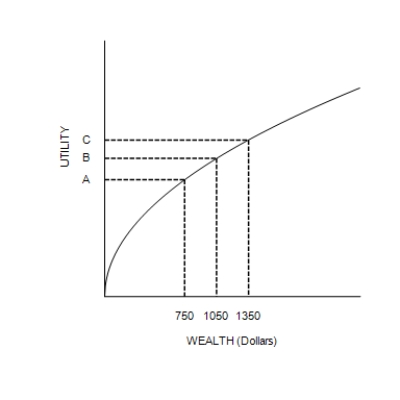 -Refer to Figure 27-1. From the appearance of the utility function, we know that
 (Multiple Choice)
4.9/5 (74)
(74) Figure 27-3
The following figure shows a utility function for Dexter. 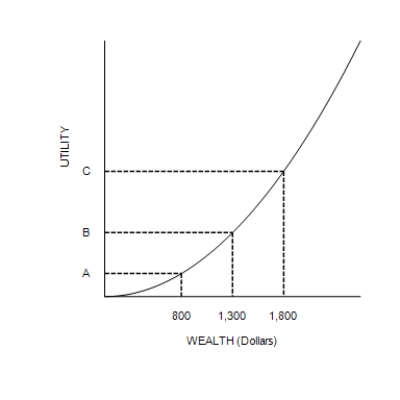 -Refer to Figure 27-3. Suppose Dexter begins with $1,300 in wealth. Starting from there,
 (Multiple Choice)
4.8/5 (83)
(83) You have a choice among three options. Option 1: receive $900 immediately. Option 2: receive $1,200 one year from now. Option 3: receive $2,000 five years from now. The interest rate is 15 percent. Rank these three options from highest present value to lowest present value.
(Multiple Choice)
4.8/5 (82)
(82) If you are faced with the choice of receiving $500 today or $800 6 years from today, you will be indifferent between the two possibilities if the interest rate is 8.148 percent.
(True/False)
4.7/5 (74)
(74) A company has an investment project that will cost $2 million today and yield a payoff of $3 million in 5 years. If the interest rate is 7%, should the firm undertake the project? Show evidence to support your answer.
(Essay)
4.9/5 (91)
(91) 
Filters
- Essay(0)
- Multiple Choice(0)
- Short Answer(0)
- True False(0)
- Matching(0)