



 Chat with AI
Exam 27: Tools of Finance

Exam 1: Ten Principles of Economics220 Questions
Exam 2: Thinking Like an Economist284 Questions
Exam 3: Interdependence and the Gains From Trade192 Questions
Exam 4: The Market Forces of Supply and Demand277 Questions
Exam 5: Elasticity and Its Application222 Questions
Exam 6: Supply, Demand, and Government Policies321 Questions
Exam 7: Consumers, Producers, and the Efficiency of Markets218 Questions
Exam 8: Applications: The Costs of Taxation203 Questions
Exam 9: Application: International Trade214 Questions
Exam 10: Externalities204 Questions
Exam 11: Public Goods and Common Resources182 Questions
Exam 12: The Design of the Tax System225 Questions
Exam 13: The Costs of Production261 Questions
Exam 14: Firms in Competitive Markets243 Questions
Exam 15: Monopoly231 Questions
Exam 16: Monopolistic Competition246 Questions
Exam 17: Oligopoly204 Questions
Exam 18: The Markets for the Factors of Production232 Questions
Exam 19: Earnings and Discrimination230 Questions
Exam 20: Income Inequality and Poverty194 Questions
Exam 21: The Theory of Consumer Choice209 Questions
Exam 22: Frontiers in Microeconomics185 Questions
Exam 23: Measuring a Nations Income231 Questions
Exam 24: Measuring the Cost of Living214 Questions
Exam 25: Production and Growth187 Questions
Exam 26: Saving, Investment, and the Financial System225 Questions
Exam 27: Tools of Finance198 Questions
Exam 28: Unemployment and Its Natural Rate361 Questions
Exam 29: The Monetary System210 Questions
Exam 30: Money Growth and Inflation201 Questions
Exam 31: Open-Economy Macroeconomics: Basic Concepts194 Questions
Exam 32: A Macroeconomic Theory of the Open Economy188 Questions
Exam 33: Aggregate Demand and Aggregate Supply189 Questions
Exam 34: The Influence of Monetary and Fiscal Policy on Aggregate Demand207 Questions
Exam 35: The Short-Run Tradeoff Between Inflation and Unemployment223 Questions
Exam 36: Six Debates Over Macroeconomic Policy154 Questions
Select questions type


Amanda talks with several different brokers at a social gathering. She hears the following advice from brokers A, B, and C. Which broker, if any, gave her incorrect advice?
(Multiple Choice)
4.8/5  (79)
(79) Suppose you win a small lottery and you are given the following choice: You can (1) receive an immediate payment of $10,000 or (2) three annual payments, each in the amount of $3,600, with the first payment coming one year from now, the second two years from now, and the third three years from now. You would choose to take the three annual payments if the interest rate is
(Multiple Choice)
4.8/5 (94)
(94) Managed mutual funds usually outperform mutual funds that are supposed to follow some stock index.
(True/False)
4.8/5 (75)
(75) According to the efficient markets hypothesis, at any moment in time, the market price is the best estimate of the company's value based on publicly available information.
(True/False)
4.8/5 (71)
(71) Which of the following is not consistent with the efficient market hypothesis?
(Multiple Choice)
4.8/5 (77)
(77) The largest reduction in a portfolio's risk is achieved when the number of stocks in the portfolio is increased from
(Multiple Choice)
4.7/5 (80)
(80) Fundamental analysis shows that Quadrangle Company is fairly valued. Then Quadrangle Company unexpectedly improves its production techniques and unexpectedly hires a new CEO away from another very successful competitor. Suppose this has no effect on the price of the stock of Quadrangle Company.
(Multiple Choice)
4.8/5 (73)
(73) Figure 27-1
The following figure shows a utility function for Ren. 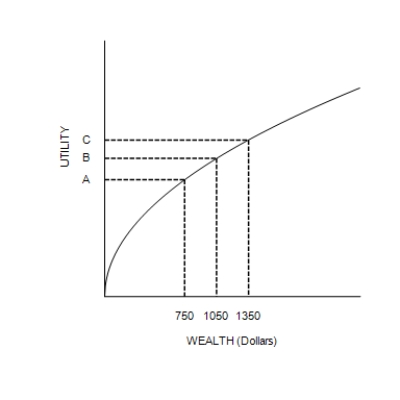 -Refer to Figure 27-1. Suppose the vertical distance between the points (0, A) and (0, B) is 9. If his wealth increased from $1,050 to $1,350, then
 (Multiple Choice)
5.0/5 (77)
(77) Which of the following pairs of portfolios exemplifies the risk-return tradeoff?
(Multiple Choice)
4.9/5 (86)
(86) Suppose your uncle offers you $200 today or $355 in 8 years. You would prefer to take the $200 today if the interest rate is
(Multiple Choice)
4.7/5 (79)
(79) Scenario 27-2
Suppose Dave has a utility function
where W is his wealth in millions of dollars and U is the utility he obtains.
-Refer to Scenario 27-2. Is Dave risk averse? Explain.
(Essay)
4.9/5 (68)
(68) Suppose you are deciding whether or not to buy a particular bond for $5,980.17. If you buy the bond and hold it for 5 years, then at that time you will receive a payment of $10,000. You will buy the bond today if the interest rate is
(Multiple Choice)
4.9/5 (79)
(79) According to fundamental analysis, when choosing stocks for your portfolio, you should prefer undervalued stocks.
(True/False)
4.9/5 (88)
(88) The sooner a payment is received and the higher the interest rate, the greater the present value of a future payment.
(True/False)
4.8/5 (74)
(74) Riley says that the present value of $700 to be received one year from today if the interest rate is 6 percent is less than the present value of $700 to be received two years from today if the interest rate is 3 percent. Anh says that $700 saved for one year at 6 percent interest has a smaller future value than $700 saved for two years at 3 percent interest.
(Multiple Choice)
4.8/5 (87)
(87) When the price of an asset rises above what appears to be its fundamental value, the market is said to be experiencing a speculative bubble.
(True/False)
4.7/5 (83)
(83) According to the efficient markets hypothesis, worse-than-expected news about a corporation will
(Multiple Choice)
4.8/5 (81)
(81) In answering which of the following questions would you find it necessary to calculate a present value?
(Multiple Choice)
4.9/5 (71)
(71) 
Filters
- Essay(0)
- Multiple Choice(0)
- Short Answer(0)
- True False(0)
- Matching(0)