



 Chat with AI
Exam 25: Government and Product Markets Antitrust and Regulation

Exam 1: What Economics Is About174 Questions
Exam 2: Production Possibilities Frontier Framework156 Questions
Exam 3: Supply and Demand Theory224 Questions
Exam 4: Prices Free Controlled and Relative122 Questions
Exam 5: Supply Demand and Price Applications76 Questions
Exam 6: Macroeconomic Measurements Part I Prices and Unemployment151 Questions
Exam 7: Macroeconomic Measurements Part II Gdp and Real Gdp150 Questions
Exam 8: Aggregate Demand and Aggregate Supply204 Questions
Exam 9: Classical Macroeconomics and the Self Regulating Economy172 Questions
Exam 10: Keynesian Macroeconomics and Economic Instability a Critique of the Self Regulating Economy200 Questions
Exam 11: Fiscal Policy and the Federal Budget167 Questions
Exam 12: Money Banking and the Financial System150 Questions
Exam 13: The Federal Reserve System180 Questions
Exam 14: Money and the Economy150 Questions
Exam 15: Monetary Policy185 Questions
Exam 16: Expectations Theory and the Economy150 Questions
Exam 17: Economic Growth Resources Technology Ideas and Institutions103 Questions
Exam 18: Debates in Macroeconomics Over the Role and Effects of Government100 Questions
Exam 19: Elasticity204 Questions
Exam 20: Consumer Choice and Behavioral Economics179 Questions
Exam 21: Production and Costs245 Questions
Exam 22: Perfect Competition187 Questions
Exam 23: Monopoly195 Questions
Exam 24: Monopolistic Competition Oligopoly and Game Theory172 Questions
Exam 25: Government and Product Markets Antitrust and Regulation158 Questions
Exam 26: Factor Markets With Emphasis on the Labor Market184 Questions
Exam 27: Wages Unions and Labor138 Questions
Exam 28: The Distribution of Income and Poverty99 Questions
Exam 29: Interest Rent and Profit198 Questions
Exam 30: Market Failure Externalities Public Goods and Asymmetric Information187 Questions
Exam 31: Public Choice and Special Interest Group Politics135 Questions
Exam 32: Building Theories to Explain Everyday Life From Observations to Questions to Theories to Predictions62 Questions
Exam 33: International Trade152 Questions
Exam 34: International Finance122 Questions
Exam 35: The Economic Case for and Against Government Five Topics Considered87 Questions
Exam 36: Stocks Bonds Futures and Options110 Questions
Select questions type


Assuming the same revenue and cost conditions, a monopoly produces less than a perfectly competitive firm produces, charges a higher price, and causes a deadweight loss.
(True/False)
4.8/5  (82)
(82) The Wheeler-Lea Act of 1938 was designed to close the merger loophole that remained in the Clayton Act.
(True/False)
4.8/5 (80)
(80) Exhibit 25-3
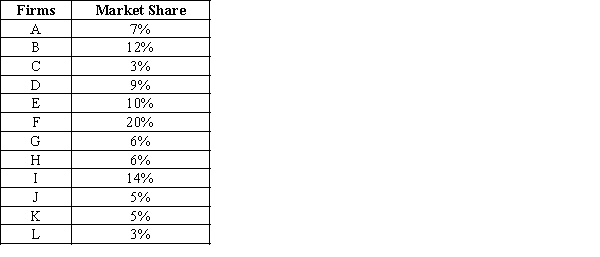
-Refer to Exhibit 25-3. The four-firm concentration ratio for this industry is
-Refer to Exhibit 25-3. The four-firm concentration ratio for this industry is (Multiple Choice)
4.8/5 (85)
(85) If company A and B combine under single ownership of control, this would be a __________ merger.
(Multiple Choice)
4.8/5 (65)
(65) Exhibit 25-40
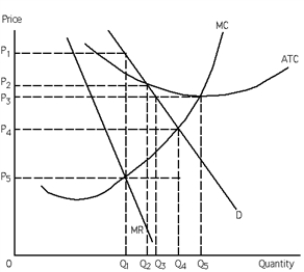 -Refer to Exhibit 25-4. If marginal-cost pricing regulation were imposed, the firm would be forced to set price at the level of
 (Multiple Choice)
4.8/5 (78)
(78) In Industry A, the largest four firms together have a 30 percent share of the market and there are a total of eight firms in the market. In Industry B, the largest four firms together have a 30 percent share of the market and there are 100 other firms in the market. If we want to distinguish between the concentration in these two industries, the best measure to use is the
(Multiple Choice)
4.9/5 (92)
(92) The act which empowered the Federal Trade Commission to deal with false and deceptive acts or practices was the
(Multiple Choice)
4.9/5 (68)
(68) The antitrust act that bans anticompetitive mergers that occur as a result of one company acquiring the physical assets of another company is the
(Multiple Choice)
4.9/5 (75)
(75) Marginal cost regulatory pricing turns out to be the same as output regulation (for a natural monopoly firm) if the output level set by government is the
(Multiple Choice)
4.7/5 (69)
(69) Which of the following lends support to the capture theory of regulation?
(Multiple Choice)
4.7/5 (84)
(84) Empirical research has shown that immediately upon deregulation of the airline industry,
(Multiple Choice)
4.9/5 (92)
(92) The public choice theory of regulation states that a regulatory agency makes decisions based on
(Multiple Choice)
4.9/5 (81)
(81) If an industry consists of 20 firms holding equal market shares, the Herfindahl index is
(Multiple Choice)
5.0/5 (90)
(90) 
Filters
- Essay(0)
- Multiple Choice(0)
- Short Answer(0)
- True False(0)
- Matching(0)