



 Chat with AI
Exam 25: Government and Product Markets Antitrust and Regulation

Exam 1: What Economics Is About174 Questions
Exam 2: Production Possibilities Frontier Framework156 Questions
Exam 3: Supply and Demand Theory224 Questions
Exam 4: Prices Free Controlled and Relative122 Questions
Exam 5: Supply Demand and Price Applications76 Questions
Exam 6: Macroeconomic Measurements Part I Prices and Unemployment151 Questions
Exam 7: Macroeconomic Measurements Part II Gdp and Real Gdp150 Questions
Exam 8: Aggregate Demand and Aggregate Supply204 Questions
Exam 9: Classical Macroeconomics and the Self Regulating Economy172 Questions
Exam 10: Keynesian Macroeconomics and Economic Instability a Critique of the Self Regulating Economy200 Questions
Exam 11: Fiscal Policy and the Federal Budget167 Questions
Exam 12: Money Banking and the Financial System150 Questions
Exam 13: The Federal Reserve System180 Questions
Exam 14: Money and the Economy150 Questions
Exam 15: Monetary Policy185 Questions
Exam 16: Expectations Theory and the Economy150 Questions
Exam 17: Economic Growth Resources Technology Ideas and Institutions103 Questions
Exam 18: Debates in Macroeconomics Over the Role and Effects of Government100 Questions
Exam 19: Elasticity204 Questions
Exam 20: Consumer Choice and Behavioral Economics179 Questions
Exam 21: Production and Costs245 Questions
Exam 22: Perfect Competition187 Questions
Exam 23: Monopoly195 Questions
Exam 24: Monopolistic Competition Oligopoly and Game Theory172 Questions
Exam 25: Government and Product Markets Antitrust and Regulation158 Questions
Exam 26: Factor Markets With Emphasis on the Labor Market184 Questions
Exam 27: Wages Unions and Labor138 Questions
Exam 28: The Distribution of Income and Poverty99 Questions
Exam 29: Interest Rent and Profit198 Questions
Exam 30: Market Failure Externalities Public Goods and Asymmetric Information187 Questions
Exam 31: Public Choice and Special Interest Group Politics135 Questions
Exam 32: Building Theories to Explain Everyday Life From Observations to Questions to Theories to Predictions62 Questions
Exam 33: International Trade152 Questions
Exam 34: International Finance122 Questions
Exam 35: The Economic Case for and Against Government Five Topics Considered87 Questions
Exam 36: Stocks Bonds Futures and Options110 Questions
Select questions type


Exhibit 25-40
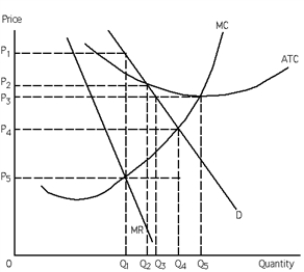 -Refer to Exhibit 25-4. The profits of an unregulated natural monopoly that becomes regulated on the basis of marginal-cost pricing would
 (Multiple Choice)
4.8/5  (83)
(83) The act that was passed in an attempt to decrease the failure rate of small businesses by protecting them from the competition of large and growing chain stores was the
(Multiple Choice)
4.9/5 (84)
(84) The statement, "Every person who shall monopolize, or attempt to monopolize, or combine or conspire with any other person or persons to monopolize any part of the trade or commerce...shall be guilty of a misdemeanor" is a part of the
(Multiple Choice)
5.0/5 (75)
(75) "To understand the decisions of regulatory bodies, you must first understand how the decisions affect the regulators themselves." The person who made this statement probably believes in the __________ theory of regulation.
(Multiple Choice)
5.0/5 (78)
(78) If two firms in the same industry (but at different stages of the production process) merged, this would be a(n) __________ merger.
(Multiple Choice)
4.8/5 (73)
(73) Which of the following is not a realistic scenario faced by government regulators of a natural monopoly?
(Multiple Choice)
4.9/5 (74)
(74) If there are five firms in an industry and the market shares of the firms are 45 percent, 22 percent, 17 percent, 10 percent and 6 percent. The four-firm concentration ratio for this industry is __________________ percent and the Herfindahl Index is ________________.
(Multiple Choice)
4.8/5 (76)
(76) A local government prevents any firm from competing with a natural monopoly firm. Those people who believe this is a wise policy action would likely say
(Multiple Choice)
4.7/5 (75)
(75) There are ten firms in an industry. Five of the firms each have a market share of 13 percent and five of the firms each have a market share of 7 percent. The Herfindahl index is
(Multiple Choice)
4.8/5 (83)
(83) The advantage of the Herfindahl index over the four- and eight-firm concentration ratios is that it provides information
(Multiple Choice)
4.7/5 (84)
(84) The Justice Department considers a Herfindahl index less than __________ to be representative of an unconcentrated (competitive) industry.
(Multiple Choice)
4.7/5 (74)
(74) What is the Herfindahl index of an industry made up of ten equal-sized firms?
(Multiple Choice)
4.7/5 (67)
(67) Network goods such as telephones, computer operating systems and the like, will tend to become monopolies because consumers will naturally tend to buy from the largest supplier of the good. who will eventually become a monopoly. This monopoly position
(Multiple Choice)
4.7/5 (85)
(85) 
Filters
- Essay(0)
- Multiple Choice(0)
- Short Answer(0)
- True False(0)
- Matching(0)