



 Chat with AI
Exam 25: Government and Product Markets Antitrust and Regulation

Exam 1: What Economics Is About174 Questions
Exam 2: Production Possibilities Frontier Framework156 Questions
Exam 3: Supply and Demand Theory224 Questions
Exam 4: Prices Free Controlled and Relative122 Questions
Exam 5: Supply Demand and Price Applications76 Questions
Exam 6: Macroeconomic Measurements Part I Prices and Unemployment151 Questions
Exam 7: Macroeconomic Measurements Part II Gdp and Real Gdp150 Questions
Exam 8: Aggregate Demand and Aggregate Supply204 Questions
Exam 9: Classical Macroeconomics and the Self Regulating Economy172 Questions
Exam 10: Keynesian Macroeconomics and Economic Instability a Critique of the Self Regulating Economy200 Questions
Exam 11: Fiscal Policy and the Federal Budget167 Questions
Exam 12: Money Banking and the Financial System150 Questions
Exam 13: The Federal Reserve System180 Questions
Exam 14: Money and the Economy150 Questions
Exam 15: Monetary Policy185 Questions
Exam 16: Expectations Theory and the Economy150 Questions
Exam 17: Economic Growth Resources Technology Ideas and Institutions103 Questions
Exam 18: Debates in Macroeconomics Over the Role and Effects of Government100 Questions
Exam 19: Elasticity204 Questions
Exam 20: Consumer Choice and Behavioral Economics179 Questions
Exam 21: Production and Costs245 Questions
Exam 22: Perfect Competition187 Questions
Exam 23: Monopoly195 Questions
Exam 24: Monopolistic Competition Oligopoly and Game Theory172 Questions
Exam 25: Government and Product Markets Antitrust and Regulation158 Questions
Exam 26: Factor Markets With Emphasis on the Labor Market184 Questions
Exam 27: Wages Unions and Labor138 Questions
Exam 28: The Distribution of Income and Poverty99 Questions
Exam 29: Interest Rent and Profit198 Questions
Exam 30: Market Failure Externalities Public Goods and Asymmetric Information187 Questions
Exam 31: Public Choice and Special Interest Group Politics135 Questions
Exam 32: Building Theories to Explain Everyday Life From Observations to Questions to Theories to Predictions62 Questions
Exam 33: International Trade152 Questions
Exam 34: International Finance122 Questions
Exam 35: The Economic Case for and Against Government Five Topics Considered87 Questions
Exam 36: Stocks Bonds Futures and Options110 Questions
Select questions type


The public interest theory of regulation holds that regulators will
(Multiple Choice)
4.8/5  (90)
(90) Exhibit 25-5
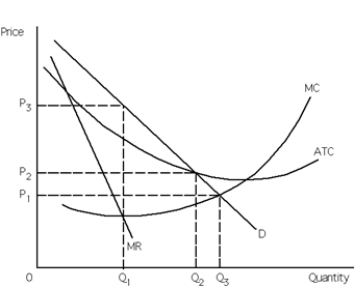 -Refer to Exhibit 25-5. If the natural monopoly firm were to maximize profits it would produce __________ quantity of output and charge a price of __________ per unit.
 (Multiple Choice)
4.8/5 (75)
(75) The Clayton Act of 1914 makes price discrimination, exclusive dealers, tying contracts, and the acquisition of competing companies' stock illegal when their effects "substantially lessen competition or tend to create a monopoly."
(True/False)
4.9/5 (82)
(82) The type of proposed merger that generally concerns the federal government the most is a horizontal merger.
(True/False)
4.9/5 (85)
(85) "Regulatory lag" refers to the period between the time when
(Multiple Choice)
4.8/5 (62)
(62) Which antitrust legislation made price discrimination illegal?
(Multiple Choice)
4.8/5 (98)
(98) If the four-firm concentration ratio in an industry is 80 percent, and the top four firms hold equal market shares, the Herfindahl index for the industry is
(Multiple Choice)
4.7/5 (79)
(79) The Wheeler-Lea Act of 1938 empowered the Federal Trade Commission to
(Multiple Choice)
4.7/5 (76)
(76) If the four-firm concentration ratio is 100 percent, this means that the
(Multiple Choice)
4.8/5 (65)
(65) If government regulators guarantee that a natural monopoly will earn normal profits, then
(Multiple Choice)
4.7/5 (78)
(78) Which of the following was declared illegal by the Sherman Act of 1890?
(Multiple Choice)
4.9/5 (75)
(75) The type of regulatory pricing (of a natural monopoly firm) that is consistent with resource-allocative efficiency is __________ cost pricing.
(Multiple Choice)
4.8/5 (84)
(84) Which of the following is not a way that natural monopolies are regulated?
(Multiple Choice)
4.8/5 (75)
(75) Thomas Edison constructed the first building that was used solely to make
(Multiple Choice)
4.8/5 (77)
(77) If natural monopolies are regulated to produce where there is a normal profit, they produce where
(Multiple Choice)
4.7/5 (78)
(78) 
Filters
- Essay(0)
- Multiple Choice(0)
- Short Answer(0)
- True False(0)
- Matching(0)