



 Chat with AI
Exam 25: Government and Product Markets Antitrust and Regulation

Exam 1: What Economics Is About174 Questions
Exam 2: Production Possibilities Frontier Framework156 Questions
Exam 3: Supply and Demand Theory224 Questions
Exam 4: Prices Free Controlled and Relative122 Questions
Exam 5: Supply Demand and Price Applications76 Questions
Exam 6: Macroeconomic Measurements Part I Prices and Unemployment151 Questions
Exam 7: Macroeconomic Measurements Part II Gdp and Real Gdp150 Questions
Exam 8: Aggregate Demand and Aggregate Supply204 Questions
Exam 9: Classical Macroeconomics and the Self Regulating Economy172 Questions
Exam 10: Keynesian Macroeconomics and Economic Instability a Critique of the Self Regulating Economy200 Questions
Exam 11: Fiscal Policy and the Federal Budget167 Questions
Exam 12: Money Banking and the Financial System150 Questions
Exam 13: The Federal Reserve System180 Questions
Exam 14: Money and the Economy150 Questions
Exam 15: Monetary Policy185 Questions
Exam 16: Expectations Theory and the Economy150 Questions
Exam 17: Economic Growth Resources Technology Ideas and Institutions103 Questions
Exam 18: Debates in Macroeconomics Over the Role and Effects of Government100 Questions
Exam 19: Elasticity204 Questions
Exam 20: Consumer Choice and Behavioral Economics179 Questions
Exam 21: Production and Costs245 Questions
Exam 22: Perfect Competition187 Questions
Exam 23: Monopoly195 Questions
Exam 24: Monopolistic Competition Oligopoly and Game Theory172 Questions
Exam 25: Government and Product Markets Antitrust and Regulation158 Questions
Exam 26: Factor Markets With Emphasis on the Labor Market184 Questions
Exam 27: Wages Unions and Labor138 Questions
Exam 28: The Distribution of Income and Poverty99 Questions
Exam 29: Interest Rent and Profit198 Questions
Exam 30: Market Failure Externalities Public Goods and Asymmetric Information187 Questions
Exam 31: Public Choice and Special Interest Group Politics135 Questions
Exam 32: Building Theories to Explain Everyday Life From Observations to Questions to Theories to Predictions62 Questions
Exam 33: International Trade152 Questions
Exam 34: International Finance122 Questions
Exam 35: The Economic Case for and Against Government Five Topics Considered87 Questions
Exam 36: Stocks Bonds Futures and Options110 Questions
Select questions type


If average total costs for a natural monopoly are declining where they intersect the demand curve, and government regulators set the price equal to marginal cost, then the firm will
(Multiple Choice)
4.9/5  (70)
(70) Exhibit 25-1
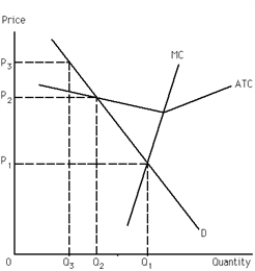 -Refer to Exhibit 25-1. What price is charged if marginal-cost price regulation is imposed on the natural monopoly firm?
 (Multiple Choice)
5.0/5 (85)
(85) Exhibit 25-3
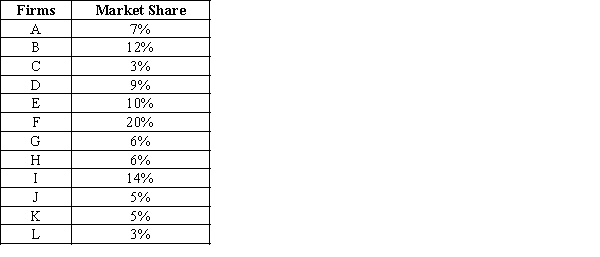
-Refer to Exhibit 25-3. The Justice Department would consider this industry to be
-Refer to Exhibit 25-3. The Justice Department would consider this industry to be (Multiple Choice)
4.8/5 (81)
(81) The act that set up a commission to deal with "unfair methods of competition" was the
(Multiple Choice)
4.8/5 (83)
(83) The existence of switching costs in the use of computer software means that buyers of computer software are __________ likely to change software programs than would be the case in the absence of switching costs, and therefore, the maker of the software program may have __________ reason to innovate.
(Multiple Choice)
4.9/5 (78)
(78) The following statement, "Every contract, combination in the form of trust or otherwise, or conspiracy, in restraint of trade or commerce among the several states, or with foreign nations, is hereby declared illegal," is part of the
(Multiple Choice)
4.8/5 (96)
(96) Suppose an industry consists of five equal-sized firms. Two of the firms plan to merge. The merger ______________ raise anti-trust concerns at the Justice Department given that the Herfindahl index before the merger was _____________ and the merger would cause the Herfindahl index to rise by __________.
(Multiple Choice)
4.8/5 (70)
(70) When it comes to network goods, being one of the first companies in a market seems to really pay off.
(True/False)
4.8/5 (86)
(86) The market shares (in percentage terms) for the 10 firms that comprise an industry are 22, 18, 14, 10, 9, 7, 6, 6, 4, and 4. The Herfindahl index is __________ and the four-firm concentration ratio is __________.
(Multiple Choice)
4.9/5 (83)
(83) If government regulators guarantee a natural monopolist that it will earn normal profits, then the monopolist will
(Multiple Choice)
4.8/5 (88)
(88) The Robinson-Patman Act of 1936 was passed in an attempt to
(Multiple Choice)
4.9/5 (68)
(68) For a natural monopoly firm, the resource-allocative efficient output is 200 units. The highest per-unit price that can be charged for this output is $3. Average total cost at 200 units is $3.50. For the natural monopoly firm that produces and sells 200 units of output,
(Multiple Choice)
4.9/5 (82)
(82) Exhibit 25-40
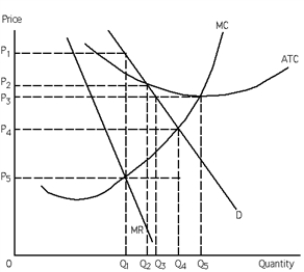 -Refer to Exhibit 25-4. The problem with average-cost pricing regulation is that once it is in place, there is a tendency for the
 (Multiple Choice)
4.9/5 (76)
(76) Natural monopolies can be regulated based on price, profit, or output.
(True/False)
4.8/5 (79)
(79) The Justice Department most closely examines proposed __________ mergers.
(Multiple Choice)
4.8/5 (87)
(87) 
Filters
- Essay(0)
- Multiple Choice(0)
- Short Answer(0)
- True False(0)
- Matching(0)