



 Chat with AI
Exam 25: Government and Product Markets Antitrust and Regulation

Exam 1: What Economics Is About174 Questions
Exam 2: Production Possibilities Frontier Framework156 Questions
Exam 3: Supply and Demand Theory224 Questions
Exam 4: Prices Free Controlled and Relative122 Questions
Exam 5: Supply Demand and Price Applications76 Questions
Exam 6: Macroeconomic Measurements Part I Prices and Unemployment151 Questions
Exam 7: Macroeconomic Measurements Part II Gdp and Real Gdp150 Questions
Exam 8: Aggregate Demand and Aggregate Supply204 Questions
Exam 9: Classical Macroeconomics and the Self Regulating Economy172 Questions
Exam 10: Keynesian Macroeconomics and Economic Instability a Critique of the Self Regulating Economy200 Questions
Exam 11: Fiscal Policy and the Federal Budget167 Questions
Exam 12: Money Banking and the Financial System150 Questions
Exam 13: The Federal Reserve System180 Questions
Exam 14: Money and the Economy150 Questions
Exam 15: Monetary Policy185 Questions
Exam 16: Expectations Theory and the Economy150 Questions
Exam 17: Economic Growth Resources Technology Ideas and Institutions103 Questions
Exam 18: Debates in Macroeconomics Over the Role and Effects of Government100 Questions
Exam 19: Elasticity204 Questions
Exam 20: Consumer Choice and Behavioral Economics179 Questions
Exam 21: Production and Costs245 Questions
Exam 22: Perfect Competition187 Questions
Exam 23: Monopoly195 Questions
Exam 24: Monopolistic Competition Oligopoly and Game Theory172 Questions
Exam 25: Government and Product Markets Antitrust and Regulation158 Questions
Exam 26: Factor Markets With Emphasis on the Labor Market184 Questions
Exam 27: Wages Unions and Labor138 Questions
Exam 28: The Distribution of Income and Poverty99 Questions
Exam 29: Interest Rent and Profit198 Questions
Exam 30: Market Failure Externalities Public Goods and Asymmetric Information187 Questions
Exam 31: Public Choice and Special Interest Group Politics135 Questions
Exam 32: Building Theories to Explain Everyday Life From Observations to Questions to Theories to Predictions62 Questions
Exam 33: International Trade152 Questions
Exam 34: International Finance122 Questions
Exam 35: The Economic Case for and Against Government Five Topics Considered87 Questions
Exam 36: Stocks Bonds Futures and Options110 Questions
Select questions type


A firm defending itself in an antitrust suit would prefer to have the market it operates in defined broadly, rather than narrowly.
(True/False)
4.8/5  (78)
(78) The Justice Department began using the Herfindahl index (rather than the four- and eight-firm concentration ratios) in 1982.
(True/False)
4.9/5 (73)
(73) The antitrust legislation that declares illegal "unfair methods of competition in commerce" is
(Multiple Choice)
4.7/5 (78)
(78) How does the four-firm concentration ratio differ from the Herfindahl index? Which one does the Justice Department currently rely on when evaluating whether or not a proposed merger should be permitted?
(Essay)
4.8/5 (75)
(75) Exhibit 25-40
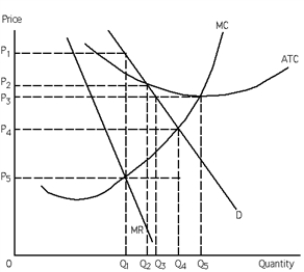 -Refer to Exhibit 25-4. With no regulation, the profit-maximizing firm would supply __________ units of output.
 (Multiple Choice)
4.9/5 (76)
(76) Exhibit 25-40
-Refer to Exhibit 25-4. What is the productive-efficient level of output?
-Refer to Exhibit 25-4. What is the productive-efficient level of output? (Multiple Choice)
4.8/5 (81)
(81) The natural monopolist might have an incentive to let costs increase under
(Multiple Choice)
4.8/5 (67)
(67) The Justice Department considers a Herfindahl index that is ____________________________ to be representative of a moderately concentrated industry.
(Multiple Choice)
4.8/5 (80)
(80) Exhibit 25-1
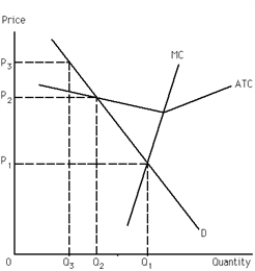 -Refer to Exhibit 25-1. Which of the following statements is false?
 (Multiple Choice)
4.9/5 (84)
(84) Antitrust law is legislation passed for the stated purpose of
(Multiple Choice)
5.0/5 (72)
(72) If I have the only telephone in town, it is essentially worthless. Then other people in town get telephones and I can call them. The value of my telephone rises as more and more of the town installs phones. This makes the telephone a(n) __________ good.
(Multiple Choice)
4.8/5 (80)
(80) What is the difference between the public interest theory of regulation and the public choice theory of regulation?
(Essay)
4.8/5 (86)
(86) The antitrust legislation that empowers the Federal Trade Commission to deal with false and deceptive acts or practices (such as false and deceptive advertising) is
(Multiple Choice)
4.9/5 (68)
(68) 
Filters
- Essay(0)
- Multiple Choice(0)
- Short Answer(0)
- True False(0)
- Matching(0)