



 Chat with AI
Exam 12: The Design of the Tax System

Exam 1: Ten Principles of Economics455 Questions
Exam 2: Thinking Like an Economist643 Questions
Exam 3: Interdependence and the Gains From Trade547 Questions
Exam 4: The Market Forces of Supply and Demand693 Questions
Exam 5: Elasticity and Its Application626 Questions
Exam 6: Supply, Demand, and Government Policies668 Questions
Exam 7: Consumers, Producers, and the Efficiency of Markets547 Questions
Exam 8: Applications: the Costs of Taxation509 Questions
Exam 9: Application: International Trade521 Questions
Exam 10: Externalities543 Questions
Exam 11: Public Goods and Common Resources452 Questions
Exam 12: The Design of the Tax System664 Questions
Exam 13: The Costs of Production649 Questions
Exam 14: Firms in Competitive Markets604 Questions
Exam 15: Monopoly662 Questions
Exam 16: Monopolistic Competition649 Questions
Exam 17: Oligopoly522 Questions
Exam 18: The Markets for the Factors of Production592 Questions
Exam 19: Earnings and Discrimination511 Questions
Exam 20: Income Inequality and Poverty478 Questions
Exam 21: The Theory of Consumer Choice570 Questions
Exam 22: Frontiers in Microeconomics461 Questions
Exam 23: Measuring a Nation S Income547 Questions
Exam 24: Measuring the Cost of Living565 Questions
Exam 25: Production and Growth527 Questions
Exam 26: Saving, Investment, and the Financial System637 Questions
Exam 27: Tools of Finance534 Questions
Exam 28: Unemployment and Its Natural Rate701 Questions
Exam 29: The Monetary System540 Questions
Exam 30: Money Growth and Inflation504 Questions
Exam 31: Open-Economy Macroeconomics: Basic Concepts540 Questions
Exam 32: A Macroeconomic Theory of the Open Economy511 Questions
Exam 33: Aggregate Demand and Aggregate Supply572 Questions
Exam 34: The Influence of Monetary and Fiscal Policy on Aggregate Demand523 Questions
Exam 35: The Short-Run Tradeoff Between Inflation and Unemployment536 Questions
Exam 36: Six Debates Over Macroeconomic Policy354 Questions
Select questions type


Income taxes and property taxes generate the highest tax revenue for state and local governments.
(True/False)
4.9/5  (86)
(86) If transfer payments are included when evaluating tax burdens, then the average tax rate of the poorest quintile of taxpayers would be approximately
(Multiple Choice)
4.8/5 (87)
(87) List the three most important expenditure programs of the federal government. How do they differ from the three most important expenditure programs of state and local governments? Explain why it makes more sense for the federal government to purchase "national defense" rather than state governments.
(Essay)
4.9/5 (86)
(86) Table 12-22  -Refer to Table 12-22. A lump-sum tax is illustrated by tax
 (Multiple Choice)
4.7/5 (79)
(79) Special tax treatment given to specific types of behavior are called
(Multiple Choice)
4.9/5 (69)
(69) Table 12-6
The table below shows the marginal tax rates for an unmarried taxpayer for various levels of taxable income. 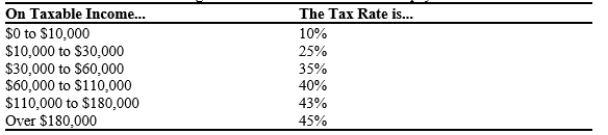 -Refer to Table 12-6. For this tax schedule, what is the average tax rate for an individual with $280,000 in taxable income?
 (Multiple Choice)
4.7/5 (78)
(78) If a tax generates a reduction in surplus that is exactly offset by the tax revenue collected by the government, the tax does not have a deadweight loss.
(True/False)
4.7/5 (79)
(79) Many economists believe that the U.S. tax system would be made more efficient if the basis of taxation were changed so that people paid taxes, more so than they do now, based on their
(Multiple Choice)
4.7/5 (78)
(78) When the marginal tax rate exceeds the average tax rate, the tax is
(Multiple Choice)
4.7/5 (76)
(76) Pat calculates that for every extra dollar she earns, she owes the government 40 cents. Her total income now is $44,000, on which she pays taxes of $11,000. Determine her average tax rate and her marginal tax rate.
(Multiple Choice)
4.8/5 (84)
(84) Two families who live in Plains, GA have identical incomes. The Smiths deduct $5,000 from their taxable income for mortgage interest paid during the year. The Jones family lives in an apartment and is not eligible for a mortgage-interest deduction. This situation exemplifies
(Multiple Choice)
4.7/5 (88)
(88) Vertical equity states that taxpayers with a greater ability to pay taxes should
(Multiple Choice)
4.9/5 (88)
(88) According to the ability-to-pay principle, it is fair for people to pay taxes based on the amount of government services that they receive.
(True/False)
4.8/5 (73)
(73) A city finances a performing arts center by adding a $2.75 tax to each ticket sold.This is an example of taxation via the benefits principle.
(True/False)
4.9/5 (87)
(87) Table 12-20
The following table presents the total tax liability for an unmarried taxpayer under four different tax schedules for the income levels shown.  -Refer to Table 12-20. Which tax schedules are proportional?
 (Multiple Choice)
4.8/5 (74)
(74) If Mary earns $80,000 in taxable income and pays $40,000 in taxes, her marginal tax rate must be 50 percent.
(True/False)
4.7/5 (77)
(77) The share of federal government spending on healthcare has risen substantially over time. This is most likely a result of
(Multiple Choice)
4.9/5 (78)
(78) The administrative burden of complying with tax laws is a cost to the government but not to taxpayers.
(True/False)
4.9/5 (76)
(76) 
Filters
- Essay(0)
- Multiple Choice(0)
- Short Answer(0)
- True False(0)
- Matching(0)