



 Chat with AI
Exam 12: The Design of the Tax System

Exam 1: Ten Principles of Economics455 Questions
Exam 2: Thinking Like an Economist643 Questions
Exam 3: Interdependence and the Gains From Trade547 Questions
Exam 4: The Market Forces of Supply and Demand693 Questions
Exam 5: Elasticity and Its Application626 Questions
Exam 6: Supply, Demand, and Government Policies668 Questions
Exam 7: Consumers, Producers, and the Efficiency of Markets547 Questions
Exam 8: Applications: the Costs of Taxation509 Questions
Exam 9: Application: International Trade521 Questions
Exam 10: Externalities543 Questions
Exam 11: Public Goods and Common Resources452 Questions
Exam 12: The Design of the Tax System664 Questions
Exam 13: The Costs of Production649 Questions
Exam 14: Firms in Competitive Markets604 Questions
Exam 15: Monopoly662 Questions
Exam 16: Monopolistic Competition649 Questions
Exam 17: Oligopoly522 Questions
Exam 18: The Markets for the Factors of Production592 Questions
Exam 19: Earnings and Discrimination511 Questions
Exam 20: Income Inequality and Poverty478 Questions
Exam 21: The Theory of Consumer Choice570 Questions
Exam 22: Frontiers in Microeconomics461 Questions
Exam 23: Measuring a Nation S Income547 Questions
Exam 24: Measuring the Cost of Living565 Questions
Exam 25: Production and Growth527 Questions
Exam 26: Saving, Investment, and the Financial System637 Questions
Exam 27: Tools of Finance534 Questions
Exam 28: Unemployment and Its Natural Rate701 Questions
Exam 29: The Monetary System540 Questions
Exam 30: Money Growth and Inflation504 Questions
Exam 31: Open-Economy Macroeconomics: Basic Concepts540 Questions
Exam 32: A Macroeconomic Theory of the Open Economy511 Questions
Exam 33: Aggregate Demand and Aggregate Supply572 Questions
Exam 34: The Influence of Monetary and Fiscal Policy on Aggregate Demand523 Questions
Exam 35: The Short-Run Tradeoff Between Inflation and Unemployment536 Questions
Exam 36: Six Debates Over Macroeconomic Policy354 Questions
Select questions type


In which of the following tax systems do taxes increase as income increases?
(Multiple Choice)
4.8/5  (83)
(83) If all taxpayers pay the same percentage of income in taxes, the tax system is proportional.
(True/False)
4.9/5 (87)
(87) The U.S. federal government spends its revenues in a number of ways. Rank the following spending categories from largest to smallest.
(Multiple Choice)
4.9/5 (72)
(72) The principle that people should pay taxes based on the benefits they receive from government services is called the
(Multiple Choice)
4.8/5 (79)
(79) Table 12-2 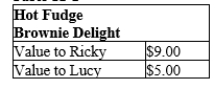 -Refer to Table 12-2. Suppose that the government imposes a $2 tax on delights, causing the price to increase from $4.00 to $6.00. Total consumer surplus will fall from
 (Multiple Choice)
4.8/5 (71)
(71) In 2010, the co-chairmen of President Obama's deficit reduction commission proposed curtailing or eliminating many tax deductions such as the one for mortgage interest. Economists who favor the proposal argue that it would
(i)correct a misallocation of resources because too much of the economy's capital stock is tied up in residential housing and too little is invested in corporate capital.
(ii)cut both spending and taxes.
(iii)encourage private philanthropy.
(Multiple Choice)
4.9/5 (73)
(73) Vertical equity is not consistent with a regressive tax structure.
(True/False)
4.8/5 (73)
(73) "A $1,000 tax paid by a poor person may be a larger sacrifice than a $10,000 tax paid by a wealthy person" is an argument in favor of
(Multiple Choice)
4.9/5 (75)
(75) The United States federal government has a large budget deficit. Long-term projections suggest that under current law, taxes, as a percentage of GDP, will __________ and government spending, as a percentage of GDP, will __________.
(Short Answer)
4.8/5 (61)
(61) Scenario 12-5
Senator Filch argues that a tax must be paid by people who benefit from government services. Senator Fudge argues that a tax must be paid in accordance with a person's ability to bear the tax burden. Senator Malfoy argues that people with a greater ability to pay a tax should pay a larger amount. Senator Moody argues that taxpayers with similar abilities to pay should contribute the same amount.
-Refer to Scenario 12-5. Which Senator is advocating taxes based on the benefits principle?
(Multiple Choice)
4.8/5 (88)
(88) Table 12-23
The dollar amounts in the last three columns are the taxes owed under the three different tax systems.  -Refer to Table 12-23. Which of the three tax systems is regressive?
 (Multiple Choice)
4.8/5 (77)
(77) An advantage of a consumption tax is that it does not distort the incentive to save.
(True/False)
4.9/5 (78)
(78) Table 12-17
The following table shows the marginal tax rates for unmarried individuals for two years. 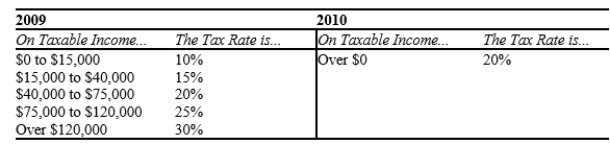 -Refer to Table 12-17. Which of the following best describes the tax schedule in 2009?
 (Multiple Choice)
4.9/5 (80)
(80) Table 12-11  -Refer to Table 12-11. If Al has taxable income of $165,000, his average tax rate is
 (Multiple Choice)
4.7/5 (75)
(75) In 2011, what percentage of federal government receipts came from corporate income taxes?
(Multiple Choice)
4.8/5 (75)
(75) 
Filters
- Essay(0)
- Multiple Choice(0)
- Short Answer(0)
- True False(0)
- Matching(0)