



 Chat with AI
Exam 12: The Design of the Tax System

Exam 1: Ten Principles of Economics455 Questions
Exam 2: Thinking Like an Economist643 Questions
Exam 3: Interdependence and the Gains From Trade547 Questions
Exam 4: The Market Forces of Supply and Demand693 Questions
Exam 5: Elasticity and Its Application626 Questions
Exam 6: Supply, Demand, and Government Policies668 Questions
Exam 7: Consumers, Producers, and the Efficiency of Markets547 Questions
Exam 8: Applications: the Costs of Taxation509 Questions
Exam 9: Application: International Trade521 Questions
Exam 10: Externalities543 Questions
Exam 11: Public Goods and Common Resources452 Questions
Exam 12: The Design of the Tax System664 Questions
Exam 13: The Costs of Production649 Questions
Exam 14: Firms in Competitive Markets604 Questions
Exam 15: Monopoly662 Questions
Exam 16: Monopolistic Competition649 Questions
Exam 17: Oligopoly522 Questions
Exam 18: The Markets for the Factors of Production592 Questions
Exam 19: Earnings and Discrimination511 Questions
Exam 20: Income Inequality and Poverty478 Questions
Exam 21: The Theory of Consumer Choice570 Questions
Exam 22: Frontiers in Microeconomics461 Questions
Exam 23: Measuring a Nation S Income547 Questions
Exam 24: Measuring the Cost of Living565 Questions
Exam 25: Production and Growth527 Questions
Exam 26: Saving, Investment, and the Financial System637 Questions
Exam 27: Tools of Finance534 Questions
Exam 28: Unemployment and Its Natural Rate701 Questions
Exam 29: The Monetary System540 Questions
Exam 30: Money Growth and Inflation504 Questions
Exam 31: Open-Economy Macroeconomics: Basic Concepts540 Questions
Exam 32: A Macroeconomic Theory of the Open Economy511 Questions
Exam 33: Aggregate Demand and Aggregate Supply572 Questions
Exam 34: The Influence of Monetary and Fiscal Policy on Aggregate Demand523 Questions
Exam 35: The Short-Run Tradeoff Between Inflation and Unemployment536 Questions
Exam 36: Six Debates Over Macroeconomic Policy354 Questions
Select questions type


Table 12-11 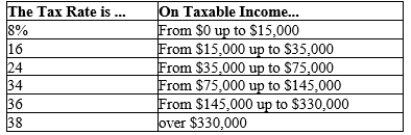 -Refer to Table 12-11. If Al has taxable income of $165,000, his marginal tax rate is
 (Multiple Choice)
4.8/5  (67)
(67) The theory that the wealthy should contribute more to police protection than the poor because they have more to protect is based on
(Multiple Choice)
4.8/5 (77)
(77) One of the most difficult issues associated with trying to structure a tax policy to satisfy horizontal equity is determining
(Multiple Choice)
4.8/5 (70)
(70) Rob's income rises from $50,000 to $60,000 and his income tax increases from $6,000 to $7,500.His marginal tax rate is 12.5%.
(True/False)
4.8/5 (82)
(82) Table 12-22  -Refer to Table 12-22. A progressive tax is illustrated by tax
 (Multiple Choice)
5.0/5 (86)
(86) 'The U.S. tax code gives preferential treatment to investors in municipal bonds. This is an example of
(Multiple Choice)
4.9/5 (102)
(102) Suppose the government imposes a tax of 10 percent on the first $40,000 of income and 20 percent on all income above $40,000. What are the tax liability and the marginal tax rate for a person whose income is $50,000?
(Multiple Choice)
4.8/5 (74)
(74) If we want to gauge the sacrifice made by a taxpayer, we should use the
(Multiple Choice)
4.8/5 (72)
(72) Table 12-22  -Refer to Table 12-22. A regressive tax is illustrated by tax
 (Multiple Choice)
4.8/5 (84)
(84) Suppose Ron is willing to pay $200 to see a professional basketball game and Felix is willing to pay $150.Assume the normal price of a ticket is $125.The local government decides to impose a $35/ticket surcharge to raise revenue, causing the ticket price to rise to $160.The resulting deadweight loss is:
(Multiple Choice)
4.8/5 (81)
(81) Athos, Porthos,and Aramis each like to take fencing lessons. The price of a fencing lesson is $11. Athos values a lesson at $16, Porthos at $14, and Aramis at $12. Suppose that if the government taxes fencing lessons at $2 each, the price will rise to $13. A consequence of the tax is that consumer surplus shrinks by
(Multiple Choice)
4.9/5 (81)
(81) What are the two types of costs that a well-designed tax policy tries to avoid or minimize?
(Essay)
4.8/5 (80)
(80) In 2011, approximately how much of federal government spending went to income security?
(Multiple Choice)
4.8/5 (91)
(91) Scenario 12-2
Suppose that Bob places a value of $10 on a movie ticket and that Lisa places a value of $7 on a movie ticket. In addition, suppose the price of a movie ticket is $5.
-Refer to Scenario 12-2. What is total consumer surplus for Bob and Lisa?
(Multiple Choice)
4.8/5 (78)
(78) Scenario 12-3
Suppose Roger and Regina receive great satisfaction from their consumption of cheesecake. Regina would be willing to purchase only one slice and would pay up to $8 for it. Roger would be willing to pay $11 for his first slice, $9 for his second slice, and $5 for his third slice. The current market price is $5 per slice.
-Refer to Scenario 12-3. Assume that the government places a $4 tax on each slice of cheesecake and that the new equilibrium price is $9. What is the deadweight loss of the tax?
(Multiple Choice)
5.0/5 (89)
(89) Vertical and horizontal equity are widely accepted and applying them to evaluate a tax system is always straightforward.
(True/False)
4.8/5 (81)
(81) If transfer payments are included when evaluating tax burdens, then the average tax rate of the poorest quintile of taxpayers would be approximately
(Multiple Choice)
4.8/5 (74)
(74) 
Filters
- Essay(0)
- Multiple Choice(0)
- Short Answer(0)
- True False(0)
- Matching(0)