



 Chat with AI
Exam 12: The Design of the Tax System

Exam 1: Ten Principles of Economics455 Questions
Exam 2: Thinking Like an Economist643 Questions
Exam 3: Interdependence and the Gains From Trade547 Questions
Exam 4: The Market Forces of Supply and Demand693 Questions
Exam 5: Elasticity and Its Application626 Questions
Exam 6: Supply, Demand, and Government Policies668 Questions
Exam 7: Consumers, Producers, and the Efficiency of Markets547 Questions
Exam 8: Applications: the Costs of Taxation509 Questions
Exam 9: Application: International Trade521 Questions
Exam 10: Externalities543 Questions
Exam 11: Public Goods and Common Resources452 Questions
Exam 12: The Design of the Tax System664 Questions
Exam 13: The Costs of Production649 Questions
Exam 14: Firms in Competitive Markets604 Questions
Exam 15: Monopoly662 Questions
Exam 16: Monopolistic Competition649 Questions
Exam 17: Oligopoly522 Questions
Exam 18: The Markets for the Factors of Production592 Questions
Exam 19: Earnings and Discrimination511 Questions
Exam 20: Income Inequality and Poverty478 Questions
Exam 21: The Theory of Consumer Choice570 Questions
Exam 22: Frontiers in Microeconomics461 Questions
Exam 23: Measuring a Nation S Income547 Questions
Exam 24: Measuring the Cost of Living565 Questions
Exam 25: Production and Growth527 Questions
Exam 26: Saving, Investment, and the Financial System637 Questions
Exam 27: Tools of Finance534 Questions
Exam 28: Unemployment and Its Natural Rate701 Questions
Exam 29: The Monetary System540 Questions
Exam 30: Money Growth and Inflation504 Questions
Exam 31: Open-Economy Macroeconomics: Basic Concepts540 Questions
Exam 32: A Macroeconomic Theory of the Open Economy511 Questions
Exam 33: Aggregate Demand and Aggregate Supply572 Questions
Exam 34: The Influence of Monetary and Fiscal Policy on Aggregate Demand523 Questions
Exam 35: The Short-Run Tradeoff Between Inflation and Unemployment536 Questions
Exam 36: Six Debates Over Macroeconomic Policy354 Questions
Select questions type


In general, the largest sources of revenue for state and local governments come from:
(Multiple Choice)
4.9/5  (79)
(79) Suppose that in 2020 the average citizen's federal tax bill is $11,888 per person, and total federal spending is $13,997 per person. In 2020, the federal government will have
(Multiple Choice)
4.9/5 (82)
(82) State and local governments receive the largest portion of their tax revenues from
(Multiple Choice)
4.9/5 (83)
(83) Suppose the country of Mankiwland has a new king, King Gregory. For the purpose of efficiency King Gregory's chief economic advisor would encourage him to design his country's tax system to minimize
(i)deadweight losses from taxes.
(ii)administrative burdens from taxes.
(iii)the tax payments themselves.
(iv)government expenditures to correct for market failures.
(Multiple Choice)
4.8/5 (87)
(87) Which of the following is true about the percent of total income all levels of government in the U.S. take as taxes?
(Multiple Choice)
4.9/5 (81)
(81) The largest source of revenue for the federal government is the
(Multiple Choice)
4.9/5 (78)
(78) Table 12-9
United States Income Tax Rates for a Single Individual, 2012 and 2013. 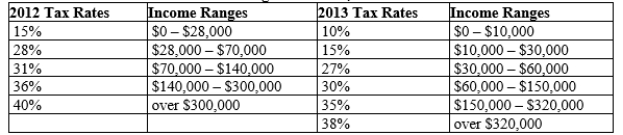 -Refer to Table 12-9. Darby is a single person whose taxable income is $320,000 a year. What happened to her average tax rate between 2012 and 2013?
 (Multiple Choice)
4.9/5 (79)
(79) Revenues from social insurance taxes are earmarked to pay for Social Security and Medicare.
(True/False)
4.8/5 (70)
(70) Table 12-15 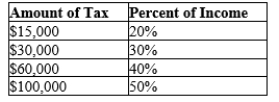 -Refer to Table 12-15. In this tax system which of the following is possible?
 (Multiple Choice)
4.9/5 (87)
(87) If James earns $80,000 in taxable income and pays $20,000 in taxes, his average tax rate is 25 percent.
(True/False)
4.7/5 (81)
(81) Table 12-10 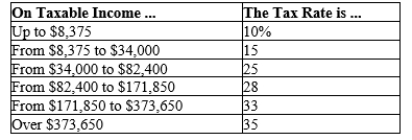 -Refer to Table 12-10. If Miss Kay has $80,000 in taxable income, her marginal tax rate is
 (Multiple Choice)
4.7/5 (71)
(71) Taxes on specific goods such as cigarettes, gasoline, and alcoholic beverages are called
(Multiple Choice)
4.8/5 (71)
(71) 
Filters
- Essay(0)
- Multiple Choice(0)
- Short Answer(0)
- True False(0)
- Matching(0)