



 Chat with AI
Exam 26: Saving, Investment, and the Financial System

Exam 1: Ten Principles of Economics455 Questions
Exam 2: Thinking Like an Economist643 Questions
Exam 3: Interdependence and the Gains From Trade547 Questions
Exam 4: The Market Forces of Supply and Demand693 Questions
Exam 5: Elasticity and Its Application626 Questions
Exam 6: Supply, Demand, and Government Policies668 Questions
Exam 7: Consumers, Producers, and the Efficiency of Markets547 Questions
Exam 8: Applications: the Costs of Taxation509 Questions
Exam 9: Application: International Trade521 Questions
Exam 10: Externalities543 Questions
Exam 11: Public Goods and Common Resources452 Questions
Exam 12: The Design of the Tax System664 Questions
Exam 13: The Costs of Production649 Questions
Exam 14: Firms in Competitive Markets604 Questions
Exam 15: Monopoly662 Questions
Exam 16: Monopolistic Competition649 Questions
Exam 17: Oligopoly522 Questions
Exam 18: The Markets for the Factors of Production592 Questions
Exam 19: Earnings and Discrimination511 Questions
Exam 20: Income Inequality and Poverty478 Questions
Exam 21: The Theory of Consumer Choice570 Questions
Exam 22: Frontiers in Microeconomics461 Questions
Exam 23: Measuring a Nation S Income547 Questions
Exam 24: Measuring the Cost of Living565 Questions
Exam 25: Production and Growth527 Questions
Exam 26: Saving, Investment, and the Financial System637 Questions
Exam 27: Tools of Finance534 Questions
Exam 28: Unemployment and Its Natural Rate701 Questions
Exam 29: The Monetary System540 Questions
Exam 30: Money Growth and Inflation504 Questions
Exam 31: Open-Economy Macroeconomics: Basic Concepts540 Questions
Exam 32: A Macroeconomic Theory of the Open Economy511 Questions
Exam 33: Aggregate Demand and Aggregate Supply572 Questions
Exam 34: The Influence of Monetary and Fiscal Policy on Aggregate Demand523 Questions
Exam 35: The Short-Run Tradeoff Between Inflation and Unemployment536 Questions
Exam 36: Six Debates Over Macroeconomic Policy354 Questions
Select questions type


Scenario 26-2. Assume the following information for an imaginary, closed economy.
GDP = $5 trillion; consumption = $3.1 trillion;
government purchases = $0.7 trillion; and taxes = $0.9 trillion.
-Refer to Scenario 26-2. Suppose, for this economy, the relationship between the real interest rate, r, and investment, I, is given by the equation I = 10.78 - 3.03r. (If, for example, r = 10, this means that the real interest rate is 10 percent.) The equilibrium real interest rate for this economy is
(Multiple Choice)
4.8/5  (86)
(86) Jim buys a $1000 bond from ABC Company. ABC Company uses the $1000 to purchase a new piece of machinery. Whose spending would be an act of investment in the language of macroeconomics?
(Multiple Choice)
4.8/5 (83)
(83) World Wide Delivery Service Corporation develops a way to speed up its deliveries and reduce its costs. We would expect that this would
(Multiple Choice)
4.9/5 (84)
(84) When the government goes from running a balanced budget to running a budget surplus,
(Multiple Choice)
4.7/5 (77)
(77) Midwestern corporation issues bonds. Southern corporation issues stock. Which corporation used equity financing?
(Multiple Choice)
4.7/5 (71)
(71) The price-earnings ratio for Wavina Coporation increased from 15 to 17. This suggests that
(Multiple Choice)
4.8/5 (68)
(68) Which of the following events could explain a decrease in interest rates together with an increase in investment?
(Multiple Choice)
4.8/5 (74)
(74) Index funds are usually outperformed by mutual funds that are actively managed by professional money managers.
(True/False)
4.7/5 (69)
(69) If the demand for loanable funds shifts to the right, then the equilibrium interest rate
(Multiple Choice)
4.9/5 (77)
(77) Figure 26-4. On the horizontal axis of the graph, L represents the quantity of loanable funds in billions of dollars. 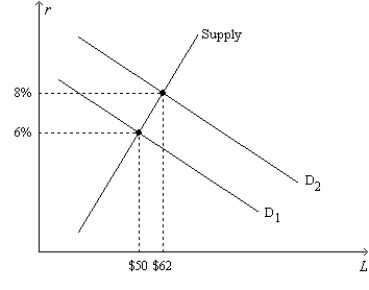 -Refer to Figure 26-4. Regard the position of the Supply curve as fixed, as on the graph. If the real interest rate is 8 percent, the inflation rate is 3 percent, and the market for loanable funds is in equilibrium, then the position of the demand-for-loanable-funds curve must be
 (Multiple Choice)
4.7/5 (74)
(74) Fortunade Corporation stock has a price of $100 per share, a dividend of $1.60 per share, and retained earnings of $2.00 per share. The dividend yield on this stock is
(Multiple Choice)
4.8/5 (75)
(75) Rank the following in order of highest to lowest interest rate:
(Multiple Choice)
4.9/5 (79)
(79) 
Filters
- Essay(0)
- Multiple Choice(0)
- Short Answer(0)
- True False(0)
- Matching(0)