



 Chat with AI
Exam 26: Saving, Investment, and the Financial System

Exam 1: Ten Principles of Economics455 Questions
Exam 2: Thinking Like an Economist643 Questions
Exam 3: Interdependence and the Gains From Trade547 Questions
Exam 4: The Market Forces of Supply and Demand693 Questions
Exam 5: Elasticity and Its Application626 Questions
Exam 6: Supply, Demand, and Government Policies668 Questions
Exam 7: Consumers, Producers, and the Efficiency of Markets547 Questions
Exam 8: Applications: the Costs of Taxation509 Questions
Exam 9: Application: International Trade521 Questions
Exam 10: Externalities543 Questions
Exam 11: Public Goods and Common Resources452 Questions
Exam 12: The Design of the Tax System664 Questions
Exam 13: The Costs of Production649 Questions
Exam 14: Firms in Competitive Markets604 Questions
Exam 15: Monopoly662 Questions
Exam 16: Monopolistic Competition649 Questions
Exam 17: Oligopoly522 Questions
Exam 18: The Markets for the Factors of Production592 Questions
Exam 19: Earnings and Discrimination511 Questions
Exam 20: Income Inequality and Poverty478 Questions
Exam 21: The Theory of Consumer Choice570 Questions
Exam 22: Frontiers in Microeconomics461 Questions
Exam 23: Measuring a Nation S Income547 Questions
Exam 24: Measuring the Cost of Living565 Questions
Exam 25: Production and Growth527 Questions
Exam 26: Saving, Investment, and the Financial System637 Questions
Exam 27: Tools of Finance534 Questions
Exam 28: Unemployment and Its Natural Rate701 Questions
Exam 29: The Monetary System540 Questions
Exam 30: Money Growth and Inflation504 Questions
Exam 31: Open-Economy Macroeconomics: Basic Concepts540 Questions
Exam 32: A Macroeconomic Theory of the Open Economy511 Questions
Exam 33: Aggregate Demand and Aggregate Supply572 Questions
Exam 34: The Influence of Monetary and Fiscal Policy on Aggregate Demand523 Questions
Exam 35: The Short-Run Tradeoff Between Inflation and Unemployment536 Questions
Exam 36: Six Debates Over Macroeconomic Policy354 Questions
Select questions type


If the nominal interest rate is 2.5 percent and the inflation rate is 2 percent, what is the real interest rate?
(Multiple Choice)
4.9/5  (72)
(72) If a reform of the tax laws encourages greater saving, the result would be
(Multiple Choice)
4.8/5 (79)
(79) Suppose a government that taxed all interest income changed its tax law so that the first $5,000 of a taxpayer's interest income was tax free. This would shift the
(Multiple Choice)
4.8/5 (87)
(87) Bond A and Bond B have identical characteristics except that Bond A has a higher interest rate. Which bond has a higher credit risk?
(Short Answer)
4.7/5 (70)
(70) Figure 26-5. Figure 26-5 shows the loanable funds market for a closed economy. 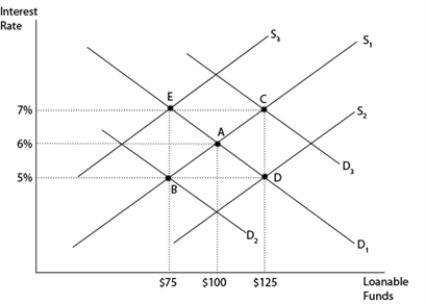 -Refer to Figure 26-5. Starting at point A, a change in tax laws that encouraged households to save more would likely cause
 (Multiple Choice)
4.8/5 (76)
(76) Identify each of the following acts as representing either saving or investment.
a.Fred uses some of his income to buy government bonds.
b.Julie takes some of her income and buys mutual funds.
c.Alex purchases a new truck for his delivery business using borrowed funds.
d.Elaine uses some of her income to buy stock in a major corporation.
e.
Henrietta hires a builder to construct a new building for her bicycle shop.
(Essay)
4.9/5 (78)
(78) Which of the following equations represents GDP for an open economy?
(Multiple Choice)
4.9/5 (74)
(74) When the government increases its borrowing, the budget _____ increases and government debt _____. The resulting change in investment due to this increased government borrowing is called _____.
(Short Answer)
4.8/5 (84)
(84) If the nominal interest rate is 3 percent and the inflation rate is 4 percent, then the real interest rate is
(Multiple Choice)
4.9/5 (82)
(82) Which of the following is not an important stock exchange in the United States?
(Multiple Choice)
4.9/5 (89)
(89) If in a closed economy Y = $11 trillion, which of the following combinations would be consistent with national saving of $3 trillion?
(Multiple Choice)
4.9/5 (90)
(90) Use the following table to answer the following questions.
Table 26-2  -Refer to Table 26-2. For which stock(s) is(are) the P/E ratio less than what is historically typical?
 (Multiple Choice)
4.9/5 (89)
(89) The old adage, "Don't put all your eggs in one basket," is very similar to a modern bit of advice concerning financial matters:
(Multiple Choice)
5.0/5 (74)
(74) National saving is the sum of _____ and _____. In a closed economy it is equal to _____ in equilibrium.
(Essay)
4.9/5 (77)
(77) 
Filters
- Essay(0)
- Multiple Choice(0)
- Short Answer(0)
- True False(0)
- Matching(0)