



 Chat with AI
Exam 26: Saving, Investment, and the Financial System

Exam 1: Ten Principles of Economics455 Questions
Exam 2: Thinking Like an Economist643 Questions
Exam 3: Interdependence and the Gains From Trade547 Questions
Exam 4: The Market Forces of Supply and Demand693 Questions
Exam 5: Elasticity and Its Application626 Questions
Exam 6: Supply, Demand, and Government Policies668 Questions
Exam 7: Consumers, Producers, and the Efficiency of Markets547 Questions
Exam 8: Applications: the Costs of Taxation509 Questions
Exam 9: Application: International Trade521 Questions
Exam 10: Externalities543 Questions
Exam 11: Public Goods and Common Resources452 Questions
Exam 12: The Design of the Tax System664 Questions
Exam 13: The Costs of Production649 Questions
Exam 14: Firms in Competitive Markets604 Questions
Exam 15: Monopoly662 Questions
Exam 16: Monopolistic Competition649 Questions
Exam 17: Oligopoly522 Questions
Exam 18: The Markets for the Factors of Production592 Questions
Exam 19: Earnings and Discrimination511 Questions
Exam 20: Income Inequality and Poverty478 Questions
Exam 21: The Theory of Consumer Choice570 Questions
Exam 22: Frontiers in Microeconomics461 Questions
Exam 23: Measuring a Nation S Income547 Questions
Exam 24: Measuring the Cost of Living565 Questions
Exam 25: Production and Growth527 Questions
Exam 26: Saving, Investment, and the Financial System637 Questions
Exam 27: Tools of Finance534 Questions
Exam 28: Unemployment and Its Natural Rate701 Questions
Exam 29: The Monetary System540 Questions
Exam 30: Money Growth and Inflation504 Questions
Exam 31: Open-Economy Macroeconomics: Basic Concepts540 Questions
Exam 32: A Macroeconomic Theory of the Open Economy511 Questions
Exam 33: Aggregate Demand and Aggregate Supply572 Questions
Exam 34: The Influence of Monetary and Fiscal Policy on Aggregate Demand523 Questions
Exam 35: The Short-Run Tradeoff Between Inflation and Unemployment536 Questions
Exam 36: Six Debates Over Macroeconomic Policy354 Questions
Select questions type


At some point during the financial crisis of 2008-2009, people with uninsured deposits at financial institutions withdrew money from their accounts at those institutions. This phenomenon characterized which element of the financial crisis?
(Multiple Choice)
4.8/5  (75)
(75) Suppose that in a closed economy GDP is equal to 15,000, government purchases are equal to 3,000, consumption equals 10,500, and taxes equal 3,500. What are private saving and public saving?
(Multiple Choice)
4.9/5 (66)
(66) Other things the same, if the government increases transfer payments to households, then the effect of this on the government's budget
(Multiple Choice)
5.0/5 (79)
(79) To state that national saving is equal to investment, for a closed economy, is to state an accounting identity.
(True/False)
4.8/5 (81)
(81) Other things being constant, when a firm sells new shares of stock, the
(Multiple Choice)
4.9/5 (75)
(75) Given that Monika's income exceeds her expenditures, Monika is best described as a
(Multiple Choice)
4.8/5 (80)
(80) When tax code changes reduce investment incentives, the _____ for loanable funds curve shifts to the _____. This results in a(n) _____ in the interest rate and a(n) _____ in investment.
(Short Answer)
4.9/5 (72)
(72) Use the following table to answer the following questions.
Table 26-1  -Refer to Table 26-1. In dollar terms, which company paid the highest dividend per share?
 (Multiple Choice)
4.7/5 (85)
(85) For an imaginary economy, when the real interest rate is 5 percent, the quantity of loanable funds demanded is $100,000 and the quantity of loanable funds supplied is $100,000. Currently, the nominal interest rate is 6 percent and the inflation rate is 2 percent. Currently,
(Multiple Choice)
4.7/5 (87)
(87) Owners of bonds that were issued by the federal government are not required to pay federal income tax on the interest income.
(True/False)
4.9/5 (71)
(71) You hold bonds issued by the city of Sacramento, California. The interest you earn each year on these bonds
(Multiple Choice)
4.8/5 (71)
(71) Suppose the Congress and president decreased the maximum annual contributions limits to retirement accounts and at the same time reduced the budget deficit. What would happen to the interest rate?
(Multiple Choice)
4.8/5 (73)
(73) Figure 26-2. The figure depicts a supply-of-loanable-funds curve and two demand-for-loanable-funds curves.
r 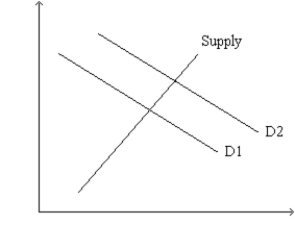 Q
-Refer to Figure 26-2. What is measured along the horizontal axis of the graph?
Q
-Refer to Figure 26-2. What is measured along the horizontal axis of the graph? (Multiple Choice)
4.9/5 (64)
(64) Bay City Mining, Inc. has a price of $20 a share, outstanding shares of 2.5 million, retained earnings of $1 million dollars, and a dividend yield of 2 percent. It has a price-earnings ratio of
(Multiple Choice)
4.9/5 (98)
(98) When opening a print shop you need to buy printers, computers, furniture, and similar items. Economists call these expenditures
(Multiple Choice)
4.8/5 (81)
(81) Interest rates fall and investment falls. Which of the following could explain these changes?
(Multiple Choice)
4.7/5 (95)
(95) 
Filters
- Essay(0)
- Multiple Choice(0)
- Short Answer(0)
- True False(0)
- Matching(0)