



 Chat with AI
Exam 26: Saving, Investment, and the Financial System

Exam 1: Ten Principles of Economics455 Questions
Exam 2: Thinking Like an Economist643 Questions
Exam 3: Interdependence and the Gains From Trade547 Questions
Exam 4: The Market Forces of Supply and Demand693 Questions
Exam 5: Elasticity and Its Application626 Questions
Exam 6: Supply, Demand, and Government Policies668 Questions
Exam 7: Consumers, Producers, and the Efficiency of Markets547 Questions
Exam 8: Applications: the Costs of Taxation509 Questions
Exam 9: Application: International Trade521 Questions
Exam 10: Externalities543 Questions
Exam 11: Public Goods and Common Resources452 Questions
Exam 12: The Design of the Tax System664 Questions
Exam 13: The Costs of Production649 Questions
Exam 14: Firms in Competitive Markets604 Questions
Exam 15: Monopoly662 Questions
Exam 16: Monopolistic Competition649 Questions
Exam 17: Oligopoly522 Questions
Exam 18: The Markets for the Factors of Production592 Questions
Exam 19: Earnings and Discrimination511 Questions
Exam 20: Income Inequality and Poverty478 Questions
Exam 21: The Theory of Consumer Choice570 Questions
Exam 22: Frontiers in Microeconomics461 Questions
Exam 23: Measuring a Nation S Income547 Questions
Exam 24: Measuring the Cost of Living565 Questions
Exam 25: Production and Growth527 Questions
Exam 26: Saving, Investment, and the Financial System637 Questions
Exam 27: Tools of Finance534 Questions
Exam 28: Unemployment and Its Natural Rate701 Questions
Exam 29: The Monetary System540 Questions
Exam 30: Money Growth and Inflation504 Questions
Exam 31: Open-Economy Macroeconomics: Basic Concepts540 Questions
Exam 32: A Macroeconomic Theory of the Open Economy511 Questions
Exam 33: Aggregate Demand and Aggregate Supply572 Questions
Exam 34: The Influence of Monetary and Fiscal Policy on Aggregate Demand523 Questions
Exam 35: The Short-Run Tradeoff Between Inflation and Unemployment536 Questions
Exam 36: Six Debates Over Macroeconomic Policy354 Questions
Select questions type


The two most important financial markets are the _____ market and the _____ market.
(Short Answer)
4.8/5  (93)
(93) Scenario 26-1. Assume the following information for an imaginary, closed economy.
GDP = $100,000; taxes = $22,000; government purchases = $25,000; national
saving = $15,000.
-Refer to Scenario 26-1. For this economy, private saving amounts to
(Multiple Choice)
4.9/5 (82)
(82) Who accepts all of the risk associated with a mutual fund's portfolio of stocks and/or bonds?
(Multiple Choice)
4.8/5 (88)
(88) Suppose that Congress were to institute an investment tax credit. What would happen in the market for loanable funds?
(Multiple Choice)
4.8/5 (92)
(92) A tech company loses a high-profile patent-infringement case against its top competitor. Which of the following is true?
(Multiple Choice)
4.9/5 (80)
(80) If Congress instituted an investment tax credit, the interest rate would
(Multiple Choice)
4.8/5 (75)
(75) The slope of the demand for loanable funds curve represents the
(Multiple Choice)
4.8/5 (82)
(82) Kroger's grocery chain wants to finance the purchase of a new warehouse. It decides to sell bonds.
(Multiple Choice)
4.9/5 (79)
(79) The model of the market for loanable funds shows that an investment tax credit will cause interest rates to rise and investment to rise. Yet we also suppose that higher interest rates lead to lower investment. How can these two conclusions be reconciled?
(Essay)
4.9/5 (85)
(85) Figure 26-4. On the horizontal axis of the graph, L represents the quantity of loanable funds in billions of dollars. 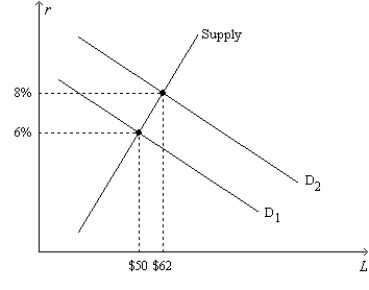 -Refer to Figure 26-4. Regard the position of the Supply curve as fixed, as on the graph. If the real interest rate is 4 percent, the inflation rate is 2 percent, and the market for loanable funds is in equilibrium, then the position of the demand-for-loanable-funds curve must be
 (Multiple Choice)
4.8/5 (77)
(77) Suppose government expenditures on goods and services and net taxes both decrease, and expenditures fall by more than net taxes. The effects of these changes on the budget deficit cause
(Multiple Choice)
4.9/5 (80)
(80) The Dow Jones Industrial Average has been computed regularly since
(Multiple Choice)
4.9/5 (75)
(75) A change in the tax laws that increases the supply of loanable funds will have a smaller effect on investment when
(Multiple Choice)
4.8/5 (85)
(85) Managed mutual funds perform better on average than index funds because stock prices are usually a good predictor of a company's true value.
(True/False)
4.9/5 (77)
(77) If the tax rate fell, holding municipal bonds would be less desirable so the interest rates on them would fall.
(True/False)
4.9/5 (65)
(65) If the government reduces transfer payments, what happens to the budget deficit? What curve does this change in the market for loanable funds, which direction does it shift, and what happens to the equilibrium interest rate?
(Essay)
4.9/5 (82)
(82) In a closed economy, if Y is 10,000, T is 1,000, G is 3,000, and C is 5,000, then
(Multiple Choice)
4.9/5 (77)
(77) Woody wants to open a pet store and needs to buy a building. Both the nominal interest rate and the inflation rate increase by 2 percent. Now, Woody
(Multiple Choice)
4.7/5 (79)
(79) In 2009, the U.S. government's budget deficit increased substantially. Other things the same, this means the
(Multiple Choice)
4.8/5 (89)
(89) 
Filters
- Essay(0)
- Multiple Choice(0)
- Short Answer(0)
- True False(0)
- Matching(0)