



 Chat with AI
Exam 8: Applications: the Costs of Taxation

Exam 1: Ten Principles of Economics455 Questions
Exam 2: Thinking Like an Economist643 Questions
Exam 3: Interdependence and the Gains From Trade547 Questions
Exam 4: The Market Forces of Supply and Demand693 Questions
Exam 5: Elasticity and Its Application626 Questions
Exam 6: Supply, Demand, and Government Policies668 Questions
Exam 7: Consumers, Producers, and the Efficiency of Markets547 Questions
Exam 8: Applications: the Costs of Taxation509 Questions
Exam 9: Application: International Trade521 Questions
Exam 10: Externalities543 Questions
Exam 11: Public Goods and Common Resources452 Questions
Exam 12: The Design of the Tax System664 Questions
Exam 13: The Costs of Production649 Questions
Exam 14: Firms in Competitive Markets604 Questions
Exam 15: Monopoly662 Questions
Exam 16: Monopolistic Competition649 Questions
Exam 17: Oligopoly522 Questions
Exam 18: The Markets for the Factors of Production592 Questions
Exam 19: Earnings and Discrimination511 Questions
Exam 20: Income Inequality and Poverty478 Questions
Exam 21: The Theory of Consumer Choice570 Questions
Exam 22: Frontiers in Microeconomics461 Questions
Exam 23: Measuring a Nation S Income547 Questions
Exam 24: Measuring the Cost of Living565 Questions
Exam 25: Production and Growth527 Questions
Exam 26: Saving, Investment, and the Financial System637 Questions
Exam 27: Tools of Finance534 Questions
Exam 28: Unemployment and Its Natural Rate701 Questions
Exam 29: The Monetary System540 Questions
Exam 30: Money Growth and Inflation504 Questions
Exam 31: Open-Economy Macroeconomics: Basic Concepts540 Questions
Exam 32: A Macroeconomic Theory of the Open Economy511 Questions
Exam 33: Aggregate Demand and Aggregate Supply572 Questions
Exam 34: The Influence of Monetary and Fiscal Policy on Aggregate Demand523 Questions
Exam 35: The Short-Run Tradeoff Between Inflation and Unemployment536 Questions
Exam 36: Six Debates Over Macroeconomic Policy354 Questions
Select questions type


Supply-side economics is a term associated with the views of
(Multiple Choice)
4.8/5  (72)
(72) Figure 8-26 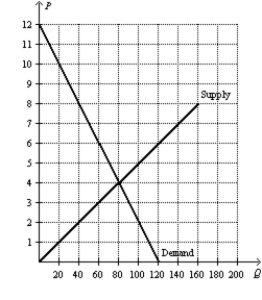 -Refer to Figure 8-26. Suppose the government places a $3 tax per unit on this good. How much is producer surplus after the tax is imposed?
 (Essay)
4.8/5 (96)
(96) Scenario 8-3
Suppose the market demand and market supply curves are given by the equations:  -Refer to Scenario 8-3. Suppose that a tax of T is placed on buyers so that the demand curve becomes:
 If T = 40, what price will buyers pay and what price will sellers receive?
-Refer to Scenario 8-3. Suppose that a tax of T is placed on buyers so that the demand curve becomes:
If T = 40, what price will buyers pay and what price will sellers receive? (Essay)
4.8/5 (95)
(95) When a tax is imposed on buyers, consumer surplus and producer surplus both decrease.
(True/False)
4.9/5 (80)
(80) Figure 8-14 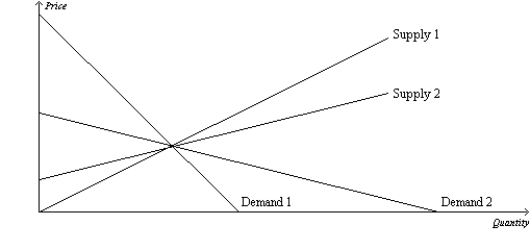 -Refer to Figure 8-14. Which of the following statements is correct?
 (Multiple Choice)
4.8/5 (85)
(85) When a tax is imposed on a good, consumer surplus decreases and producer surplus remains unchanged.
(True/False)
4.9/5 (67)
(67) Figure 8-25 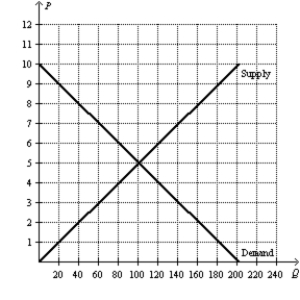 -Refer to Figure 8-25. How much is consumer surplus at the market equilibrium?
 (Essay)
4.9/5 (71)
(71) Figure 8-14
-Refer to Figure 8-14. Which of the following combinations will maximize the deadweight loss from a tax?
-Refer to Figure 8-14. Which of the following combinations will maximize the deadweight loss from a tax? (Multiple Choice)
4.8/5 (80)
(80) The benefit to buyers of participating in a market is measured by
(Multiple Choice)
4.8/5 (69)
(69) Suppose a tax of $5 per unit is imposed on a good, and the tax causes the equilibrium quantity of the good to decrease from 200 units to 100 units. The tax decreases consumer surplus by $450 and decreases producer surplus by $300. The deadweight loss from the tax is
(Multiple Choice)
4.9/5 (79)
(79) Suppose the government increases the size of a tax by 20 percent. The deadweight loss from that tax
(Multiple Choice)
4.9/5 (84)
(84) The more elastic are supply and demand in a market, the greater are the distortions caused by a tax on that market, and the more likely it is that a tax cut in that market will raise tax revenue.
(True/False)
4.8/5 (77)
(77) Suppose that instead of a supply-demand diagram, you are given the following information:
Qs = 100 + 3P
Qd = 400 - 2P
From this information compute equilibrium price and quantity. Now suppose that a tax is placed on buyers so that
Qd = 400 - 2(P + T).
If T = 15, solve for the new equilibrium price and quantity. (Note: P is the price received by sellers and P + T is the price paid by buyers.) Compare these answers for equilibrium price and quantity with your first answers. What does this show you?
(Essay)
5.0/5 (85)
(85) Tom walks Bethany's dog once a day for $50 per week. Bethany values this service at $60 per week, while the opportunity cost of Tom's time is $30 per week. The government places a tax of $35 per week on dog walkers. After the tax, what is the total surplus?
(Multiple Choice)
4.8/5 (90)
(90) Figure 8-29 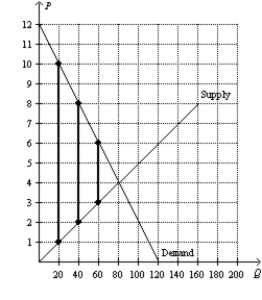 -Refer to Figure 8-29. As the size of the tax increases from $3 to $6 to $9, what happens to the deadweight loss from the tax?
 (Essay)
4.8/5 (83)
(83) When the government imposes taxes on buyers or sellers of a good, society
(Multiple Choice)
4.9/5 (84)
(84) Figure 8-8
Suppose the government imposes a $10 per unit tax on a good. 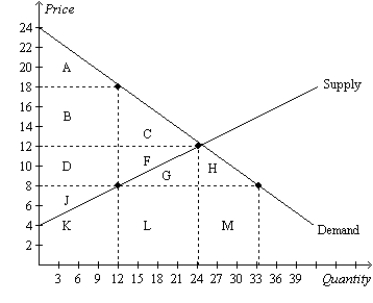 -Refer to Figure 8-8. The tax causes consumer surplus to decrease by the area
 (Multiple Choice)
4.9/5 (86)
(86) Figure 8-3
The vertical distance between points A and C represents a tax in the market. 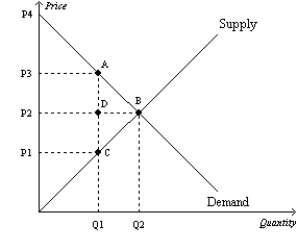 -Refer to Figure 8-3. The per-unit burden of the tax on sellers is
 (Multiple Choice)
4.8/5 (79)
(79) 
Filters
- Essay(0)
- Multiple Choice(0)
- Short Answer(0)
- True False(0)
- Matching(0)