



 Chat with AI
Exam 8: Applications: the Costs of Taxation

Exam 1: Ten Principles of Economics455 Questions
Exam 2: Thinking Like an Economist643 Questions
Exam 3: Interdependence and the Gains From Trade547 Questions
Exam 4: The Market Forces of Supply and Demand693 Questions
Exam 5: Elasticity and Its Application626 Questions
Exam 6: Supply, Demand, and Government Policies668 Questions
Exam 7: Consumers, Producers, and the Efficiency of Markets547 Questions
Exam 8: Applications: the Costs of Taxation509 Questions
Exam 9: Application: International Trade521 Questions
Exam 10: Externalities543 Questions
Exam 11: Public Goods and Common Resources452 Questions
Exam 12: The Design of the Tax System664 Questions
Exam 13: The Costs of Production649 Questions
Exam 14: Firms in Competitive Markets604 Questions
Exam 15: Monopoly662 Questions
Exam 16: Monopolistic Competition649 Questions
Exam 17: Oligopoly522 Questions
Exam 18: The Markets for the Factors of Production592 Questions
Exam 19: Earnings and Discrimination511 Questions
Exam 20: Income Inequality and Poverty478 Questions
Exam 21: The Theory of Consumer Choice570 Questions
Exam 22: Frontiers in Microeconomics461 Questions
Exam 23: Measuring a Nation S Income547 Questions
Exam 24: Measuring the Cost of Living565 Questions
Exam 25: Production and Growth527 Questions
Exam 26: Saving, Investment, and the Financial System637 Questions
Exam 27: Tools of Finance534 Questions
Exam 28: Unemployment and Its Natural Rate701 Questions
Exam 29: The Monetary System540 Questions
Exam 30: Money Growth and Inflation504 Questions
Exam 31: Open-Economy Macroeconomics: Basic Concepts540 Questions
Exam 32: A Macroeconomic Theory of the Open Economy511 Questions
Exam 33: Aggregate Demand and Aggregate Supply572 Questions
Exam 34: The Influence of Monetary and Fiscal Policy on Aggregate Demand523 Questions
Exam 35: The Short-Run Tradeoff Between Inflation and Unemployment536 Questions
Exam 36: Six Debates Over Macroeconomic Policy354 Questions
Select questions type


Figure 8-4
The vertical distance between points A and B represents a tax in the market. 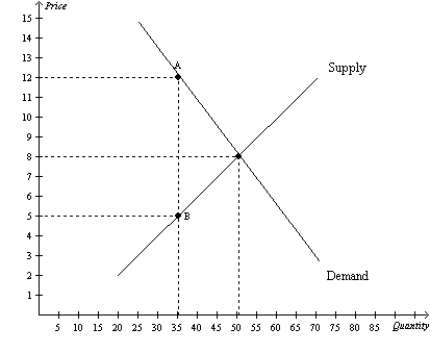 -Refer to Figure 8-4. The per-unit burden of the tax on buyers is
 (Multiple Choice)
4.9/5  (78)
(78) Figure 8-12 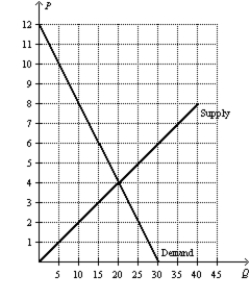 -Refer to Figure 8-12. Suppose a $3 per-unit tax is placed on this good. The amount of deadweight loss resulting from this tax is
 (Multiple Choice)
4.9/5 (78)
(78) Figure 8-6
The vertical distance between points A and B represents a tax in the market. 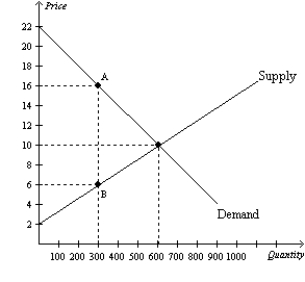 -Refer to Figure 8-6. When the government imposes the tax in this market, tax revenue is
 (Multiple Choice)
4.8/5 (78)
(78) Which of the following would likely have the smallest deadweight loss relative to the tax revenue?
(Multiple Choice)
4.9/5 (76)
(76) Figure 8-26 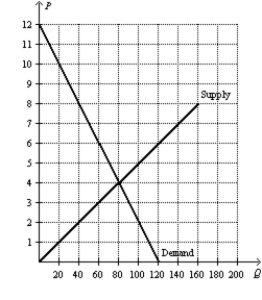 -Refer to Figure 8-26. Suppose the government places a $3 tax per unit on this good. What price will consumers pay for the good after the tax is imposed?
 (Essay)
4.8/5 (80)
(80) Figure 8-2
The vertical distance between points A and B represents a tax in the market.  -Refer to Figure 8-2. The loss of producer surplus as a result of the tax is
 (Multiple Choice)
4.7/5 (74)
(74) The benefit to buyers of participating in a market is measured by
(Multiple Choice)
4.7/5 (67)
(67) Suppose Rebecca needs a dog sitter so that she can travel to her sister's wedding. Rebecca values dog sitting for the weekend at $200. Susan is willing to dog sit for Rebecca so long as she receives at least $150. Rebecca and Susan agree on a price of $175. Suppose the government imposes a tax of $10 on dog sitting. The tax has made Rebecca and Susan worse off by a total of
(Multiple Choice)
4.9/5 (88)
(88) It does not matter whether a tax is levied on the buyers or the sellers of a good because
(Multiple Choice)
4.8/5 (81)
(81) Figure 8-10 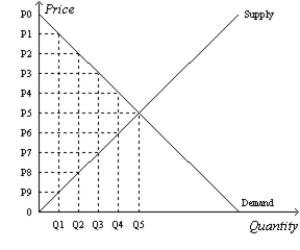 -Refer to Figure 8-10. Suppose the government imposes a tax that reduces the quantity sold in the market after the tax to Q2. The tax revenue is
 (Multiple Choice)
4.9/5 (74)
(74) Figure 8-8
Suppose the government imposes a $10 per unit tax on a good. 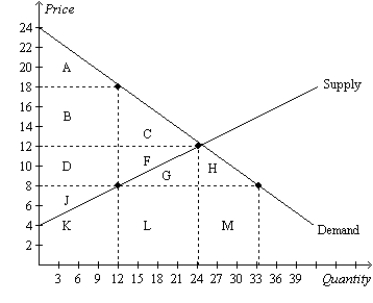 -Refer to Figure 8-8. The government collects tax revenue that is the area
 (Multiple Choice)
4.9/5 (69)
(69) If the tax on a good is doubled, the deadweight loss of the tax
(Multiple Choice)
4.8/5 (67)
(67) Figure 8-2
The vertical distance between points A and B represents a tax in the market.
-Refer to Figure 8-2. The imposition of the tax causes the quantity sold to
-Refer to Figure 8-2. The imposition of the tax causes the quantity sold to (Multiple Choice)
4.9/5 (77)
(77) Buyers of a product will bear the larger part of the tax burden, and sellers will bear a smaller part of the tax burden, when the
(Multiple Choice)
4.8/5 (84)
(84) Figure 8-12
-Refer to Figure 8-12. Suppose a $3 per-unit tax is placed on this good. The amount of tax revenue collected by the government is
-Refer to Figure 8-12. Suppose a $3 per-unit tax is placed on this good. The amount of tax revenue collected by the government is (Multiple Choice)
4.8/5 (84)
(84) As the tax on a good increases from $1 per unit to $2 per unit to $3 per unit and so on, the
(Multiple Choice)
4.9/5 (84)
(84) Figure 8-9
The vertical distance between points A and C represents a tax in the market. 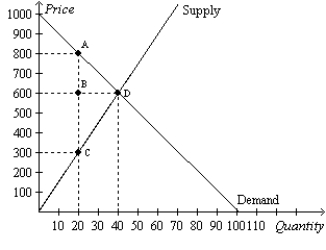 -Refer to Figure 8-9. The imposition of the tax causes the price received by sellers to decrease by
 (Multiple Choice)
4.9/5 (85)
(85) Suppose a tax of $4 per unit is imposed on a good, and the tax causes the equilibrium quantity of the good to decrease from 2,000 units to 1,700 units. The tax decreases consumer surplus by $3,000 and decreases producer surplus by $4,400. The deadweight loss of the tax is
(Multiple Choice)
4.9/5 (75)
(75) Figure 8-1  -Refer to Figure 8-1. Suppose the government imposes a tax of P' - P'''. The consumer surplus after the tax is measured by the area
 (Multiple Choice)
4.7/5 (74)
(74) 
Filters
- Essay(0)
- Multiple Choice(0)
- Short Answer(0)
- True False(0)
- Matching(0)