



 Chat with AI
Exam 8: Applications: the Costs of Taxation

Exam 1: Ten Principles of Economics455 Questions
Exam 2: Thinking Like an Economist643 Questions
Exam 3: Interdependence and the Gains From Trade547 Questions
Exam 4: The Market Forces of Supply and Demand693 Questions
Exam 5: Elasticity and Its Application626 Questions
Exam 6: Supply, Demand, and Government Policies668 Questions
Exam 7: Consumers, Producers, and the Efficiency of Markets547 Questions
Exam 8: Applications: the Costs of Taxation509 Questions
Exam 9: Application: International Trade521 Questions
Exam 10: Externalities543 Questions
Exam 11: Public Goods and Common Resources452 Questions
Exam 12: The Design of the Tax System664 Questions
Exam 13: The Costs of Production649 Questions
Exam 14: Firms in Competitive Markets604 Questions
Exam 15: Monopoly662 Questions
Exam 16: Monopolistic Competition649 Questions
Exam 17: Oligopoly522 Questions
Exam 18: The Markets for the Factors of Production592 Questions
Exam 19: Earnings and Discrimination511 Questions
Exam 20: Income Inequality and Poverty478 Questions
Exam 21: The Theory of Consumer Choice570 Questions
Exam 22: Frontiers in Microeconomics461 Questions
Exam 23: Measuring a Nation S Income547 Questions
Exam 24: Measuring the Cost of Living565 Questions
Exam 25: Production and Growth527 Questions
Exam 26: Saving, Investment, and the Financial System637 Questions
Exam 27: Tools of Finance534 Questions
Exam 28: Unemployment and Its Natural Rate701 Questions
Exam 29: The Monetary System540 Questions
Exam 30: Money Growth and Inflation504 Questions
Exam 31: Open-Economy Macroeconomics: Basic Concepts540 Questions
Exam 32: A Macroeconomic Theory of the Open Economy511 Questions
Exam 33: Aggregate Demand and Aggregate Supply572 Questions
Exam 34: The Influence of Monetary and Fiscal Policy on Aggregate Demand523 Questions
Exam 35: The Short-Run Tradeoff Between Inflation and Unemployment536 Questions
Exam 36: Six Debates Over Macroeconomic Policy354 Questions
Select questions type


Figure 8-26 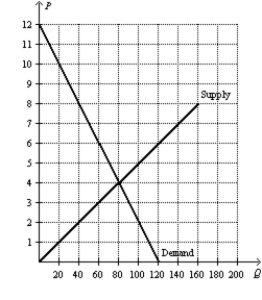 -Refer to Figure 8-26. Suppose the government increases the size of the tax on this good from $3 per unit to $6 per unit. Will the tax revenue collected from the tax increase, decrease, or stay the same?
 (Essay)
4.7/5  (77)
(77) The graph that represents the amount of deadweight loss (measured on the vertical axis) as a function of the size of the tax (measured on the horizontal axis) looks like
(Multiple Choice)
4.9/5 (83)
(83) Figure 8-15 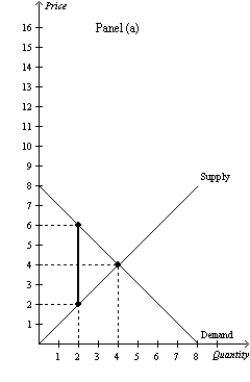
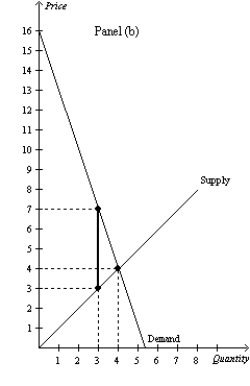 -Refer to Figure 8-15. Panel (a) and Panel (b) each illustrate a $4 tax placed on a market. In comparison to Panel (b), Panel (a) illustrates which of the following statements?
 (Multiple Choice)
4.9/5 (84)
(84) John has been in the habit of mowing Willa's lawn each week for $20. John's opportunity cost is $15, and Willa would be willing to pay $25 to have her lawn mowed. What is the maximum tax the government can impose on lawn mowing without discouraging John and Willa from continuing their mutually beneficial arrangement?
(Essay)
5.0/5 (81)
(81) Figure 8-10 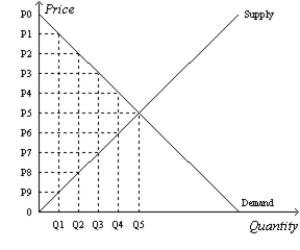 -Refer to Figure 8-10. Suppose the government imposes a tax that reduces the quantity sold in the market after the tax to Q2. Without the tax, the total surplus is
 (Multiple Choice)
4.9/5 (73)
(73) Because taxes distort incentives, they cause markets to allocate resources inefficiently.
(True/False)
4.9/5 (72)
(72) The higher a country's tax rates, the more likely that country will be
(Multiple Choice)
4.9/5 (75)
(75) Figure 8-1  -Refer to Figure 8-1. Suppose the government imposes a tax of P' - P'''. The area measured by M represents
 (Multiple Choice)
4.9/5 (82)
(82) When a tax is imposed on sellers, consumer surplus and producer surplus both decrease.
(True/False)
4.8/5 (102)
(102) Figure 8-2
The vertical distance between points A and B represents a tax in the market.  -Refer to Figure 8-2. The loss of consumer surplus for those buyers of the good who continue to buy it after the tax is imposed is
 (Multiple Choice)
4.9/5 (86)
(86) Figure 8-29 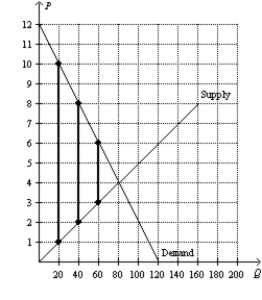 -Refer to Figure 8-29. As the size of the tax increases from $3 to $6 to $9, what happens to tax revenues?
 (Essay)
4.9/5 (75)
(75) In the market for widgets, the supply curve is the typical upward-sloping straight line, and the demand curve is the typical downward-sloping straight line. The equilibrium quantity in the market for widgets is 200 per month when there is no tax. Then a tax of $5 per widget is imposed. The price paid by buyers increases by $2 and the after-tax price received by sellers falls by $3. The government is able to raise $750 per month in revenue from the tax. The deadweight loss from the tax is
(Multiple Choice)
4.8/5 (85)
(85) Figure 8-1
-Refer to Figure 8-1. Suppose the government imposes a tax of P' - P'''. The area measured by J+K+I represents
-Refer to Figure 8-1. Suppose the government imposes a tax of P' - P'''. The area measured by J+K+I represents (Multiple Choice)
4.9/5 (82)
(82) When a tax is imposed on a good for which the demand is relatively elastic and the supply is relatively inelastic,
(Multiple Choice)
4.9/5 (79)
(79) Economists generally agree that the most important tax in the U.S. economy is the
(Multiple Choice)
4.8/5 (84)
(84) Assume that for good X the supply curve for a good is a typical, upward-sloping straight line, and the demand curve is a typical downward-sloping straight line. If the good is taxed, and the tax is doubled, the
(Multiple Choice)
4.8/5 (71)
(71) Normally, both buyers and sellers of a good become worse off when the good is taxed.
(True/False)
4.9/5 (66)
(66) 
Filters
- Essay(0)
- Multiple Choice(0)
- Short Answer(0)
- True False(0)
- Matching(0)