



 Chat with AI
Exam 8: Applications: the Costs of Taxation

Exam 1: Ten Principles of Economics455 Questions
Exam 2: Thinking Like an Economist643 Questions
Exam 3: Interdependence and the Gains From Trade547 Questions
Exam 4: The Market Forces of Supply and Demand693 Questions
Exam 5: Elasticity and Its Application626 Questions
Exam 6: Supply, Demand, and Government Policies668 Questions
Exam 7: Consumers, Producers, and the Efficiency of Markets547 Questions
Exam 8: Applications: the Costs of Taxation509 Questions
Exam 9: Application: International Trade521 Questions
Exam 10: Externalities543 Questions
Exam 11: Public Goods and Common Resources452 Questions
Exam 12: The Design of the Tax System664 Questions
Exam 13: The Costs of Production649 Questions
Exam 14: Firms in Competitive Markets604 Questions
Exam 15: Monopoly662 Questions
Exam 16: Monopolistic Competition649 Questions
Exam 17: Oligopoly522 Questions
Exam 18: The Markets for the Factors of Production592 Questions
Exam 19: Earnings and Discrimination511 Questions
Exam 20: Income Inequality and Poverty478 Questions
Exam 21: The Theory of Consumer Choice570 Questions
Exam 22: Frontiers in Microeconomics461 Questions
Exam 23: Measuring a Nation S Income547 Questions
Exam 24: Measuring the Cost of Living565 Questions
Exam 25: Production and Growth527 Questions
Exam 26: Saving, Investment, and the Financial System637 Questions
Exam 27: Tools of Finance534 Questions
Exam 28: Unemployment and Its Natural Rate701 Questions
Exam 29: The Monetary System540 Questions
Exam 30: Money Growth and Inflation504 Questions
Exam 31: Open-Economy Macroeconomics: Basic Concepts540 Questions
Exam 32: A Macroeconomic Theory of the Open Economy511 Questions
Exam 33: Aggregate Demand and Aggregate Supply572 Questions
Exam 34: The Influence of Monetary and Fiscal Policy on Aggregate Demand523 Questions
Exam 35: The Short-Run Tradeoff Between Inflation and Unemployment536 Questions
Exam 36: Six Debates Over Macroeconomic Policy354 Questions
Select questions type


Figure 8-6
The vertical distance between points A and B represents a tax in the market. 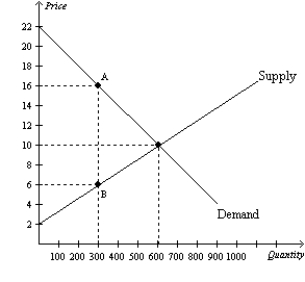 -Refer to Figure 8-6. What happens to producer surplus when the tax is imposed in this market?
 (Multiple Choice)
4.9/5  (64)
(64) Scenario 8-1
Erin would be willing to pay as much as $100 per week to have her house cleaned. Ernesto's opportunity cost of cleaning Erin's house is $70 per week.
-Refer to Scenario 8-1. If Ernesto cleans Erin's house for $90, Ernesto's producer surplus is
(Multiple Choice)
4.8/5 (96)
(96) Figure 8-22  -Refer to Figure 8-22. Suppose the government initially imposes a $3 per-unit tax on this good. Now suppose the government is deciding whether to lower the tax to $1.50 or raise it to $4.50. Which of the following statements is not correct?
 (Multiple Choice)
4.8/5 (77)
(77) If a tax did not induce buyers or sellers to change their behavior, it would not cause a deadweight loss.
(True/False)
4.9/5 (76)
(76) Figure 8-5
Suppose that the government imposes a tax of P3 - P1.  -Refer to Figure 8-5. The tax is levied on
 (Multiple Choice)
4.9/5 (84)
(84) Suppose a tax is imposed on bananas. In which of the following cases will the tax cause the equilibrium quantity of bananas to shrink by the largest amount?
(Multiple Choice)
4.8/5 (67)
(67) Figure 8-10 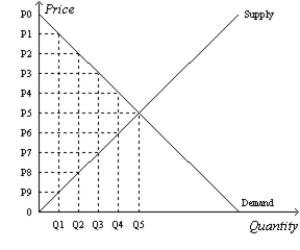 -Refer to Figure 8-10. Suppose the government imposes a tax that reduces the quantity sold in the market after the tax to Q2. The size of the tax is
 (Multiple Choice)
4.8/5 (74)
(74) Figure 8-23. The figure represents the relationship between the size of a tax and the tax revenue raised by that tax. 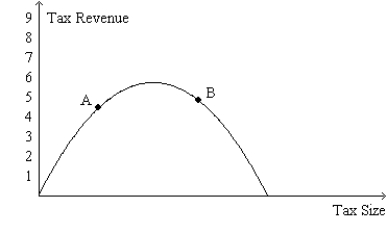 -Refer to Figure 8-23. If the economy is at point A on the curve, then a decrease in the tax rate will
 (Multiple Choice)
4.7/5 (84)
(84) When a tax is imposed on sellers, producer surplus decreases but consumer surplus increases.
(True/False)
4.9/5 (82)
(82) Suppose the federal government doubles the gasoline tax. The deadweight loss associated with the tax
(Multiple Choice)
4.8/5 (86)
(86) Figure 8-25 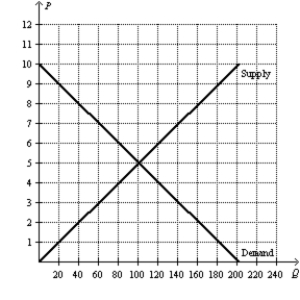 -Refer to Figure 8-25. Suppose the government places a $4 tax per unit on this good. How many units of this good will be bought and sold after the tax is imposed?
 (Essay)
4.8/5 (82)
(82) Figure 8-19
The vertical distance between points A and B represents the original tax. 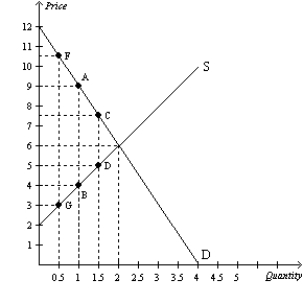 -Refer to Figure 8-19. If the government changed the per-unit tax from $5.00 to $7.50, then the price paid by buyers would be $10.50, the price received by sellers would be $3, and the quantity sold in the market would be 0.5 units. Compared to the original tax rate, this higher tax rate would
 (Multiple Choice)
4.8/5 (70)
(70) Figure 8-10
-Refer to Figure 8-10. Suppose the government imposes a tax that reduces the quantity sold in the market after the tax to Q2. The price that buyers pay is
-Refer to Figure 8-10. Suppose the government imposes a tax that reduces the quantity sold in the market after the tax to Q2. The price that buyers pay is (Multiple Choice)
4.9/5 (83)
(83) Figure 8-2
The vertical distance between points A and B represents a tax in the market.  -Refer to Figure 8-2. The per-unit burden of the tax on buyers is
 (Multiple Choice)
4.7/5 (81)
(81) Figure 8-6
The vertical distance between points A and B represents a tax in the market.
-Refer to Figure 8-6. When the tax is imposed in this market, the price buyers effectively pay is
-Refer to Figure 8-6. When the tax is imposed in this market, the price buyers effectively pay is (Multiple Choice)
4.9/5 (81)
(81) Scenario 8-2
Roland mows Karla's lawn for $25. Roland's opportunity cost of mowing Karla's lawn is $20, and Karla's willingness to pay Roland to mow her lawn is $28.
-Refer to Scenario 8-2. Assume Roland is required to pay a tax of $3 each time he mows a lawn. Which of the following results is most likely?
(Multiple Choice)
4.8/5 (71)
(71) Figure 8-4
The vertical distance between points A and B represents a tax in the market. 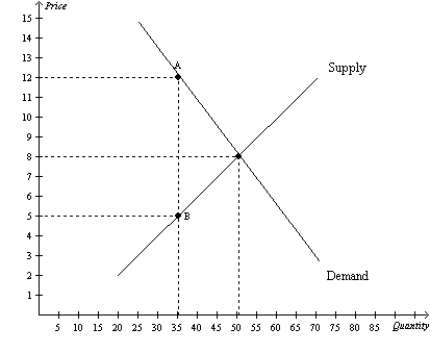 -Refer to Figure 8-4. The equilibrium price before the tax is imposed is
 (Multiple Choice)
4.8/5 (73)
(73) 
Filters
- Essay(0)
- Multiple Choice(0)
- Short Answer(0)
- True False(0)
- Matching(0)