



 Chat with AI
Exam 13: The Costs of Production

Exam 1: Ten Principles of Economics455 Questions
Exam 2: Thinking Like an Economist645 Questions
Exam 3: Interdependence and the Gains From Trade550 Questions
Exam 4: The Market Forces of Supply and Demand693 Questions
Exam 5: Elasticity and Its Application625 Questions
Exam 6: Supply, Demand, and Government Policies671 Questions
Exam 7: Consumers, Producers, and the Efficiency of Markets547 Questions
Exam 8: Application: The Costs of Taxation507 Questions
Exam 9: Application: International Trade521 Questions
Exam 10: Externalities543 Questions
Exam 11: Public Goods and Common Resources453 Questions
Exam 12: The Design of the Tax System563 Questions
Exam 13: The Costs of Production649 Questions
Exam 14: Firms in Competitive Markets608 Questions
Exam 15: Monopoly662 Questions
Exam 16: Monopolistic Competition649 Questions
Exam 17: Oligopoly522 Questions
Exam 18: The Markets for the Factors of Production592 Questions
Exam 19: Earnings and Discrimination511 Questions
Exam 20: Income Inequality and Poverty478 Questions
Exam 21: The Theory of Consumer Choice568 Questions
Exam 22: Frontiers in Microeconomics461 Questions
Select questions type


Table 13-14 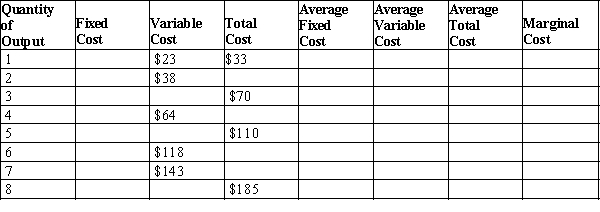 -Refer to Table 13-14. What is the average fixed cost of producing 8 units of output?
 (Multiple Choice)
4.9/5  (68)
(68) Cindy's Car Wash has average variable costs of $2 and average total costs of $3 when it produces 100 units of output (car washes). The firm's total variable cost is
(Multiple Choice)
4.9/5 (68)
(68) Figure 13-9
The figure below depicts average total cost functions for a firm that produces automobiles. 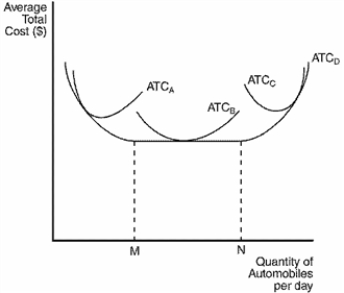 -Refer to Figure 13-9. At levels of output between M and N, the firm experiences
 (Multiple Choice)
4.8/5 (79)
(79) Johnny is a sophomore in college and has a 1.5 cumulative grade point average (GPA). Johnny's cumulative GPA will fall even further next semester if he performs worse than (i)
His cumulative GPa.(ii)
He ever performed before.(iii)
He did last semester.
(Multiple Choice)
4.8/5 (71)
(71) Variable cost divided by the change in quantity produced is
(Multiple Choice)
4.9/5 (76)
(76) As Bubba's Bubble Gum Company adds workers while using the same amount of machinery, some workers may be underutilized because they have little work to do while waiting in line to use the machinery. When this occurs, Bubba's Bubble Gum Company encounters
(Multiple Choice)
4.9/5 (71)
(71) Table 13-11 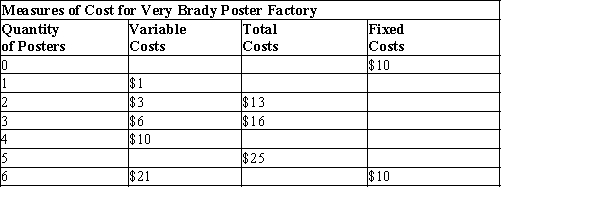 -Refer to Table 13-11. What is the variable cost of producing 0 posters?
 (Multiple Choice)
4.8/5 (76)
(76) Table 13-7
The Flying Elvis Copter Rides 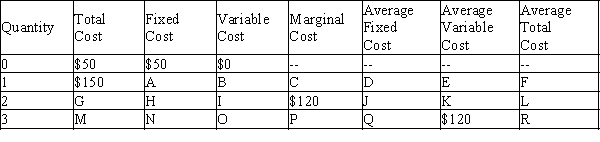 -Refer to Table 13-7. What is the value of I?
 (Multiple Choice)
4.8/5 (88)
(88) Which of the following can be added to profit to obtain total revenue?
(Multiple Choice)
4.9/5 (79)
(79) Scenario 13-11
Walter builds birdhouses. He spends $5 on the materials for each birdhouse. He can build one in 30 minutes. He is semi-retired but earns $8 per hour at the local hardware store. He can sell a birdhouse for $20 each.
-Refer to Scenario 13-11. An economist would calculate the total cost for one birdhouse to be
(Multiple Choice)
4.8/5 (79)
(79) Table 13-11
-Refer to Table 13-11. The marginal cost of producing the 6th poster is
-Refer to Table 13-11. The marginal cost of producing the 6th poster is (Multiple Choice)
4.9/5 (82)
(82) An example of an explicit cost would be the wages that a business owner pays her employees.
(True/False)
4.8/5 (73)
(73) Table 13-2 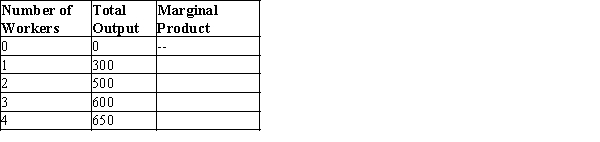 -Refer to Table 13-2. What is the marginal product of the second worker?
 (Multiple Choice)
4.8/5 (91)
(91) Figure 13-3 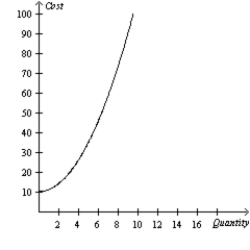 -Refer to Figure 13-3. Assuming that the firm depicted produces cookies, which of the statements below is most consistent with the shape of the total cost curve?
 (Multiple Choice)
4.8/5 (66)
(66) Figure 1
b.
Figure 2
c.
Figure 3
d.
Figure 4
ANSWER:
b
DIFFICULTY:
Moderate
LEARNING OBJECTIVES:
ECON.MANK.174 - Given a graph of the production function and input costs, derive the firm's total-cost curve.
TOPICS:
Producer theory
Production costs
KEYWORDS:
BLOOM'S: Comprehension
CUSTOM ID:
176.13.3 - MC - MANK08
-Refer to Figure 13-7. Which of the figures represents the marginal cost curve for a typical firm?
(Multiple Choice)
4.9/5 (70)
(70) Scenario 13-14
If Farmer Brown plants no seeds on his farm, he gets no harvest. If he plants 1 bag of seeds, he gets 5 bushels of wheat. If he plants 2 bags, he gets 9 bushels. If he plants 3 bags, he gets 12 bushels. A bag of seeds costs $120, and seeds are his only cost.
-Refer to Scenario 13-14. Farmer Brown's production function exhibits
(Multiple Choice)
4.9/5 (90)
(90) How long does it take a firm to go from the short run to the long run?
(Multiple Choice)
4.9/5 (63)
(63) 
Filters
- Essay(0)
- Multiple Choice(0)
- Short Answer(0)
- True False(0)
- Matching(0)