



 Chat with AI
Exam 13: The Costs of Production

Exam 1: Ten Principles of Economics455 Questions
Exam 2: Thinking Like an Economist645 Questions
Exam 3: Interdependence and the Gains From Trade550 Questions
Exam 4: The Market Forces of Supply and Demand693 Questions
Exam 5: Elasticity and Its Application625 Questions
Exam 6: Supply, Demand, and Government Policies671 Questions
Exam 7: Consumers, Producers, and the Efficiency of Markets547 Questions
Exam 8: Application: The Costs of Taxation507 Questions
Exam 9: Application: International Trade521 Questions
Exam 10: Externalities543 Questions
Exam 11: Public Goods and Common Resources453 Questions
Exam 12: The Design of the Tax System563 Questions
Exam 13: The Costs of Production649 Questions
Exam 14: Firms in Competitive Markets608 Questions
Exam 15: Monopoly662 Questions
Exam 16: Monopolistic Competition649 Questions
Exam 17: Oligopoly522 Questions
Exam 18: The Markets for the Factors of Production592 Questions
Exam 19: Earnings and Discrimination511 Questions
Exam 20: Income Inequality and Poverty478 Questions
Exam 21: The Theory of Consumer Choice568 Questions
Exam 22: Frontiers in Microeconomics461 Questions
Select questions type


Figure 1
b.
Figure 2
c.
Figure 3
d.
Figure 4
ANSWER:
d
DIFFICULTY:
Moderate
LEARNING OBJECTIVES:
ECON.MANK.174 - Given a graph of the production function and input costs, derive the firm's total-cost curve.
TOPICS:
Producer theory
Production function
KEYWORDS:
BLOOM'S: Comprehension
CUSTOM ID:
178.13.3 - MC - MANK08
Figure 13-8 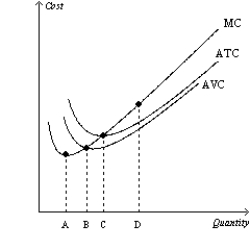 -Refer to Figure 13-8. Which of the following statements is correct?
 (Multiple Choice)
4.9/5  (84)
(84) Scenario 13-20
Suppose that a given firm experiences decreasing marginal product of labor with the addition of each worker regardless of the current output level.
-Refer to Scenario 13-20. Average variable cost will be
(Multiple Choice)
4.9/5 (70)
(70) Table 13-3 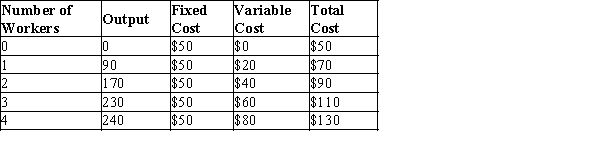 -Refer to Table 13-3. The marginal product of the third worker is
 (Multiple Choice)
4.8/5 (72)
(72) Scenario 13-8
Wanda owns a lemonade stand. She produces lemonade using five inputs: water, sugar, lemons, paper cups, and labor. Her costs per glass are as follows: $0.01 for water, $0.02 for sugar, $0.03 for lemons, $0.02 for cups, and $0.10 for the opportunity cost of her labor. She can sell 300 glasses for $0.50 each.
-Refer to Scenario 13-8. What are Wanda's total accounting profits?
(Multiple Choice)
4.9/5 (68)
(68) Table 13-14 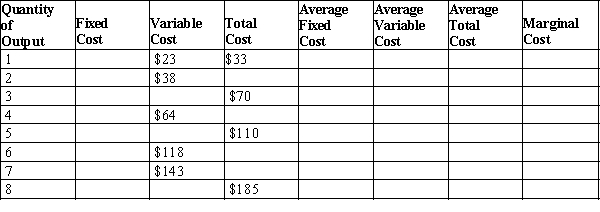 -Refer to Table 13-14. What is the average variable cost of producing 3 units of output?
 (Multiple Choice)
4.9/5 (75)
(75) How would a production function that exhibits decreasing marginal product affect the shape of the total cost curve? Explain or draw a graph.
(Essay)
4.8/5 (92)
(92) Table 13-14
-Refer to Table 13-14. What is the average total cost of producing 2 units of output?
-Refer to Table 13-14. What is the average total cost of producing 2 units of output? (Multiple Choice)
4.8/5 (81)
(81) Figure 13-5 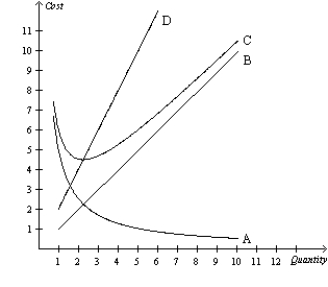 -Refer to Figure 13-5. Curve D represents which type of cost curve?
 (Multiple Choice)
4.8/5 (73)
(73) Economies of scale commonly arise because of coordination problems.
(True/False)
4.8/5 (83)
(83) When average cost is greater than marginal cost, marginal cost must be
(Multiple Choice)
4.9/5 (71)
(71) Riva crafts and sells hard cider as a part-time job. She can bottle and sell four cases in a week. She is considering hiring her friend Atul to help her. Atul can bottle and sell three cases per week. What is the maximum total output possible if Riva hires Atul?
(Multiple Choice)
4.8/5 (76)
(76) 
Filters
- Essay(0)
- Multiple Choice(0)
- Short Answer(0)
- True False(0)
- Matching(0)