



 Chat with AI
Exam 13: The Costs of Production

Exam 1: Ten Principles of Economics455 Questions
Exam 2: Thinking Like an Economist645 Questions
Exam 3: Interdependence and the Gains From Trade550 Questions
Exam 4: The Market Forces of Supply and Demand693 Questions
Exam 5: Elasticity and Its Application625 Questions
Exam 6: Supply, Demand, and Government Policies671 Questions
Exam 7: Consumers, Producers, and the Efficiency of Markets547 Questions
Exam 8: Application: The Costs of Taxation507 Questions
Exam 9: Application: International Trade521 Questions
Exam 10: Externalities543 Questions
Exam 11: Public Goods and Common Resources453 Questions
Exam 12: The Design of the Tax System563 Questions
Exam 13: The Costs of Production649 Questions
Exam 14: Firms in Competitive Markets608 Questions
Exam 15: Monopoly662 Questions
Exam 16: Monopolistic Competition649 Questions
Exam 17: Oligopoly522 Questions
Exam 18: The Markets for the Factors of Production592 Questions
Exam 19: Earnings and Discrimination511 Questions
Exam 20: Income Inequality and Poverty478 Questions
Exam 21: The Theory of Consumer Choice568 Questions
Exam 22: Frontiers in Microeconomics461 Questions
Select questions type


Scenario 13-2
Chelsea wants to start her own Christmas ornament business. She can purchase a suitable factory that costs $100,000. Chelsea currently has $150,000 in the bank earning 3 percent interest per year.
-Refer to Scenario 13-2. Suppose Chelsea purchases the factory using her own money. What is Chelsea's annual implicit opportunity cost of purchasing the factory?
(Multiple Choice)
4.8/5  (76)
(76) Scenario 13-11
Walter builds birdhouses. He spends $5 on the materials for each birdhouse. He can build one in 30 minutes. He is semi-retired but earns $8 per hour at the local hardware store. He can sell a birdhouse for $20 each.
-Refer to Scenario 13-11. An accountant would calculate the total profit for one birdhouse to be
(Multiple Choice)
5.0/5 (76)
(76) Johnny is a sophomore in college and has a 1.5 cumulative grade point average (GPA). Johnny's cumulative GPA will be better next semester if he (i)
Performs better than he did last semester.
(ii)
Performs better than his cumulative GPa.(iii)
Gives an average performance.
(Multiple Choice)
4.9/5 (83)
(83) Table 13-15 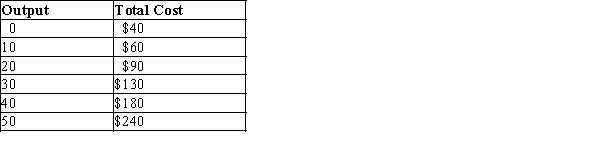 -Refer to Table 13-15. What is variable cost when output equals 30 units?
 (Multiple Choice)
4.7/5 (77)
(77) Table 13-9 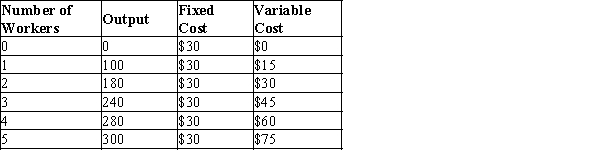 -Refer to Table 13-9. The average variable cost of producing 240 units is
 (Multiple Choice)
4.7/5 (85)
(85) Table 13-9
-Refer to Table 13-9. What is the marginal product of the third worker?
-Refer to Table 13-9. What is the marginal product of the third worker? (Multiple Choice)
4.9/5 (72)
(72) Scenario 13-16
Barney builds custom wooden birdhouses. He can make 150 birdhouses per month and sell them for $50 each. His average total cost is $30 per birdhouse.
-Refer to Scenario 13-16. Barney is considering hiring his best friend Fred to work for him. Fred can build 125 birdhouses per month. If Barney hires Fred, what will be the monthly marginal product?
(Multiple Choice)
5.0/5 (78)
(78) Anna borrows $5,000 from a bank and withdraws $1,000 from her personal savings to start a coffee shop. The interest rate is 5 percent for both the bank loan and her personal savings. Her opportunity cost of capital is $250.
(True/False)
4.9/5 (76)
(76) Table 13-7
The Flying Elvis Copter Rides 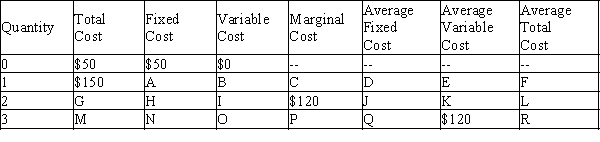 -Refer to Table 13-7. What is the value of G?
 (Multiple Choice)
4.8/5 (74)
(74) The fact that many inputs are fixed in the short run but variable in the long run has little impact on the firm's cost curves.
(True/False)
4.8/5 (78)
(78) There is general agreement among economists that the long-run time period exceeds one year.
(True/False)
4.8/5 (78)
(78) If the marginal cost of producing the tenth unit of output is $3, and if the average total cost of producing the tenth unit of output is $2, then at ten units of output, average total cost is rising.
(True/False)
4.8/5 (68)
(68) Jacqui decides to open her own business and earns $50,000 in accounting profit the first year. When deciding to open her own business, she withdrew $20,000 from her savings, which earned 5 percent interest. She also turned down three separate job offers with annual salaries of $30,000, $40,000, and $45,000. What is Jacqui's economic profit from running her own business?
(Multiple Choice)
4.9/5 (79)
(79) Table 13-10 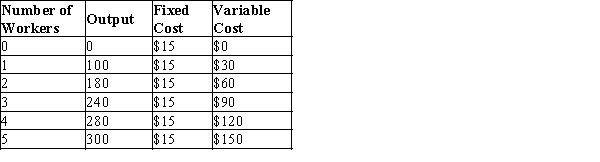 -Refer to Table 13-10. What is the marginal product of the fourth worker?
 (Multiple Choice)
4.7/5 (87)
(87) Figure 13-6 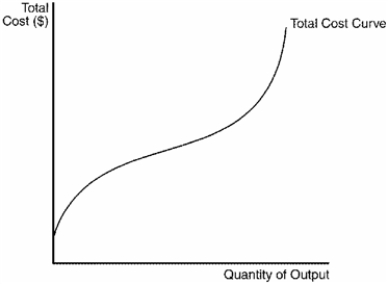 -Refer to Figure 13-6. Which of the following can be inferred from the figure above? (i)
Marginal cost is increasing at all levels of output.
(ii)
Marginal product is increasing at low levels of output.
(iii)
Marginal product is decreasing at high levels of output.
-Refer to Figure 13-6. Which of the following can be inferred from the figure above? (i)
Marginal cost is increasing at all levels of output.
(ii)
Marginal product is increasing at low levels of output.
(iii)
Marginal product is decreasing at high levels of output. (Multiple Choice)
4.7/5 (77)
(77) Tsintah weaves traditional Navaho rugs. She weaves and sells 50 rugs. Her average cost of production per rug is $50. She sells each rug for a price of $65. Tsintah's total revenues are
(Multiple Choice)
4.7/5 (83)
(83) Table 13-7 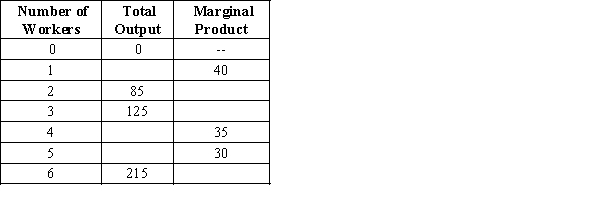 -Refer to Table 13-7. What is the marginal product of the sixth worker?
 (Multiple Choice)
4.8/5 (77)
(77) In the long run, a factory is usually considered a fixed input.
(True/False)
4.9/5 (74)
(74) Scenario 13-6
Ziva is an organic lettuce farmer, but she also spends part of her day as a professional organizing consultant. As a consultant, Ziva helps people organize their houses. Due to the popularity of her home-organization services, Farmer Ziva has more clients requesting her services than she has time to help if she maintains her farming business. Farmer Ziva charges $25 an hour for her home-organization services. One spring day, Ziva spends 10 hours in her fields planting $130 worth of seeds on her farm. She expects that the seeds she planted will yield $300 worth of lettuce.
-Refer to Scenario 13-6. What is the total opportunity cost of the day that Farmer Ziva spent in the field planting lettuce?
(Multiple Choice)
4.8/5 (87)
(87) 
Filters
- Essay(0)
- Multiple Choice(0)
- Short Answer(0)
- True False(0)
- Matching(0)