



 Chat with AI
Exam 13: The Costs of Production

Exam 1: Ten Principles of Economics455 Questions
Exam 2: Thinking Like an Economist645 Questions
Exam 3: Interdependence and the Gains From Trade550 Questions
Exam 4: The Market Forces of Supply and Demand693 Questions
Exam 5: Elasticity and Its Application625 Questions
Exam 6: Supply, Demand, and Government Policies671 Questions
Exam 7: Consumers, Producers, and the Efficiency of Markets547 Questions
Exam 8: Application: The Costs of Taxation507 Questions
Exam 9: Application: International Trade521 Questions
Exam 10: Externalities543 Questions
Exam 11: Public Goods and Common Resources453 Questions
Exam 12: The Design of the Tax System563 Questions
Exam 13: The Costs of Production649 Questions
Exam 14: Firms in Competitive Markets608 Questions
Exam 15: Monopoly662 Questions
Exam 16: Monopolistic Competition649 Questions
Exam 17: Oligopoly522 Questions
Exam 18: The Markets for the Factors of Production592 Questions
Exam 19: Earnings and Discrimination511 Questions
Exam 20: Income Inequality and Poverty478 Questions
Exam 21: The Theory of Consumer Choice568 Questions
Exam 22: Frontiers in Microeconomics461 Questions
Select questions type


Which of these assumptions is often realistic for a firm in the short run?
(Multiple Choice)
4.7/5  (80)
(80) Scenario 13-3
Kachina is a senior majoring in graphic design at Awesome University (AU). While she has been attending college, Kachina started a computer consulting business to help senior citizens learn how to use their iPads. Kachina charges $25 per hour for her consulting services. She also works 5 hours a week for the Economics Department to maintain that department's Web page. The Economics Department pays Kachina $20 per hour.
-Refer to Scenario 13-3. Which of the following statements is correct?
(Multiple Choice)
4.8/5 (85)
(85) Scenario 13-11
Walter builds birdhouses. He spends $5 on the materials for each birdhouse. He can build one in 30 minutes. He is semi-retired but earns $8 per hour at the local hardware store. He can sell a birdhouse for $20 each.
-Refer to Scenario 13-11. An economist would calculate the total profit for one birdhouse to be
(Multiple Choice)
4.9/5 (78)
(78) On a 100-acre farm, a farmer is able to produce 3,000 bushels of wheat when he hires 2 workers. He is able to produce 4,400 bushels of wheat when he hires 3 workers. Which of the following possibilities is consistent with the property of diminishing marginal product?
(Multiple Choice)
4.8/5 (91)
(91) Scenario 13-6
Ziva is an organic lettuce farmer, but she also spends part of her day as a professional organizing consultant. As a consultant, Ziva helps people organize their houses. Due to the popularity of her home-organization services, Farmer Ziva has more clients requesting her services than she has time to help if she maintains her farming business. Farmer Ziva charges $25 an hour for her home-organization services. One spring day, Ziva spends 10 hours in her fields planting $130 worth of seeds on her farm. She expects that the seeds she planted will yield $300 worth of lettuce.
-Refer to Scenario 13-6. Ziva's economic profit from farming equals
(Multiple Choice)
4.8/5 (60)
(60) Table 13-1 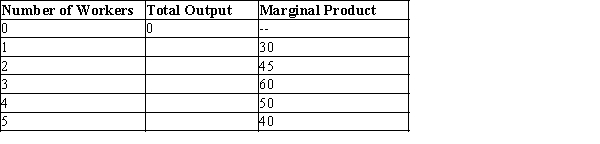 -Refer to Table 13-1. What is total output when 1 worker is hired?
 (Multiple Choice)
4.8/5 (75)
(75) Scenario 13-13
Christine is an artist who creates custom cookie jars. Her annual revenue from selling the cookie jars is $90,000. The annual explicit costs of the materials used to make the cookie jars are $54,000.
-Refer to Scenario 13-13. Christine used $5,000 from her personal savings account to buy pottery tools for her business. The savings account paid 1% annual interest. Christine could earn $6,000 per year as a tax preparer. What is the annual economic profit of her cookie jar business?
(Multiple Choice)
4.7/5 (72)
(72) Tony's Taco Truck has average variable costs of $1 and average fixed costs of $2 when it produces 50 units of output (tacos). The truck's total cost at 50 units of output is
(Multiple Choice)
4.7/5 (74)
(74) Table 13-5 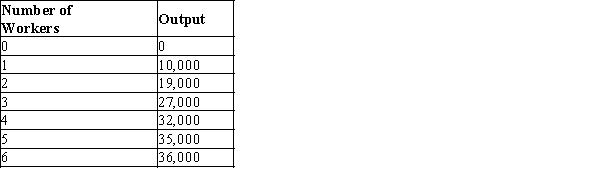 -Refer to Table 13-5. The marginal product of the third worker is
 (Multiple Choice)
4.9/5 (70)
(70) Eldin is a house painter. He can paint three houses per week. He is considering hiring his friend Murphy. Together, Eldin and Murphy can paint five houses per week. What is Murphy's marginal product?
(Multiple Choice)
4.7/5 (94)
(94) Economies of scale often arise because higher production levels allow specialization among workers.
(True/False)
4.9/5 (69)
(69) Whenever marginal cost is greater than average total cost,
(Multiple Choice)
4.9/5 (95)
(95) When calculating a firm's profit, an economist will subtract only
(Multiple Choice)
4.9/5 (75)
(75) Table 13-11 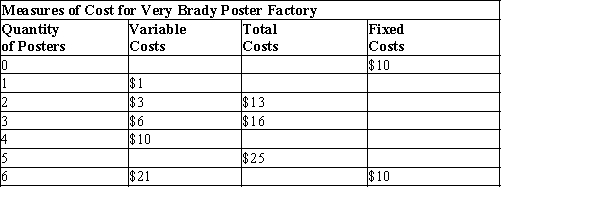 -Refer to Table 13-11. The average fixed cost of producing 5 posters is
 (Multiple Choice)
4.8/5 (74)
(74) Figure 13-9
The figure below depicts average total cost functions for a firm that produces automobiles. 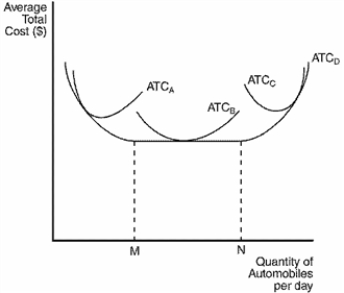 -Refer to Figure 13-9. At levels of output less than M, the firm experiences
 (Multiple Choice)
4.8/5 (71)
(71) Scenario 13-15
Joan grows pumpkins. If Joan plants no seeds on her farm, she gets no harvest. If she plants 1 bag of seeds, she gets 500 pumpkins. If she plants 2 bags, she gets 800 pumpkins. If she plants 3 bags, she gets 900 pumpkins. A bag of seeds costs $100, and seeds are her only cost.
-Refer to Scenario 13-15. Joan's total-cost curve is
(Multiple Choice)
4.8/5 (90)
(90) 
Filters
- Essay(0)
- Multiple Choice(0)
- Short Answer(0)
- True False(0)
- Matching(0)