



 Chat with AI
Exam 15: Europe in the Renaissance and Reformation, 1350-1600

Exam 1: The Earliest Human Societies, to 2500 Bce82 Questions
Exam 2: Complex Societies in Southwest Asia and the Nile Valley, 3800-500 Bce75 Questions
Exam 3: The Foundation of Indian Society, to 300 Ce81 Questions
Exam 4: Chinas Classical Age, to 221 Bce80 Questions
Exam 5: The Greek Experience, 3500-30 Bce75 Questions
Exam 6: The World of Rome, Ca 1000 Bce-400 Ce75 Questions
Exam 7: East Asia and the Spread of Buddhism, 221 Bce-845 Ce77 Questions
Exam 8: Continuity and Change in Europe and Western Asia, 250-85078 Questions
Exam 9: The Islamic World, 600-140065 Questions
Exam 10: African Societies and Kingdoms, 1000 Bce-1500 Ce77 Questions
Exam 11: The Americas, 3200 Bce-1500 Ce77 Questions
Exam 12: Cultural Exchange in Central and Southern Asia, 300-140076 Questions
Exam 13: States and Cultures in East Asia, 800-140079 Questions
Exam 14: Europe and Western Asia in the Middle Ages, 800-145079 Questions
Exam 15: Europe in the Renaissance and Reformation, 1350-160079 Questions
Exam 16: The Acceleration of Global Contact, 1450-160078 Questions
Exam 17: The Islamic World Powers, 1300-180077 Questions
Exam 18: European Power and Expansion, 1500-175078 Questions
Exam 19: New Worldviews and Ways of Life, 1540-179081 Questions
Exam 20: Africa and the World, 1400-180076 Questions
Exam 21: Continuity and Change in East Asia, 1400-180073 Questions
Exam 22: Revolutions in the Atlantic World, 1775-182581 Questions
Exam 23: The Revolution in Energy and Industry, 1760-185079 Questions
Exam 24: Ideologies of Change in Europe, 1815-191482 Questions
Exam 25: Africa, the Ottoman Empire, and the New Imperialism, 1800-191479 Questions
Exam 26: Asia and the Pacific in the Era of Imperialism, 1800-191479 Questions
Exam 27: The Americas in the Age of Liberalism, 1810-191776 Questions
Exam 28: World War and Revolution, 1914-192981 Questions
Exam 29: Nationalism in Asia, 1914-193976 Questions
Exam 30: The Great Depression and World War Ii, 1929-194580 Questions
Exam 31: Review82 Questions
Exam 32: Liberalization, 1968-2000s75 Questions
Exam 33: The Contemporary World in Historical Perspective73 Questions
Exam 34: 20th Century Global Issues and Developments20 Questions
Select questions type


Henry VIII of England and Isabella and Ferdinand of Spain used similar moves to diminish the power of which of the following groups?
(Multiple Choice)
4.9/5  (82)
(82) The status of women changed dramatically as a result of the Reformation. In what ways were women affected? How can we explain these changes?
(Essay)
4.8/5 (97)
(97) Early humanists sought to synthesize classical teachings with which of the following?
(Multiple Choice)
4.9/5 (84)
(84) What percentage of those tried and executed as witches were women?
(Multiple Choice)
4.9/5 (73)
(73) What were the guiding principles and basic tactics of the rulers of England, France, and Spain in their efforts to centralize their states? To what extent did these rulers rely on new policies and practices? Which of these monarchs was the most successful, and why?
(Essay)
4.8/5 (86)
(86) In 1545, the papacy created what body to help plan the Church's response to the Reformation?
(Multiple Choice)
4.7/5 (85)
(85) Which of the following was an important consequence of the Renaissance?
(Multiple Choice)
4.8/5 (80)
(80) In the Habsburg-Valois wars of the sixteenth century, why did the Catholic French kings support the Lutheran German princes?
(Multiple Choice)
5.0/5 (68)
(68) Describe the basic ideas of Calvinism. How are Calvin's reformation ideas different from those of Luther?
(Essay)
4.8/5 (86)
(86) Why did the wealthy sponsor artists during the Renaissance?
(Multiple Choice)
4.9/5 (64)
(64) Based upon Map 15.2, "Religious Divisions in Europe, ca. 1555," which city appears to have been at the heart of the Calvinist movement? 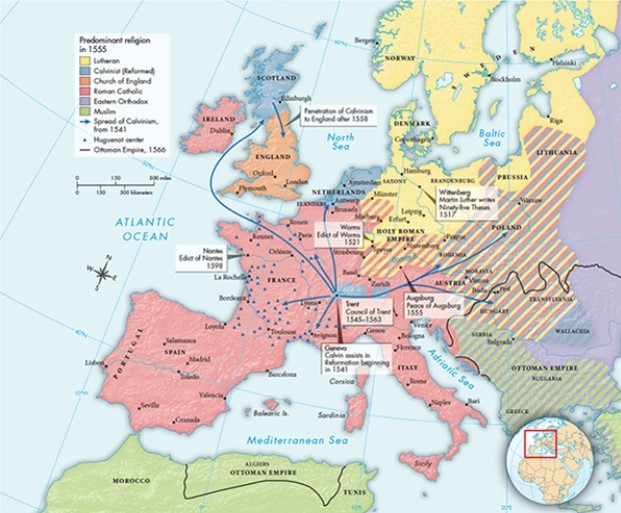
(Multiple Choice)
4.9/5 (85)
(85) Based on Map 15.2, "Religious Divisions in Europe, ca. 1555," which religious faith likely exercised the biggest influence on the Dutch colonists who migrated to the New World in the early seventeenth century? 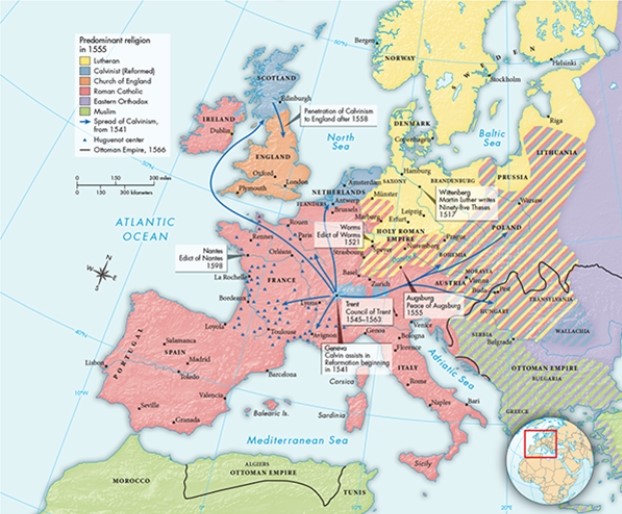
(Multiple Choice)
4.9/5 (66)
(66) Which of the following helped form Luther's understanding of Christianity as relying only on faith, grace, and Scripture?
(Multiple Choice)
4.7/5 (92)
(92) 
Filters
- Essay(0)
- Multiple Choice(0)
- Short Answer(0)
- True False(0)
- Matching(0)