



 Chat with AI
Exam 17: The Islamic World Powers, 1300-1800

Exam 1: The Earliest Human Societies, to 2500 Bce82 Questions
Exam 2: Complex Societies in Southwest Asia and the Nile Valley, 3800-500 Bce75 Questions
Exam 3: The Foundation of Indian Society, to 300 Ce81 Questions
Exam 4: Chinas Classical Age, to 221 Bce80 Questions
Exam 5: The Greek Experience, 3500-30 Bce75 Questions
Exam 6: The World of Rome, Ca 1000 Bce-400 Ce75 Questions
Exam 7: East Asia and the Spread of Buddhism, 221 Bce-845 Ce77 Questions
Exam 8: Continuity and Change in Europe and Western Asia, 250-85078 Questions
Exam 9: The Islamic World, 600-140065 Questions
Exam 10: African Societies and Kingdoms, 1000 Bce-1500 Ce77 Questions
Exam 11: The Americas, 3200 Bce-1500 Ce77 Questions
Exam 12: Cultural Exchange in Central and Southern Asia, 300-140076 Questions
Exam 13: States and Cultures in East Asia, 800-140079 Questions
Exam 14: Europe and Western Asia in the Middle Ages, 800-145079 Questions
Exam 15: Europe in the Renaissance and Reformation, 1350-160079 Questions
Exam 16: The Acceleration of Global Contact, 1450-160078 Questions
Exam 17: The Islamic World Powers, 1300-180077 Questions
Exam 18: European Power and Expansion, 1500-175078 Questions
Exam 19: New Worldviews and Ways of Life, 1540-179081 Questions
Exam 20: Africa and the World, 1400-180076 Questions
Exam 21: Continuity and Change in East Asia, 1400-180073 Questions
Exam 22: Revolutions in the Atlantic World, 1775-182581 Questions
Exam 23: The Revolution in Energy and Industry, 1760-185079 Questions
Exam 24: Ideologies of Change in Europe, 1815-191482 Questions
Exam 25: Africa, the Ottoman Empire, and the New Imperialism, 1800-191479 Questions
Exam 26: Asia and the Pacific in the Era of Imperialism, 1800-191479 Questions
Exam 27: The Americas in the Age of Liberalism, 1810-191776 Questions
Exam 28: World War and Revolution, 1914-192981 Questions
Exam 29: Nationalism in Asia, 1914-193976 Questions
Exam 30: The Great Depression and World War Ii, 1929-194580 Questions
Exam 31: Review82 Questions
Exam 32: Liberalization, 1968-2000s75 Questions
Exam 33: The Contemporary World in Historical Perspective73 Questions
Exam 34: 20th Century Global Issues and Developments20 Questions
Select questions type


Use the following to answer questions :
-ulama

Free
(Multiple Choice)
4.9/5  (83)
(83) Correct Answer: Verified
J
The Book of the Sea was a collection of what?
Free
(Multiple Choice)
4.7/5 (88)
(88) Correct Answer:Verified
VerifiedB
Explain the significance, both short and long term, of the code of laws created under Suleiman I.
(Essay)
4.8/5 (77)
(77) Which of the following was an important feature of the governing of the Mughal Empire under Akbar?
(Multiple Choice)
4.7/5 (80)
(80) After the death of Timur, his empire was held together by which of the following?
(Multiple Choice)
4.9/5 (67)
(67) After the reign of Suleiman, the Ottoman inheritance system changed so that the sons of the sultan were
(Multiple Choice)
4.8/5 (77)
(77) The interactions between the subjects of this illustration reflect which of the following? 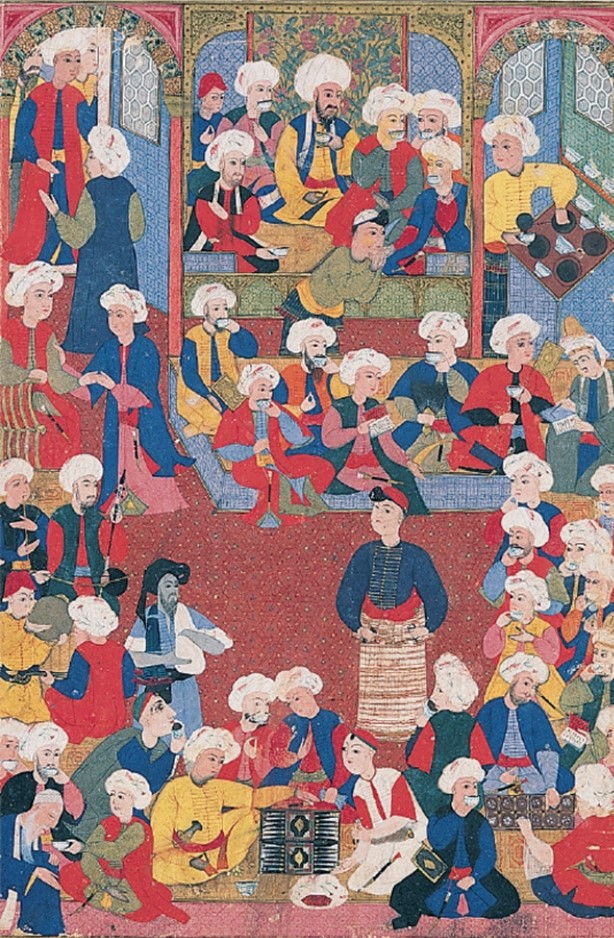
(Multiple Choice)
4.8/5 (76)
(76) Suleiman and Francis I of France formed an alliance to prevent the expansion in Europe of what ruling family?
(Multiple Choice)
4.9/5 (87)
(87) How was the British East India Company able to enter the Indian spice trade?
(Multiple Choice)
4.9/5 (75)
(75) How did Suleiman, Abbas, and Akbar use monumental buildings to establish and display the wealth and power of their empires?
(Essay)
4.9/5 (91)
(91) The text refers to Ottoman Turkey, Safavid Persia, and Mughal India as world powers. How accurate is this assertion?
(Essay)
4.9/5 (82)
(82) What did being an imperial slave in the Ottoman Empire mean for those individuals?
(Multiple Choice)
4.9/5 (68)
(68) What important group did Selim bring under Ottoman control?
(Multiple Choice)
4.7/5 (74)
(74) 
Filters
- Essay(0)
- Multiple Choice(0)
- Short Answer(0)
- True False(0)
- Matching(0)