



 Chat with AI
Exam 17: The Islamic World Powers, 1300-1800

Exam 1: The Earliest Human Societies, to 2500 Bce82 Questions
Exam 2: Complex Societies in Southwest Asia and the Nile Valley, 3800-500 Bce75 Questions
Exam 3: The Foundation of Indian Society, to 300 Ce81 Questions
Exam 4: Chinas Classical Age, to 221 Bce80 Questions
Exam 5: The Greek Experience, 3500-30 Bce75 Questions
Exam 6: The World of Rome, Ca 1000 Bce-400 Ce75 Questions
Exam 7: East Asia and the Spread of Buddhism, 221 Bce-845 Ce77 Questions
Exam 8: Continuity and Change in Europe and Western Asia, 250-85078 Questions
Exam 9: The Islamic World, 600-140065 Questions
Exam 10: African Societies and Kingdoms, 1000 Bce-1500 Ce77 Questions
Exam 11: The Americas, 3200 Bce-1500 Ce77 Questions
Exam 12: Cultural Exchange in Central and Southern Asia, 300-140076 Questions
Exam 13: States and Cultures in East Asia, 800-140079 Questions
Exam 14: Europe and Western Asia in the Middle Ages, 800-145079 Questions
Exam 15: Europe in the Renaissance and Reformation, 1350-160079 Questions
Exam 16: The Acceleration of Global Contact, 1450-160078 Questions
Exam 17: The Islamic World Powers, 1300-180077 Questions
Exam 18: European Power and Expansion, 1500-175078 Questions
Exam 19: New Worldviews and Ways of Life, 1540-179081 Questions
Exam 20: Africa and the World, 1400-180076 Questions
Exam 21: Continuity and Change in East Asia, 1400-180073 Questions
Exam 22: Revolutions in the Atlantic World, 1775-182581 Questions
Exam 23: The Revolution in Energy and Industry, 1760-185079 Questions
Exam 24: Ideologies of Change in Europe, 1815-191482 Questions
Exam 25: Africa, the Ottoman Empire, and the New Imperialism, 1800-191479 Questions
Exam 26: Asia and the Pacific in the Era of Imperialism, 1800-191479 Questions
Exam 27: The Americas in the Age of Liberalism, 1810-191776 Questions
Exam 28: World War and Revolution, 1914-192981 Questions
Exam 29: Nationalism in Asia, 1914-193976 Questions
Exam 30: The Great Depression and World War Ii, 1929-194580 Questions
Exam 31: Review82 Questions
Exam 32: Liberalization, 1968-2000s75 Questions
Exam 33: The Contemporary World in Historical Perspective73 Questions
Exam 34: 20th Century Global Issues and Developments20 Questions
Select questions type


Which of the following was a distinctive feature of the Ottoman sultans from about 1500 onward?
(Multiple Choice)
4.9/5  (82)
(82) Compare the careers and accomplishments of Sultan Suleiman I of the Ottoman Empire and Shah Akbar of the Mughal Empire. Which ruler seems to have been more successful?
(Essay)
4.9/5 (61)
(61) According to Map 17.4, "The Muslim World, ca. 1700," which of the following empires were once a part of Timur's empire? 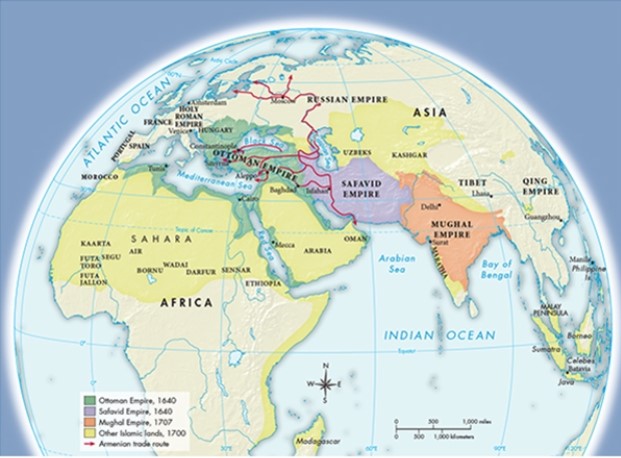
(Multiple Choice)
4.8/5 (88)
(88) Describe, in general terms, the expansion of the Ottoman Empire up to 1683. In what ways did this expansion transform the Ottoman state into a world power?
(Essay)
4.8/5 (73)
(73) Discuss the symbolic importance of gardens in Islamic art, architecture, and literature.
(Essay)
4.9/5 (73)
(73) Based on the evidence in Map 17.3, "India, 1707-1805," what did the British East India Company share in common with others who traded in spices, slaves, precious metals, and material goods? 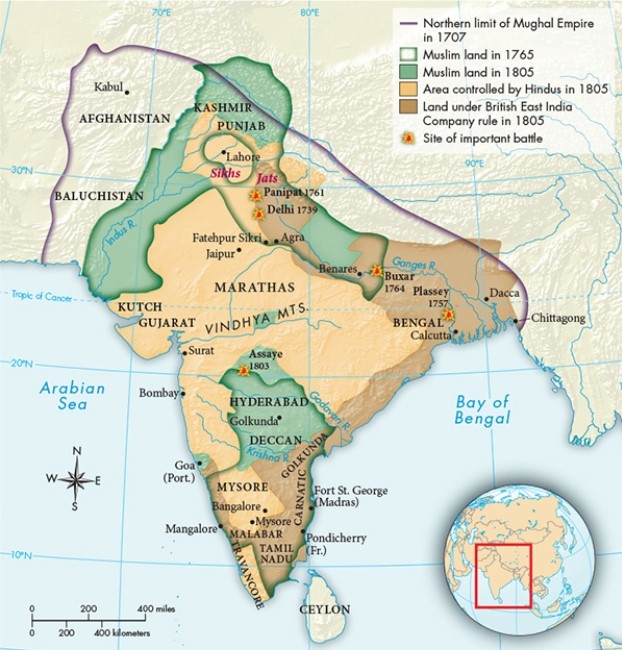
(Multiple Choice)
4.8/5 (75)
(75) Akbar's reign has been characterized as the "Golden Age of India." Why? Why did the Mughal Empire ultimately collapse?
(Essay)
5.0/5 (74)
(74) What did Shah Abbas force the merchant community of Julfa to do after he conquered Armenia?
(Multiple Choice)
4.7/5 (91)
(91) Where did Shah Jahan found a new Indian capital city in 1639?
(Multiple Choice)
4.8/5 (72)
(72) What happened to the Mughal ruler Humayun after he lost most of the Mughal territory in Afghanistan?
(Multiple Choice)
4.8/5 (61)
(61) In 1739, the Mughal army was defeated in battle by Nadir Shah, who was from where?
(Multiple Choice)
4.8/5 (92)
(92) 
Filters
- Essay(0)
- Multiple Choice(0)
- Short Answer(0)
- True False(0)
- Matching(0)