



 Chat with AI
Exam 30: The Great Depression and World War Ii, 1929-1945

Exam 1: The Earliest Human Societies, to 2500 Bce82 Questions
Exam 2: Complex Societies in Southwest Asia and the Nile Valley, 3800-500 Bce75 Questions
Exam 3: The Foundation of Indian Society, to 300 Ce81 Questions
Exam 4: Chinas Classical Age, to 221 Bce80 Questions
Exam 5: The Greek Experience, 3500-30 Bce75 Questions
Exam 6: The World of Rome, Ca 1000 Bce-400 Ce75 Questions
Exam 7: East Asia and the Spread of Buddhism, 221 Bce-845 Ce77 Questions
Exam 8: Continuity and Change in Europe and Western Asia, 250-85078 Questions
Exam 9: The Islamic World, 600-140065 Questions
Exam 10: African Societies and Kingdoms, 1000 Bce-1500 Ce77 Questions
Exam 11: The Americas, 3200 Bce-1500 Ce77 Questions
Exam 12: Cultural Exchange in Central and Southern Asia, 300-140076 Questions
Exam 13: States and Cultures in East Asia, 800-140079 Questions
Exam 14: Europe and Western Asia in the Middle Ages, 800-145079 Questions
Exam 15: Europe in the Renaissance and Reformation, 1350-160079 Questions
Exam 16: The Acceleration of Global Contact, 1450-160078 Questions
Exam 17: The Islamic World Powers, 1300-180077 Questions
Exam 18: European Power and Expansion, 1500-175078 Questions
Exam 19: New Worldviews and Ways of Life, 1540-179081 Questions
Exam 20: Africa and the World, 1400-180076 Questions
Exam 21: Continuity and Change in East Asia, 1400-180073 Questions
Exam 22: Revolutions in the Atlantic World, 1775-182581 Questions
Exam 23: The Revolution in Energy and Industry, 1760-185079 Questions
Exam 24: Ideologies of Change in Europe, 1815-191482 Questions
Exam 25: Africa, the Ottoman Empire, and the New Imperialism, 1800-191479 Questions
Exam 26: Asia and the Pacific in the Era of Imperialism, 1800-191479 Questions
Exam 27: The Americas in the Age of Liberalism, 1810-191776 Questions
Exam 28: World War and Revolution, 1914-192981 Questions
Exam 29: Nationalism in Asia, 1914-193976 Questions
Exam 30: The Great Depression and World War Ii, 1929-194580 Questions
Exam 31: Review82 Questions
Exam 32: Liberalization, 1968-2000s75 Questions
Exam 33: The Contemporary World in Historical Perspective73 Questions
Exam 34: 20th Century Global Issues and Developments20 Questions
Select questions type


How did Stalin's reforms of Soviet society transform the lives of Soviet women?

Free
(Essay)
4.8/5  (85)
(85) Correct Answer: Verified
Answer would ideally include:
In 1917, Russian women had been granted equal legal rights with men and were urged to work outside the home. Stalin continued to urge women to work outside the home in factories, heavy industry, construction, and on farms. Women were also encouraged to have advanced degrees, particularly in science and technology. At the same time, Stalin also encouraged women to still marry, have children, and support traditional family values.
Which of the following characterized Nazi culture under Hitler?
Free
(Multiple Choice)
4.9/5 (95)
(95) Correct Answer:Verified
VerifiedC
Vladimir Lenin's New Economic Policy was a political compromise with what group?
Free
(Multiple Choice)
4.9/5 (75)
(75) Correct Answer:Verified
VerifiedB
By 1941, what group made up one-half of all Communist Party members in the Soviet Union?
(Multiple Choice)
4.9/5 (69)
(69) How did Hitler and the Nazi Party use propaganda to gather support? What kinds of propaganda did they use?
(Essay)
5.0/5 (66)
(66) Which of these best characterizes the impact of the New Deal?
(Multiple Choice)
4.9/5 (77)
(77) What action taken by the Nazis, as illustrated in Map 30.1, "The Growth of Nazi Germany, 1933-1939," was a direct violation of the Treaty of Versailles? 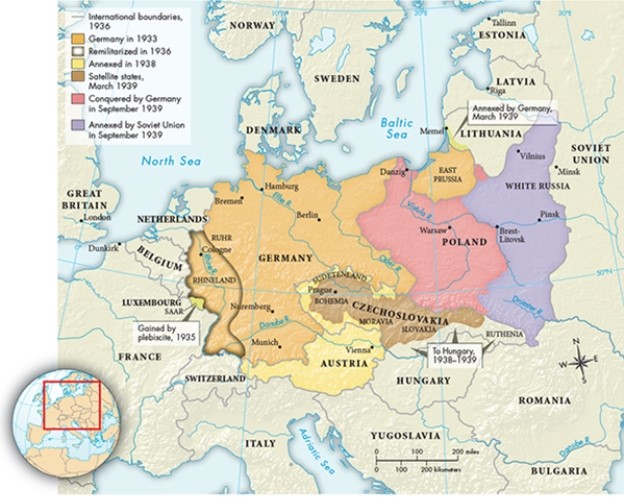
(Multiple Choice)
5.0/5 (79)
(79) Based on Map 30.2, "World War II in Europe and Africa, 1939-1945," which was the only European member of the Allies not occupied by the Axis powers? 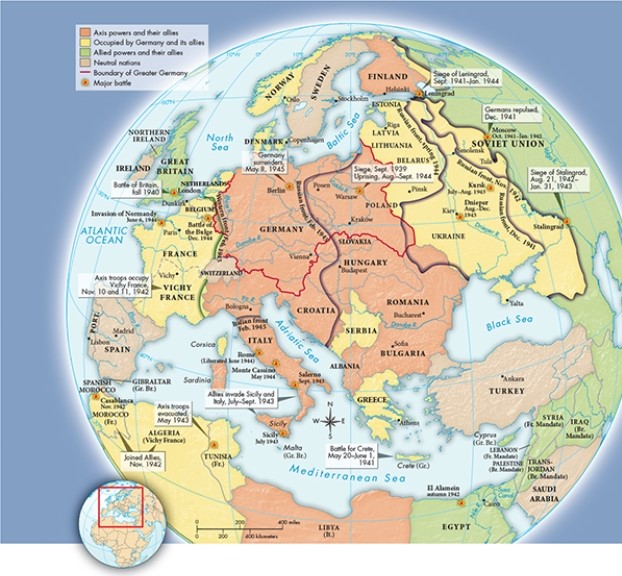
(Multiple Choice)
5.0/5 (74)
(74) What World War II battle was the turning point for the Allies in the Pacific in 1944?
(Multiple Choice)
4.9/5 (74)
(74) 
Filters
- Essay(0)
- Multiple Choice(0)
- Short Answer(0)
- True False(0)
- Matching(0)