



 Chat with AI
Exam 2: Introductory Chemistry

Exam 1: Organization of the Human Body105 Questions
Exam 2: Introductory Chemistry99 Questions
Exam 3: Cells112 Questions
Exam 4: Tissues106 Questions
Exam 5: The Integumentary System110 Questions
Exam 6: The Skeletal System92 Questions
Exam 7: Joints88 Questions
Exam 8: The Muscular System99 Questions
Exam 9: Nervous Tissue79 Questions
Exam 10: Central Nervous System, Spinal Nerves, and Cranial Nerves96 Questions
Exam 11: Autonomic Nervous System82 Questions
Exam 12: Somatic Senses and Special Sense102 Questions
Exam 13: The Endocrine System97 Questions
Exam 14: The Cardiovascular System: Blood92 Questions
Exam 15: The Cardiovascular System: Heart69 Questions
Exam 16: The Cardiovascular System: Blood Vessels and Circulation95 Questions
Exam 17: The Lymphatic System and Immunity91 Questions
Exam 18: The Respiratory System102 Questions
Exam 19: The Digestive System97 Questions
Exam 20: Nutrition and Metabolism85 Questions
Exam 21: The Urinary System90 Questions
Exam 22: Fluid, Electrolyte, and Acid-Base Balance81 Questions
Exam 23: The Reproductive Systems95 Questions
Exam 24: Development and Inheritance90 Questions
Select questions type


Certain sex hormones such as estrogens and testosterone are classified chemically as
(Multiple Choice)
4.8/5  (77)
(77) A solution with a high hydrogen ion concentration has a _____ pH.
(Short Answer)
4.9/5 (85)
(85) Substances that cannot be broken down into simpler substances by ordinary chemical means are called
(Multiple Choice)
5.0/5 (64)
(64) A substance that can be dissolved in a solvent is called a/an _____.
(Short Answer)
4.9/5 (83)
(83) A compound is a molecule composed of two or more different elements.
(True/False)
4.8/5 (91)
(91) Which of the following is NOT one of four major elements that make up about 96% of the human body's mass?
(Multiple Choice)
4.9/5 (86)
(86) Water requires a large amount of heat to change from a liquid to a gas.
(True/False)
4.9/5 (76)
(76) In addition to the four major elements, there are an additional ___ lesser elements that make up approximately 3.6% of the body's mass.
(Multiple Choice)
4.8/5 (78)
(78) Which of the following molecules contains polar covalent bonds?
(Multiple Choice)
4.8/5 (78)
(78) A chemical bond formed between two oppositely charged ions is a/an
(Multiple Choice)
4.8/5 (82)
(82) To prevent rapid, drastic changes in the pH of body fluids, the body
(Multiple Choice)
4.9/5 (86)
(86) The backbone and rings of all organic molecules are formed by
(Multiple Choice)
4.9/5 (83)
(83) If the chemical reaction shown in the figure proceeds from right to left (indicated by arrow labeled E in the figure)leading to the breakdown of the substrate sucrose (labeled C in the figure), which of the following enzymes is most likely to catalyze this reaction? 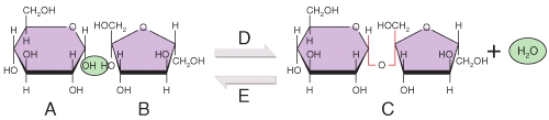
(Multiple Choice)
4.8/5 (76)
(76) A change in the shape of a protein that results in loss of function is called denaturation.
(True/False)
4.9/5 (75)
(75) Which of the labeled chemicals in this reaction are considered to be carbohydrates? 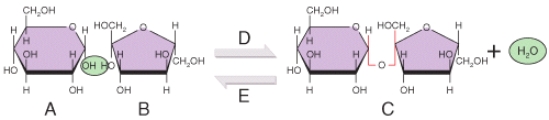
(Multiple Choice)
4.8/5 (80)
(80) 
Filters
- Essay(0)
- Multiple Choice(0)
- Short Answer(0)
- True False(0)
- Matching(0)