



 Chat with AI
Exam 12: Somatic Senses and Special Sense

Exam 1: Organization of the Human Body105 Questions
Exam 2: Introductory Chemistry99 Questions
Exam 3: Cells112 Questions
Exam 4: Tissues106 Questions
Exam 5: The Integumentary System110 Questions
Exam 6: The Skeletal System92 Questions
Exam 7: Joints88 Questions
Exam 8: The Muscular System99 Questions
Exam 9: Nervous Tissue79 Questions
Exam 10: Central Nervous System, Spinal Nerves, and Cranial Nerves96 Questions
Exam 11: Autonomic Nervous System82 Questions
Exam 12: Somatic Senses and Special Sense102 Questions
Exam 13: The Endocrine System97 Questions
Exam 14: The Cardiovascular System: Blood92 Questions
Exam 15: The Cardiovascular System: Heart69 Questions
Exam 16: The Cardiovascular System: Blood Vessels and Circulation95 Questions
Exam 17: The Lymphatic System and Immunity91 Questions
Exam 18: The Respiratory System102 Questions
Exam 19: The Digestive System97 Questions
Exam 20: Nutrition and Metabolism85 Questions
Exam 21: The Urinary System90 Questions
Exam 22: Fluid, Electrolyte, and Acid-Base Balance81 Questions
Exam 23: The Reproductive Systems95 Questions
Exam 24: Development and Inheritance90 Questions
Select questions type


Which region(s)of the membranous labyrinth contain otoliths or ear stones embedded in a gelatinous mass called the otolithic membrane?
(Multiple Choice)
4.8/5  (86)
(86) The sense that tells us which muscles are contracted, the amount of tension in a joint, the position of the joints, and orientation of the head is called
(Multiple Choice)
4.9/5 (79)
(79) The utricle contains a small, thickened region called the macula that contains hair cells responsible for helping to maintain static equilibrium.
(True/False)
5.0/5 (83)
(83) The muscles of the iris and ciliary muscle are considered to be extrinsic eye muscles because they are voluntary.
(True/False)
4.7/5 (77)
(77) Name the three coats of the eye and structures that belong to each coat.
(Essay)
4.8/5 (72)
(72) Accommodation for near vision involves changing the shape of the
(Multiple Choice)
4.8/5 (71)
(71) Type I cutaneous mechanoreceptors quickly adapt to prolonged touch sensations.
(True/False)
4.9/5 (81)
(81) Muscle spindles are found at the junction of a tendon with a muscle.
(True/False)
4.8/5 (73)
(73) Which of the following statements describes a task that is accomplished using the extrinsic eye muscles?
(Multiple Choice)
4.9/5 (68)
(68) The sensory receptors that respond to tastants in food are called
(Multiple Choice)
4.9/5 (71)
(71) The brain regions (labeled D and E on the diagram)involved in relaying and processing visual information are the _____ and _____, respectively. 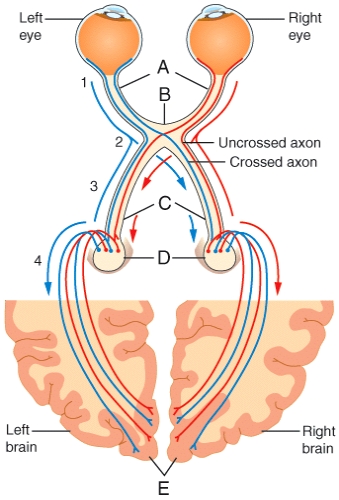
(Multiple Choice)
4.9/5 (77)
(77) The sense of balance that tells you "where your head is at" when you are NOT moving is called _____ equilibrium and is a function of the _____ in the inner ear.
(Multiple Choice)
4.9/5 (71)
(71) The diagram shows the sequence of events that occur as sound waves are converted into electrical impulses. Which of the following statements best describes what is occurring at the point marked 4 in the diagram? 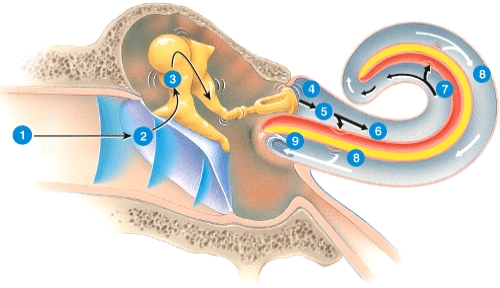
(Multiple Choice)
4.8/5 (73)
(73) The medical term for the condition commonly referred to as "pinkeye" is
(Multiple Choice)
4.7/5 (76)
(76) When you sniff the air to detect or identify odors, you are
(Multiple Choice)
5.0/5 (68)
(68) 
Filters
- Essay(0)
- Multiple Choice(0)
- Short Answer(0)
- True False(0)
- Matching(0)