



 Chat with AI
Exam 14: The Cardiovascular System: Blood

Exam 1: Organization of the Human Body105 Questions
Exam 2: Introductory Chemistry99 Questions
Exam 3: Cells112 Questions
Exam 4: Tissues106 Questions
Exam 5: The Integumentary System110 Questions
Exam 6: The Skeletal System92 Questions
Exam 7: Joints88 Questions
Exam 8: The Muscular System99 Questions
Exam 9: Nervous Tissue79 Questions
Exam 10: Central Nervous System, Spinal Nerves, and Cranial Nerves96 Questions
Exam 11: Autonomic Nervous System82 Questions
Exam 12: Somatic Senses and Special Sense102 Questions
Exam 13: The Endocrine System97 Questions
Exam 14: The Cardiovascular System: Blood92 Questions
Exam 15: The Cardiovascular System: Heart69 Questions
Exam 16: The Cardiovascular System: Blood Vessels and Circulation95 Questions
Exam 17: The Lymphatic System and Immunity91 Questions
Exam 18: The Respiratory System102 Questions
Exam 19: The Digestive System97 Questions
Exam 20: Nutrition and Metabolism85 Questions
Exam 21: The Urinary System90 Questions
Exam 22: Fluid, Electrolyte, and Acid-Base Balance81 Questions
Exam 23: The Reproductive Systems95 Questions
Exam 24: Development and Inheritance90 Questions
Select questions type


The only important RBC antigens that need to be considered in human blood transfusions are the ABO antigens.
(True/False)
4.8/5  (90)
(90) Which of the following blood cells can develop into "wandering macrophages"?
(Multiple Choice)
4.9/5 (82)
(82) Small inappropriate blood clots formed inside of a blood vessel are usually dissolved by a process called
(Multiple Choice)
4.8/5 (78)
(78) Bone marrow transplants have been used to successfully treat
(Multiple Choice)
5.0/5 (74)
(74) The kidney continually excretes breakdown products from erythrocytes.
(True/False)
5.0/5 (78)
(78) Which of the following is a potential cause of anemia in humans?
(Multiple Choice)
4.8/5 (77)
(77) Which of the labeled cells in the photomicrographs contains cytosolic granules that release histamine to intensify the inflammatory response? 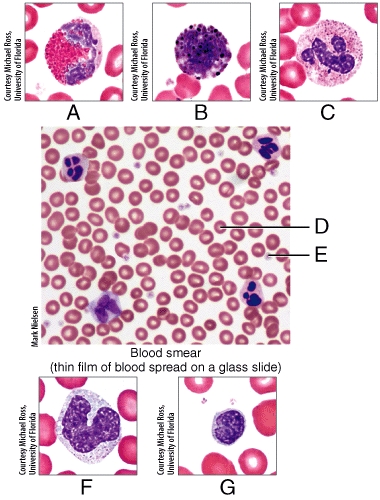
(Multiple Choice)
4.9/5 (81)
(81) Platelets are disc-shaped formed elements in the blood that are generated by splintering a large cell in the bone marrow called a _____ into approximately 2000 to 3000 fragments.
(Multiple Choice)
4.9/5 (83)
(83) 
Filters
- Essay(0)
- Multiple Choice(0)
- Short Answer(0)
- True False(0)
- Matching(0)