



 Chat with AI
Exam 18: The Respiratory System

Exam 1: Organization of the Human Body105 Questions
Exam 2: Introductory Chemistry99 Questions
Exam 3: Cells112 Questions
Exam 4: Tissues106 Questions
Exam 5: The Integumentary System110 Questions
Exam 6: The Skeletal System92 Questions
Exam 7: Joints88 Questions
Exam 8: The Muscular System99 Questions
Exam 9: Nervous Tissue79 Questions
Exam 10: Central Nervous System, Spinal Nerves, and Cranial Nerves96 Questions
Exam 11: Autonomic Nervous System82 Questions
Exam 12: Somatic Senses and Special Sense102 Questions
Exam 13: The Endocrine System97 Questions
Exam 14: The Cardiovascular System: Blood92 Questions
Exam 15: The Cardiovascular System: Heart69 Questions
Exam 16: The Cardiovascular System: Blood Vessels and Circulation95 Questions
Exam 17: The Lymphatic System and Immunity91 Questions
Exam 18: The Respiratory System102 Questions
Exam 19: The Digestive System97 Questions
Exam 20: Nutrition and Metabolism85 Questions
Exam 21: The Urinary System90 Questions
Exam 22: Fluid, Electrolyte, and Acid-Base Balance81 Questions
Exam 23: The Reproductive Systems95 Questions
Exam 24: Development and Inheritance90 Questions
Select questions type


Which of the labeled respiratory organs in the given diagram represents the larynx? 
(Multiple Choice)
4.7/5  (72)
(72) In clinical practice, pulmonary ventilation refers to inspiration only.
(True/False)
4.7/5 (83)
(83) The openings to the auditory (Eustachian)tubes are located in the
(Multiple Choice)
4.9/5 (83)
(83) After a rigorous exercise session has ended, there is an abrupt drop in the ventilation rate followed by a more gradual decrease. The initial abrupt drop in ventilation primarily results from decreased stimulation of
(Multiple Choice)
4.8/5 (76)
(76) Under normal breathing conditions at sea level, the lowest concentration of carbon dioxide (PCO2)would be observed at point _____ in the diagram of external and internal respiration. 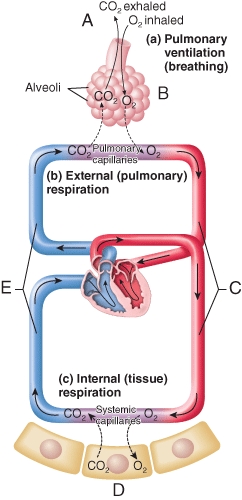
(Multiple Choice)
4.9/5 (89)
(89) The exchange of gases that occurs during external respiration takes place in the
(Multiple Choice)
4.9/5 (79)
(79) The air pressure inside the lungs is called the alveolar pressure.
(True/False)
4.8/5 (93)
(93) Which of the following lists a correct order in which inhaled air sequentially moves through the structures of the respiratory passageway?
(Multiple Choice)
4.9/5 (90)
(90) The fluid that lines the inside of the alveoli is produced by
(Multiple Choice)
4.9/5 (88)
(88) The painful breathing experienced by someone with pleurisy is caused by
(Multiple Choice)
4.7/5 (94)
(94) Which of the labeled locations on the diagram of external and internal respiration would have the following concentrations of gases: PO2 = 105 mm Hg and PCO2 = 40 mm Hg? 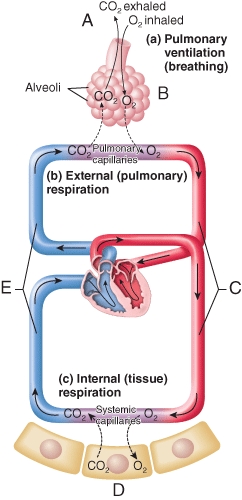
(Multiple Choice)
4.8/5 (76)
(76) Which of the labeled steps in the diagrams do NOT involve contraction of any respiratory muscles? 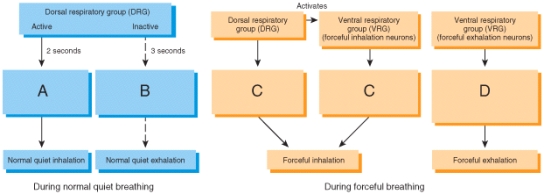
(Multiple Choice)
4.8/5 (88)
(88) Which of the labeled steps in the diagram involve contraction of the abdominal muscles? 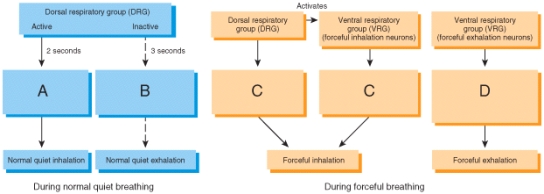
(Multiple Choice)
4.7/5 (64)
(64) The volume of air that can be forcibly exhaled after a normal exhalation is the
(Multiple Choice)
4.8/5 (73)
(73) The exchange of gases between blood in the systemic capillaries and tissue cells is called
(Multiple Choice)
4.9/5 (71)
(71) 
Filters
- Essay(0)
- Multiple Choice(0)
- Short Answer(0)
- True False(0)
- Matching(0)