



 Chat with AI
Exam 12: Firms in Perfectly Competitive Markets

Exam 1: Economics: Foundations and Models459 Questions
Exam 2: Trade-Offs, Comparative Advantage, and the Market System492 Questions
Exam 3: Where Prices Come From: the Interaction of Demand and Supply476 Questions
Exam 4: Economic Efficiency, Government Price Setting, and Taxes420 Questions
Exam 5: Externalities, Environmental Policy, and Public Goods262 Questions
Exam 6: Elasticity: the Responsiveness of Demand and Supply293 Questions
Exam 7: The Economics of Health Care337 Questions
Exam 8: Firms, the Stock Market, and Corporate Governance512 Questions
Exam 9: Comparative Advantage and the Gains From International Trade377 Questions
Exam 10: Consumer Choice and Behavioral Economics304 Questions
Exam 11: Technology, Production, and Costs326 Questions
Exam 12: Firms in Perfectly Competitive Markets296 Questions
Exam 13: Monopolistic Competition: the Competitive Model in a More Realistic Setting272 Questions
Exam 14: Oligopoly: Firms in Less Competitive Markets256 Questions
Exam 15: Monopoly and Antitrust Policy279 Questions
Exam 16: Pricing Strategy258 Questions
Exam 17: The Markets for Labor and Other Factors of Production279 Questions
Exam 18: Public Choice, Taxes, and the Distribution of Income258 Questions
Exam 19: Gdp: Measuring Total Production and Income260 Questions
Exam 20: Unemployment and Inflation290 Questions
Exam 21: Economic Growth, the Financial System, and Business Cycles251 Questions
Exam 22: Long-Run Economic Growth: Sources and Policies261 Questions
Exam 23: Aggregate Expenditure and Output in the Short Run305 Questions
Exam 24: Aggregate Demand and Aggregate Supply Analysis286 Questions
Exam 25: Money, Banks, and the Federal Reserve System278 Questions
Exam 26: Monetary Policy280 Questions
Exam 27: Fiscal Policy313 Questions
Exam 28: Inflation, Unemployment, and Federal Reserve Policy257 Questions
Exam 29: Macroeconomics in an Open Economy277 Questions
Exam 30: The International Financial System258 Questions
Select questions type


Both buyers and sellers are price takers in a perfectly competitive market because
(Multiple Choice)
4.8/5  (71)
(71) Firms in perfect competition produce the productively efficient output level in the short run and in the long run.
(True/False)
5.0/5 (85)
(85) The price of a seller's product in perfect competition is determined by
(Multiple Choice)
4.8/5 (69)
(69) What is meant by productive efficiency? How does a perfectly competitive firm achieve productive efficiency?
(Essay)
4.9/5 (85)
(85) Table 12-1
 Table 12-1 shows the short-run cost data of a perfectly competitive firm that produces plastic camera cases. Assume that output can only be increased in batches of 100 units.
-Refer to Table 12-1. Suppose the fixed cost of production rises by $500 and the price per unit is still $8. What happens to the firm's profit-maximizing output level?
Table 12-1 shows the short-run cost data of a perfectly competitive firm that produces plastic camera cases. Assume that output can only be increased in batches of 100 units.
-Refer to Table 12-1. Suppose the fixed cost of production rises by $500 and the price per unit is still $8. What happens to the firm's profit-maximizing output level? (Multiple Choice)
4.8/5 (78)
(78) Figure 12-15 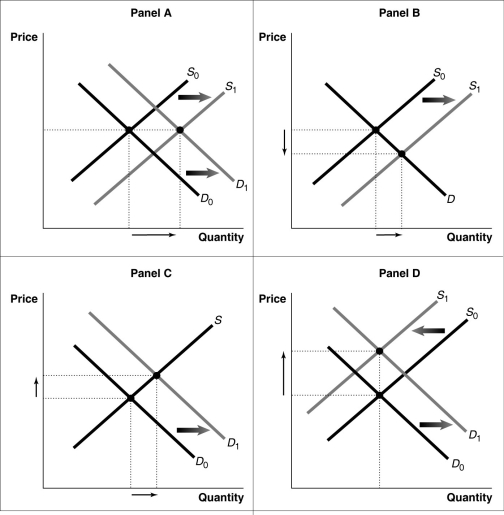 -Refer to Figure 12-15. Suppose a typical firm in a perfectly competitive market is earning economic profits in the short run. Which of the diagrams in the figure depicts what happens in the industry as it transitions to a long-run equilibrium?
 (Multiple Choice)
4.9/5 (71)
(71) If a firm in a perfectly competitive industry introduces a lower-cost way of producing an existing product, the firm will be able to earn economic profits in the long run.
(True/False)
5.0/5 (86)
(86) For a perfectly competitive firm, average revenue is equal to
(Multiple Choice)
4.9/5 (60)
(60) Figure 12-2  -Refer to Figure 12-2. Why is the total revenue curve a ray from the origin?
 (Multiple Choice)
5.0/5 (71)
(71) In early 2007, Pioneer and JVC, two Japanese electronics firms, each announced that their profits were going to be lower than expected because they both had to cut prices for LCD and plasma television sets. Which of the following could explain why these firms did not simply raise their prices and increase their profits?
(Multiple Choice)
4.9/5 (84)
(84) Suppose the equilibrium price in a perfectly competitive industry is $15 and a firm in the industry charges $21. Which of the following will happen?
(Multiple Choice)
4.8/5 (74)
(74) If a perfectly competitive apple farm's marginal revenue exceeds the marginal cost of the last bushel of apples sold, what should the farm do to maximize its profit?
(Multiple Choice)
4.9/5 (87)
(87) Figure 12-9  Figure 12-9 shows cost and demand curves facing a profit-maximizing, perfectly competitive firm.
-Refer to Figure 12-9. At price P3, the firm would produce
Figure 12-9 shows cost and demand curves facing a profit-maximizing, perfectly competitive firm.
-Refer to Figure 12-9. At price P3, the firm would produce (Multiple Choice)
4.8/5 (71)
(71) The demand curve for each seller's product in perfect competition is horizontal at the market price because
(Multiple Choice)
4.9/5 (85)
(85) If a perfectly competitive firm's price is less than its average total cost but greater than its average variable cost, the firm
(Multiple Choice)
4.8/5 (82)
(82) Which of the following is a characteristic of an oligopolistic market structure?
(Multiple Choice)
4.9/5 (73)
(73) 
Filters
- Essay(0)
- Multiple Choice(0)
- Short Answer(0)
- True False(0)
- Matching(0)