



 Chat with AI
Exam 12: Firms in Perfectly Competitive Markets

Exam 1: Economics: Foundations and Models459 Questions
Exam 2: Trade-Offs, Comparative Advantage, and the Market System492 Questions
Exam 3: Where Prices Come From: the Interaction of Demand and Supply476 Questions
Exam 4: Economic Efficiency, Government Price Setting, and Taxes420 Questions
Exam 5: Externalities, Environmental Policy, and Public Goods262 Questions
Exam 6: Elasticity: the Responsiveness of Demand and Supply293 Questions
Exam 7: The Economics of Health Care337 Questions
Exam 8: Firms, the Stock Market, and Corporate Governance512 Questions
Exam 9: Comparative Advantage and the Gains From International Trade377 Questions
Exam 10: Consumer Choice and Behavioral Economics304 Questions
Exam 11: Technology, Production, and Costs326 Questions
Exam 12: Firms in Perfectly Competitive Markets296 Questions
Exam 13: Monopolistic Competition: the Competitive Model in a More Realistic Setting272 Questions
Exam 14: Oligopoly: Firms in Less Competitive Markets256 Questions
Exam 15: Monopoly and Antitrust Policy279 Questions
Exam 16: Pricing Strategy258 Questions
Exam 17: The Markets for Labor and Other Factors of Production279 Questions
Exam 18: Public Choice, Taxes, and the Distribution of Income258 Questions
Exam 19: Gdp: Measuring Total Production and Income260 Questions
Exam 20: Unemployment and Inflation290 Questions
Exam 21: Economic Growth, the Financial System, and Business Cycles251 Questions
Exam 22: Long-Run Economic Growth: Sources and Policies261 Questions
Exam 23: Aggregate Expenditure and Output in the Short Run305 Questions
Exam 24: Aggregate Demand and Aggregate Supply Analysis286 Questions
Exam 25: Money, Banks, and the Federal Reserve System278 Questions
Exam 26: Monetary Policy280 Questions
Exam 27: Fiscal Policy313 Questions
Exam 28: Inflation, Unemployment, and Federal Reserve Policy257 Questions
Exam 29: Macroeconomics in an Open Economy277 Questions
Exam 30: The International Financial System258 Questions
Select questions type


Figure 12-9  Figure 12-9 shows cost and demand curves facing a profit-maximizing, perfectly competitive firm.
-Refer to Figure 12-9. At price P3, the firm would
Figure 12-9 shows cost and demand curves facing a profit-maximizing, perfectly competitive firm.
-Refer to Figure 12-9. At price P3, the firm would (Multiple Choice)
4.8/5  (83)
(83) The price a perfectly competitive firm receives for its output
(Multiple Choice)
4.9/5 (71)
(71) Table 12-4
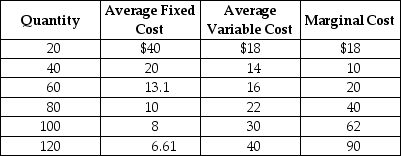 Table 12-4 shows the short-run cost data of a perfectly competitive firm. Assume that output can only be increased in batches of 20 units.
-Refer to Table 12-4. If the market price is $45 the firm will produce
Table 12-4 shows the short-run cost data of a perfectly competitive firm. Assume that output can only be increased in batches of 20 units.
-Refer to Table 12-4. If the market price is $45 the firm will produce (Multiple Choice)
4.9/5 (91)
(91) What assumptions are necessary for a market to be perfectly competitive? Explain why each of these assumptions is important.
(Essay)
4.7/5 (76)
(76) Apple introduced its iPhone 3G in July 2008 and within a month sales had topped 3 million units. By April 2009, more than 25,000 apps for the iPhone 3G were available in the iTunes store, an indication that in a competitive market,
(Multiple Choice)
4.8/5 (62)
(62) Competition has driven the economic profits in the video rental business to zero. Surya Bacha, who owns a video rental business, would be better off leaving the industry for another alternative.
(True/False)
4.9/5 (80)
(80) Figure 12-5  Figure 12-5 shows cost and demand curves facing a typical firm in a constant-cost, perfectly competitive industry.
-Refer to Figure 12-5. The firm's manager suggests that the firm's goal should be to maximize average profit. If the firm does this, what is the amount of profit that it will earn?
Figure 12-5 shows cost and demand curves facing a typical firm in a constant-cost, perfectly competitive industry.
-Refer to Figure 12-5. The firm's manager suggests that the firm's goal should be to maximize average profit. If the firm does this, what is the amount of profit that it will earn? (Multiple Choice)
4.9/5 (68)
(68) A firm could continue to operate for years without ever earning a profit as long as it is producing an output where
(Multiple Choice)
4.7/5 (79)
(79) Figure 12-10  -Refer to Figure 12-10. The firm's short-run supply curve is its
 (Multiple Choice)
4.9/5 (89)
(89) If a firm's total variable cost exceeds its total revenue, the firm should stop production by shutting down temporarily.
(True/False)
4.9/5 (87)
(87) Which of the following describes the difference between the market demand curve for a perfectly competitive industry and the demand curve for a firm in this industry?
(Multiple Choice)
4.7/5 (77)
(77) Figure 12-14 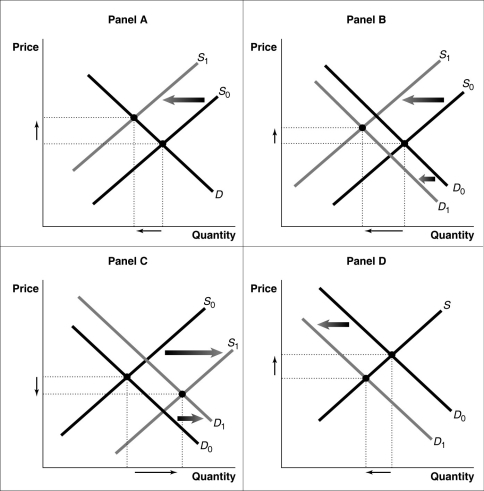 -Refer to Figure 12-14. Consider a typical firm in a perfectly competitive industry which is incurring short-run losses. Which of the diagrams in the figure shows the effect on the industry as it transitions to a long-run equilibrium?
 (Multiple Choice)
4.8/5 (74)
(74) In August 2008, Ethan Nicholas developed the iShoot app for the Apple iPhone 3G, and within five months had earned $800,000 from this program. By May 2009, Nicholas had dropped the price from $4.99 to $1.99 in an attempt to maintain sales. This example indicates that in a competitive market,
(Multiple Choice)
4.9/5 (86)
(86) All of the following can be used to compute average profit except
(Multiple Choice)
4.9/5 (94)
(94) The marginal revenue curve for a perfectly competitive firm
(Multiple Choice)
4.9/5 (79)
(79) Figure 12-7  Figure 12-7 illustrates the cost curves of a perfectly competitive firm.
-Refer to Figure 12-7. If the market price is P1
Figure 12-7 illustrates the cost curves of a perfectly competitive firm.
-Refer to Figure 12-7. If the market price is P1 (Multiple Choice)
4.8/5 (75)
(75) If price = marginal cost at the output produced by a perfectly competitive firm and the firm is earning an economic profit, then
(Multiple Choice)
4.7/5 (71)
(71) To maximize profit, a firm will produce the level of output where MR = MC. If a firm actually makes a profit depends on the relationship of price to average total cost. What are the three possible relationships between price and average total cost that determine if a firm will make a profit, experience a loss, or break even?
(Essay)
4.9/5 (83)
(83) Figure 12-19 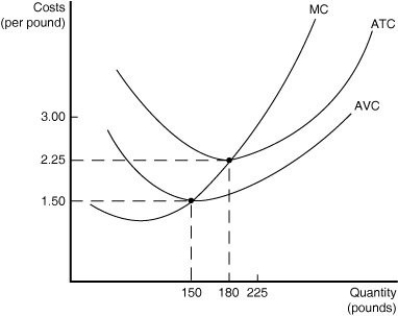 -Refer to Figure 12-19. The figure above shows the cost curves of a perfectly competitive firm in the coffee market. Use the graph in Figure 12-19 to answer the following questions. Assume the market price is $3 per pound.
a. What is the lowest price at which the coffee grower will supply output in the short run?
b. In the diagram draw the firm's demand curve (label this "MR" for marginal revenue).
c. What is the firm's profit-maximizing output?
d. Is the firm earning a profit or a loss? Identify the area in the graph that represents the firm's profit or loss.
e. Explain how entry or exit will occur in the market to ensure that firms will break even in the long run.
-Refer to Figure 12-19. The figure above shows the cost curves of a perfectly competitive firm in the coffee market. Use the graph in Figure 12-19 to answer the following questions. Assume the market price is $3 per pound.
a. What is the lowest price at which the coffee grower will supply output in the short run?
b. In the diagram draw the firm's demand curve (label this "MR" for marginal revenue).
c. What is the firm's profit-maximizing output?
d. Is the firm earning a profit or a loss? Identify the area in the graph that represents the firm's profit or loss.
e. Explain how entry or exit will occur in the market to ensure that firms will break even in the long run. (Essay)
4.8/5 (92)
(92) 
Filters
- Essay(0)
- Multiple Choice(0)
- Short Answer(0)
- True False(0)
- Matching(0)