



 Chat with AI
Exam 12: Firms in Perfectly Competitive Markets

Exam 1: Economics: Foundations and Models459 Questions
Exam 2: Trade-Offs, Comparative Advantage, and the Market System492 Questions
Exam 3: Where Prices Come From: the Interaction of Demand and Supply476 Questions
Exam 4: Economic Efficiency, Government Price Setting, and Taxes420 Questions
Exam 5: Externalities, Environmental Policy, and Public Goods262 Questions
Exam 6: Elasticity: the Responsiveness of Demand and Supply293 Questions
Exam 7: The Economics of Health Care337 Questions
Exam 8: Firms, the Stock Market, and Corporate Governance512 Questions
Exam 9: Comparative Advantage and the Gains From International Trade377 Questions
Exam 10: Consumer Choice and Behavioral Economics304 Questions
Exam 11: Technology, Production, and Costs326 Questions
Exam 12: Firms in Perfectly Competitive Markets296 Questions
Exam 13: Monopolistic Competition: the Competitive Model in a More Realistic Setting272 Questions
Exam 14: Oligopoly: Firms in Less Competitive Markets256 Questions
Exam 15: Monopoly and Antitrust Policy279 Questions
Exam 16: Pricing Strategy258 Questions
Exam 17: The Markets for Labor and Other Factors of Production279 Questions
Exam 18: Public Choice, Taxes, and the Distribution of Income258 Questions
Exam 19: Gdp: Measuring Total Production and Income260 Questions
Exam 20: Unemployment and Inflation290 Questions
Exam 21: Economic Growth, the Financial System, and Business Cycles251 Questions
Exam 22: Long-Run Economic Growth: Sources and Policies261 Questions
Exam 23: Aggregate Expenditure and Output in the Short Run305 Questions
Exam 24: Aggregate Demand and Aggregate Supply Analysis286 Questions
Exam 25: Money, Banks, and the Federal Reserve System278 Questions
Exam 26: Monetary Policy280 Questions
Exam 27: Fiscal Policy313 Questions
Exam 28: Inflation, Unemployment, and Federal Reserve Policy257 Questions
Exam 29: Macroeconomics in an Open Economy277 Questions
Exam 30: The International Financial System258 Questions
Select questions type


Suppose Veronica sells teapots in the perfectly competitive teapot market. Her output per day and her costs are as follows:
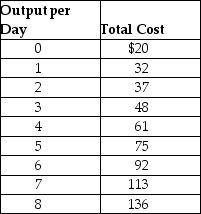 Suppose the current equilibrium price in the teapot market is $15. To maximize profit, how many teapots will Veronica produce, what price will she charge, and how much profit (or loss) will she make? Draw a graph to illustrate your answer. Your graph should include Veronica's demand, ATC, AVC, MC, and MR curves, the price she is charging, the quantity she is producing, and the area representing her profit (or loss).
 (Essay)
4.8/5  (80)
(80) If the market price is $40, the average revenue of selling five units is
(Multiple Choice)
4.7/5 (86)
(86) What characteristic of a competitive market has made the "long run pretty short" in the market for iPhone apps?
(Multiple Choice)
4.7/5 (83)
(83) Figure 12-8  -Refer to Figure 12-8. Suppose the firm produces 4,000 units. What does the shaded area labeled B represent?
 (Multiple Choice)
4.8/5 (74)
(74) When firms exit a perfectly competitive industry, the market supply curve shifts to the left.
(True/False)
4.7/5 (60)
(60) Article Summary
According to the Department of Agriculture, net farm income in 2017 will rise from $61.5 billion in 2016 to $63.4 billion in 2017, a modest 3.1 percent increase but also the first increase since 2013. Much of the increase came from the sales of grain inventory, along with increased revenue from milk and livestock. The net income for 2017 is still only about half of its peak level, and according to agricultural economist David Widmar, income closer to $72 billion would be a sign of an improving farm economy.
-Refer to the Article Summary. Assume that after the slight increase in U.S. farm income in 2017, farmers are expected to break even in 2018. This means that at the quantity being produced in 2018
(Multiple Choice)
4.7/5 (75)
(75) In a perfectly competitive industry, in the long-run equilibrium
(Multiple Choice)
4.8/5 (89)
(89) Suppose there are economies of scale in the production of a specialized memory chip that is used in manufacturing microwaves. This suggests that the microwave industry is a decreasing-cost industry.
(True/False)
5.0/5 (63)
(63) Producing where marginal revenue equals marginal cost is equivalent to producing where
(Multiple Choice)
4.9/5 (72)
(72) Figure 12-9  Figure 12-9 shows cost and demand curves facing a profit-maximizing, perfectly competitive firm.
-Refer to Figure 12-9. At price P1, the firm would produce
Figure 12-9 shows cost and demand curves facing a profit-maximizing, perfectly competitive firm.
-Refer to Figure 12-9. At price P1, the firm would produce (Multiple Choice)
4.8/5 (87)
(87) Suppose Veronica sells teapots in the perfectly competitive teapot market. Her output per day and her costs are as follows:
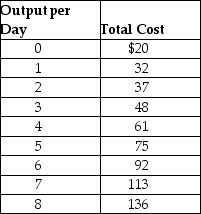 Suppose the current equilibrium price in the teapot market is $20. To maximize profit, how many teapots will Veronica produce, what price will she charge, and how much profit (or loss) will she make? Draw a graph to illustrate your answer. Your graph should include Veronica's demand, ATC, AVC, MC, and MR curves, the price she is charging, the quantity she is producing, and the area representing her profit (or loss).
 (Essay)
4.7/5 (88)
(88) An increase in a firm's fixed cost will not change the firm's profit-maximizing output in the short run.
(True/False)
4.9/5 (88)
(88) If a firm's fixed cost exceeds its total revenue, the firm should stop production by shutting down temporarily.
(True/False)
4.8/5 (83)
(83) When plasma television sets were first introduced prices were high and few firms were in the market. Later, economic profits attracted new firms and the price of plasma televisions fell. This example illustrates
(Multiple Choice)
4.9/5 (82)
(82) Which of the following is not an assumption of perfectly competitive markets?
(Multiple Choice)
4.8/5 (77)
(77) Ben's Peanut Shoppe suffers a short-run loss. Ben will not choose to shut down if
(Multiple Choice)
4.8/5 (82)
(82) Which of the following is not true for a firm in perfect competition?
(Multiple Choice)
4.8/5 (90)
(90) 
Filters
- Essay(0)
- Multiple Choice(0)
- Short Answer(0)
- True False(0)
- Matching(0)