



 Chat with AI
Exam 16: Pricing Strategy

Exam 1: Economics: Foundations and Models459 Questions
Exam 2: Trade-Offs, Comparative Advantage, and the Market System492 Questions
Exam 3: Where Prices Come From: the Interaction of Demand and Supply476 Questions
Exam 4: Economic Efficiency, Government Price Setting, and Taxes420 Questions
Exam 5: Externalities, Environmental Policy, and Public Goods262 Questions
Exam 6: Elasticity: the Responsiveness of Demand and Supply293 Questions
Exam 7: The Economics of Health Care337 Questions
Exam 8: Firms, the Stock Market, and Corporate Governance512 Questions
Exam 9: Comparative Advantage and the Gains From International Trade377 Questions
Exam 10: Consumer Choice and Behavioral Economics304 Questions
Exam 11: Technology, Production, and Costs326 Questions
Exam 12: Firms in Perfectly Competitive Markets296 Questions
Exam 13: Monopolistic Competition: the Competitive Model in a More Realistic Setting272 Questions
Exam 14: Oligopoly: Firms in Less Competitive Markets256 Questions
Exam 15: Monopoly and Antitrust Policy279 Questions
Exam 16: Pricing Strategy258 Questions
Exam 17: The Markets for Labor and Other Factors of Production279 Questions
Exam 18: Public Choice, Taxes, and the Distribution of Income258 Questions
Exam 19: Gdp: Measuring Total Production and Income260 Questions
Exam 20: Unemployment and Inflation290 Questions
Exam 21: Economic Growth, the Financial System, and Business Cycles251 Questions
Exam 22: Long-Run Economic Growth: Sources and Policies261 Questions
Exam 23: Aggregate Expenditure and Output in the Short Run305 Questions
Exam 24: Aggregate Demand and Aggregate Supply Analysis286 Questions
Exam 25: Money, Banks, and the Federal Reserve System278 Questions
Exam 26: Monetary Policy280 Questions
Exam 27: Fiscal Policy313 Questions
Exam 28: Inflation, Unemployment, and Federal Reserve Policy257 Questions
Exam 29: Macroeconomics in an Open Economy277 Questions
Exam 30: The International Financial System258 Questions
Select questions type


A firm that engages in price discrimination must be able to identify the preferences of every
customer it serves.
(True/False)
4.7/5  (68)
(68) Table 16-2
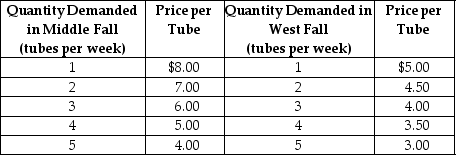 Neem Products sells its Ayurvedic Neem toothpaste in two completely isolated markets with demand schedules as shown in Table 16-2. The average cost of production is constant at $2 per tube.
-Refer to Table 16-2. What are the total profits from both markets combined?
Neem Products sells its Ayurvedic Neem toothpaste in two completely isolated markets with demand schedules as shown in Table 16-2. The average cost of production is constant at $2 per tube.
-Refer to Table 16-2. What are the total profits from both markets combined? (Multiple Choice)
4.8/5 (71)
(71) Article Summary
Brandeis University economist Benjamin Shiller has written a paper which explains how Netflix could combine demographic data with customers' Web browsing habits to more accurately predict how much a customer would be willing to pay for a Netflix subscription, and how using this method of first-degree price discrimination would generate higher profits. Shiller explains that the more information a company has about its customers, the better it is at being able to set prices to increase profits. As he stated in his paper, "Using all variables to tailor prices, one can yield variable profits 1.39 percent higher than variable profits obtained using non-tailored 2nd degree price-discrimination. Using demographics alone to tailor prices raises profits by much less, yielding variable profits only 0.14% higher than variable profits attainable under 2nd degree [price discrimination]."
-Refer to the Article Summary. The pricing method described in the article is referred to as first-degree price discrimination. First-degree price discrimination is also known as
(Multiple Choice)
4.7/5 (81)
(81) Figure 16-6  Watanabe Sensei operates the only martial arts school in Hartfield. For simplicity, assume that consumers have identical demand curves and that Sensei knows what this demand curve is. Figure 16-6 shows this demand curve.
-Refer to Figure 16-6. Sensei's friend, Marcel, suggests that he charge a one-time membership fee to use the martial arts school, in addition to a per-class charge. Suppose Sensei charges the monopoly price for each class and also imposes a one-time membership fee. What is the maximum amount of revenue from the membership fee he can collect from all his customers?
Watanabe Sensei operates the only martial arts school in Hartfield. For simplicity, assume that consumers have identical demand curves and that Sensei knows what this demand curve is. Figure 16-6 shows this demand curve.
-Refer to Figure 16-6. Sensei's friend, Marcel, suggests that he charge a one-time membership fee to use the martial arts school, in addition to a per-class charge. Suppose Sensei charges the monopoly price for each class and also imposes a one-time membership fee. What is the maximum amount of revenue from the membership fee he can collect from all his customers? (Multiple Choice)
4.9/5 (76)
(76) Arnold's Airport Transport provides passenger transportation to and from the local airport. Arnold charges a flat rate of $30 per person for round-trip service, and he gives a $5 discount to senior citizens. Assume Arnold's marginal cost is $3.00 per person. Draw two graphs, one showing demand and marginal cost for his $30 customers, of which he has 300 per month, and the other graph showing demand and marginal cost for his senior citizen customers, of which he has 100 per month. If Arnold charged all of his customers $30, he would have 325 customers per month.
(Essay)
4.8/5 (71)
(71) Figure 16-7  The Lizard Lounge is well known for its exotic cocktails. Figure 16-7 shows its estimated demand curve for cocktails.
-Refer to Figure 16-7. The owners of the Lizard Lounge are considering the following four pricing options:
a. A single price scheme where the price of cocktails equals the monopoly price.
b. A single price scheme where the cocktail price equals the competitive price.
c. A two-part tariff: a monopoly price for cocktails and a cover charge that will generate total revenue equal to the area X.
d. A two-part tariff: a competitive price for cocktails and a cover charge that will generate total revenue equal to the area X + Y + Z.
Which scheme will earn the largest profit?
The Lizard Lounge is well known for its exotic cocktails. Figure 16-7 shows its estimated demand curve for cocktails.
-Refer to Figure 16-7. The owners of the Lizard Lounge are considering the following four pricing options:
a. A single price scheme where the price of cocktails equals the monopoly price.
b. A single price scheme where the cocktail price equals the competitive price.
c. A two-part tariff: a monopoly price for cocktails and a cover charge that will generate total revenue equal to the area X.
d. A two-part tariff: a competitive price for cocktails and a cover charge that will generate total revenue equal to the area X + Y + Z.
Which scheme will earn the largest profit? (Multiple Choice)
4.9/5 (79)
(79) All of the following are disadvantages of cost-plus pricing except
(Multiple Choice)
4.7/5 (81)
(81) There is no evidence that odd pricing succeeds in convincing consumers that prices are lower than they really are.
(True/False)
4.8/5 (75)
(75) Though large firms have the knowledge and resources to utilize a better pricing strategy, many choose to use cost-plus pricing. One reason for this is that
(Multiple Choice)
4.7/5 (79)
(79) Many book publishers use cost-plus pricing to establish prices for some of their books. Would you expect a publishing company to use a strict cost-plus pricing system for all its books? How might you determine if a publishing company actually does use cost-plus pricing for all its books?
(Essay)
4.8/5 (78)
(78) Book publishers often use price discrimination across time to increase profits. Toni Morrison's book, A Mercy, was published as a hardcover edition in November 2008 at a price of $23.95. In August 2009, the paperback version was published at a price of $15.00. Assume that 100,000 hardcover books were sold to hard-core Toni Morrison fans in November 2008, and 400,000 paperback books were sold to casual readers in August 2009. Illustrate each of these situations graphically. Assume that the marginal cost of the hardcover version is $2.00 and the marginal cost of the paperback version is $0.75.
(Essay)
4.9/5 (70)
(70) Arnold Marion, a first-year economics student at Fazer College, was given an assignment to find an example of price discrimination and present it to his class. When asked for his example Arnold said "I went to a Milwaukee Brewers baseball game with my cousin last week. We paid $25 each for our seats in left field. My aunt and uncle paid $50 each for their tickets; they sat five rows behind the first base dugout. This is an example of price discrimination since we paid different prices for the same product, and the differences were not due to differences in costs." How would Arnold's economics instructor assess Arnold's example?
(Multiple Choice)
4.8/5 (91)
(91) Many golf courses charge members an annual membership fee as well as a fee each time they golf. One reason for this is
(Multiple Choice)
4.8/5 (81)
(81) Consider the following pricing strategies:
a. perfect price discrimination
b. charging different prices to different groups of customers
c. optimal two-part tariff
d. single-price monopoly pricing
Which of the pricing strategies allows a producer to capture the entire consumer surplus that would have gone to consumers under perfect competitive pricing?
(Multiple Choice)
4.8/5 (93)
(93) When firms price their products by adding a percentage markup to their average costs of production, this is called
(Multiple Choice)
4.8/5 (78)
(78) Which of the following undermines a firm's ability to engage in price discrimination?
(Multiple Choice)
4.8/5 (71)
(71) Figure 16-6 Watanabe Sensei operates the only martial arts school in Hartfield. For simplicity, assume that consumers have identical demand curves and that Sensei knows what this demand curve is. Figure 16-6 shows this demand curve.
-Refer to Figure 16-6. If Sensei acts as a single-price monopolist, his profit-maximizing price is ________ and the number of classes sold is ________.
Watanabe Sensei operates the only martial arts school in Hartfield. For simplicity, assume that consumers have identical demand curves and that Sensei knows what this demand curve is. Figure 16-6 shows this demand curve.
-Refer to Figure 16-6. If Sensei acts as a single-price monopolist, his profit-maximizing price is ________ and the number of classes sold is ________. (Multiple Choice)
4.9/5 (72)
(72) Yield management and price discrimination have enabled firms to increase profits and, at the same time
(Multiple Choice)
4.7/5 (87)
(87) What is cost-plus pricing? Why do some firms use cost-plus pricing even when the firms' managers have the resources to devise a pricing strategy that would result in greater profits?
(Essay)
4.8/5 (77)
(77) 
Filters
- Essay(0)
- Multiple Choice(0)
- Short Answer(0)
- True False(0)
- Matching(0)