



 Chat with AI
Exam 16: Pricing Strategy

Exam 1: Economics: Foundations and Models459 Questions
Exam 2: Trade-Offs, Comparative Advantage, and the Market System492 Questions
Exam 3: Where Prices Come From: the Interaction of Demand and Supply476 Questions
Exam 4: Economic Efficiency, Government Price Setting, and Taxes420 Questions
Exam 5: Externalities, Environmental Policy, and Public Goods262 Questions
Exam 6: Elasticity: the Responsiveness of Demand and Supply293 Questions
Exam 7: The Economics of Health Care337 Questions
Exam 8: Firms, the Stock Market, and Corporate Governance512 Questions
Exam 9: Comparative Advantage and the Gains From International Trade377 Questions
Exam 10: Consumer Choice and Behavioral Economics304 Questions
Exam 11: Technology, Production, and Costs326 Questions
Exam 12: Firms in Perfectly Competitive Markets296 Questions
Exam 13: Monopolistic Competition: the Competitive Model in a More Realistic Setting272 Questions
Exam 14: Oligopoly: Firms in Less Competitive Markets256 Questions
Exam 15: Monopoly and Antitrust Policy279 Questions
Exam 16: Pricing Strategy258 Questions
Exam 17: The Markets for Labor and Other Factors of Production279 Questions
Exam 18: Public Choice, Taxes, and the Distribution of Income258 Questions
Exam 19: Gdp: Measuring Total Production and Income260 Questions
Exam 20: Unemployment and Inflation290 Questions
Exam 21: Economic Growth, the Financial System, and Business Cycles251 Questions
Exam 22: Long-Run Economic Growth: Sources and Policies261 Questions
Exam 23: Aggregate Expenditure and Output in the Short Run305 Questions
Exam 24: Aggregate Demand and Aggregate Supply Analysis286 Questions
Exam 25: Money, Banks, and the Federal Reserve System278 Questions
Exam 26: Monetary Policy280 Questions
Exam 27: Fiscal Policy313 Questions
Exam 28: Inflation, Unemployment, and Federal Reserve Policy257 Questions
Exam 29: Macroeconomics in an Open Economy277 Questions
Exam 30: The International Financial System258 Questions
Select questions type


Figure 16-5  -Refer to Figure 16-5. Suppose the firm represented in the diagram decides to practice perfect price discrimination. What is the profit-maximizing price it will charge?
 (Multiple Choice)
4.9/5  (92)
(92) Until the early 1980s, The Walt Disney Company used a pricing strategy in which visitors to its theme parks paid a low admission fee and also paid for rides. This pricing strategy is an example of
(Multiple Choice)
4.8/5 (71)
(71) The costs in time and other resources that parties incur in the process of agreeing to and carrying out an exchange of goods or services are called
(Multiple Choice)
4.8/5 (77)
(77) Table 16-3
 Julie plans to start a pet-sitting service. She surveyed her neighborhood to determine the demand for this service. Assume that each person surveyed demands only one hour of pet sitting services per period. Table 16-3 above shows a portion of her survey results.
-Refer to Table 16-3. Suppose Julie's marginal cost of providing this service is constant at $7 and she decides to charge each customer according to his or her willingness to pay. What is the value of consumer surplus by her customers?
Julie plans to start a pet-sitting service. She surveyed her neighborhood to determine the demand for this service. Assume that each person surveyed demands only one hour of pet sitting services per period. Table 16-3 above shows a portion of her survey results.
-Refer to Table 16-3. Suppose Julie's marginal cost of providing this service is constant at $7 and she decides to charge each customer according to his or her willingness to pay. What is the value of consumer surplus by her customers? (Multiple Choice)
4.7/5 (83)
(83) Figure 16-3  Chantal owns a hairdressing salon which caters to two main groups of customers: residents of "The Chateau," a retirement community, and other residents in the neighborhood. Figure 16-3 shows the demand curves for the residents of the retirement community, labeled Market A, and other residents in the neighborhood, labeled Market B. The demand curves are not identical.
-Refer to Figure 16-3. Which group of customers is likely to have a more elastic demand curve (more sensitive to price)?
Chantal owns a hairdressing salon which caters to two main groups of customers: residents of "The Chateau," a retirement community, and other residents in the neighborhood. Figure 16-3 shows the demand curves for the residents of the retirement community, labeled Market A, and other residents in the neighborhood, labeled Market B. The demand curves are not identical.
-Refer to Figure 16-3. Which group of customers is likely to have a more elastic demand curve (more sensitive to price)? (Multiple Choice)
4.9/5 (79)
(79) The Bay Area subway system, BART, offers senior citizens discounted fares for BART rides. This suggests that BART authorities believe that senior citizens have a ________ demand for subway rides.
(Multiple Choice)
4.8/5 (77)
(77) Figure 16-2  Plato Playhouse, a theatre company in the university town of Wegg, caters to two groups of customers:
students and the non-student population.
Figure 16-2 shows the demand curves for the two groups of customers.
-Refer to Figure 16-2. Suppose Plato Playhouse price discriminates. What is the price charged in the two markets?
Plato Playhouse, a theatre company in the university town of Wegg, caters to two groups of customers:
students and the non-student population.
Figure 16-2 shows the demand curves for the two groups of customers.
-Refer to Figure 16-2. Suppose Plato Playhouse price discriminates. What is the price charged in the two markets? (Multiple Choice)
4.7/5 (73)
(73) Differentiating products to suit customers' tastes is a form of price discrimination.
(True/False)
4.9/5 (81)
(81) Assuming zero transactions costs, if your local grocer buys oranges at a low price from an orchard and resells them to you at a higher price, then the grocer's revenue minus costs is known as
(Multiple Choice)
4.8/5 (65)
(65) Which of the following is a necessary condition for successful price discrimination?
(Multiple Choice)
4.9/5 (83)
(83) One reason why airlines charge business travelers and leisure travelers different prices is
(Multiple Choice)
5.0/5 (82)
(82) Table 16-2
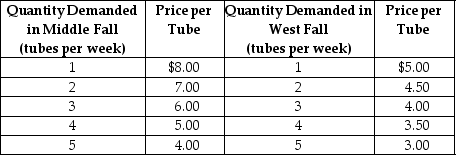 Neem Products sells its Ayurvedic Neem toothpaste in two completely isolated markets with demand schedules as shown in Table 16-2. The average cost of production is constant at $2 per tube.
-Refer to Table 16-2. How many tubes of toothpaste will Neem sell in West Fall and at what price?
Neem Products sells its Ayurvedic Neem toothpaste in two completely isolated markets with demand schedules as shown in Table 16-2. The average cost of production is constant at $2 per tube.
-Refer to Table 16-2. How many tubes of toothpaste will Neem sell in West Fall and at what price? (Multiple Choice)
4.9/5 (96)
(96) Which of the following is not a way by which price-discriminating firms can segment a market?
(Multiple Choice)
4.9/5 (90)
(90) Draw a graph that shows producer surplus, consumer surplus, and deadweight loss in a market where the seller practices perfect price discrimination. Be sure to identify the demand curve, the marginal revenue curve, the marginal cost curve, and the profit maximizing quantity on the graph.
(Essay)
4.9/5 (81)
(81) Amazon is now such a dominant online presence, the company has no need to analyze big data to assist with pricing strategies.
(True/False)
4.8/5 (83)
(83) 
Filters
- Essay(0)
- Multiple Choice(0)
- Short Answer(0)
- True False(0)
- Matching(0)