



 Chat with AI
Exam 16: Pricing Strategy

Exam 1: Economics: Foundations and Models459 Questions
Exam 2: Trade-Offs, Comparative Advantage, and the Market System492 Questions
Exam 3: Where Prices Come From: the Interaction of Demand and Supply476 Questions
Exam 4: Economic Efficiency, Government Price Setting, and Taxes420 Questions
Exam 5: Externalities, Environmental Policy, and Public Goods262 Questions
Exam 6: Elasticity: the Responsiveness of Demand and Supply293 Questions
Exam 7: The Economics of Health Care337 Questions
Exam 8: Firms, the Stock Market, and Corporate Governance512 Questions
Exam 9: Comparative Advantage and the Gains From International Trade377 Questions
Exam 10: Consumer Choice and Behavioral Economics304 Questions
Exam 11: Technology, Production, and Costs326 Questions
Exam 12: Firms in Perfectly Competitive Markets296 Questions
Exam 13: Monopolistic Competition: the Competitive Model in a More Realistic Setting272 Questions
Exam 14: Oligopoly: Firms in Less Competitive Markets256 Questions
Exam 15: Monopoly and Antitrust Policy279 Questions
Exam 16: Pricing Strategy258 Questions
Exam 17: The Markets for Labor and Other Factors of Production279 Questions
Exam 18: Public Choice, Taxes, and the Distribution of Income258 Questions
Exam 19: Gdp: Measuring Total Production and Income260 Questions
Exam 20: Unemployment and Inflation290 Questions
Exam 21: Economic Growth, the Financial System, and Business Cycles251 Questions
Exam 22: Long-Run Economic Growth: Sources and Policies261 Questions
Exam 23: Aggregate Expenditure and Output in the Short Run305 Questions
Exam 24: Aggregate Demand and Aggregate Supply Analysis286 Questions
Exam 25: Money, Banks, and the Federal Reserve System278 Questions
Exam 26: Monetary Policy280 Questions
Exam 27: Fiscal Policy313 Questions
Exam 28: Inflation, Unemployment, and Federal Reserve Policy257 Questions
Exam 29: Macroeconomics in an Open Economy277 Questions
Exam 30: The International Financial System258 Questions
Select questions type


Table 16-3
 Julie plans to start a pet-sitting service. She surveyed her neighborhood to determine the demand for this service. Assume that each person surveyed demands only one hour of pet sitting services per period. Table 16-3 above shows a portion of her survey results.
-Refer to Table 16-3. If Julie charges $10 per hour, how many hours of pet sitting services will be purchased and by whom?
Julie plans to start a pet-sitting service. She surveyed her neighborhood to determine the demand for this service. Assume that each person surveyed demands only one hour of pet sitting services per period. Table 16-3 above shows a portion of her survey results.
-Refer to Table 16-3. If Julie charges $10 per hour, how many hours of pet sitting services will be purchased and by whom? (Multiple Choice)
4.9/5  (84)
(84) Odd pricing became common in the late 19th century. Although the origins of odd pricing are uncertain, several explanations for the practice have been given. Which of the following is one of these explanations?
(Multiple Choice)
4.9/5 (73)
(73) Table 16-2
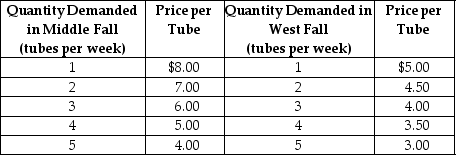 Neem Products sells its Ayurvedic Neem toothpaste in two completely isolated markets with demand schedules as shown in Table 16-2. The average cost of production is constant at $2 per tube.
-Refer to Table 16-2. Which of the following statements is true about the two markets?
Neem Products sells its Ayurvedic Neem toothpaste in two completely isolated markets with demand schedules as shown in Table 16-2. The average cost of production is constant at $2 per tube.
-Refer to Table 16-2. Which of the following statements is true about the two markets? (Multiple Choice)
4.7/5 (68)
(68) Figure 16-5  -Refer to Figure 16-5. Suppose the firm represented in the diagram decides to use a two-part pricing strategy such that it charges a fixed fee and a per-unit price equal to the monopoly price. (This is also called a two-part tariff.) What is the per-unit price?
 (Multiple Choice)
4.7/5 (80)
(80) Figure 16-2  Plato Playhouse, a theatre company in the university town of Wegg, caters to two groups of customers:
students and the non-student population.
Figure 16-2 shows the demand curves for the two groups of customers.
-Refer to Figure 16-2. Suppose Plato Playhouse charges a single price of Pd for each performance. Which of the following statements is true?
Plato Playhouse, a theatre company in the university town of Wegg, caters to two groups of customers:
students and the non-student population.
Figure 16-2 shows the demand curves for the two groups of customers.
-Refer to Figure 16-2. Suppose Plato Playhouse charges a single price of Pd for each performance. Which of the following statements is true? (Multiple Choice)
4.9/5 (84)
(84) Erin and Deidre, two residents in Ithaca, New York, are planning a trip to Boston. Erin, the sales manager for a large retailer, has to attend a business meeting. Deidre, a college student on vacation, is planning a leisurely trip to visit friends and relatives. Whose demand curve for air travel is likely to be more elastic?
(Multiple Choice)
4.9/5 (80)
(80) A successful strategy of price discrimination requires that a firm be a price taker.
(True/False)
4.8/5 (68)
(68) Consumers who will pay high prices to be among the first to own certain new products are called
(Multiple Choice)
4.8/5 (83)
(83) With perfect price discrimination, the marginal revenue curve
(Multiple Choice)
4.8/5 (79)
(79) Price discrimination is possible in which of the following market structures?
a. perfect competition
b. monopoly
c. oligopoly
d. monopolistic competition
(Multiple Choice)
4.8/5 (66)
(66) Because each customer pays according to her willingness to pay, a consumer maximizes her consumer surplus under first-degree price discrimination.
(True/False)
4.9/5 (84)
(84) Are restaurant coupons a form of price discrimination? Why or why not?
(Essay)
4.9/5 (67)
(67) Early adopters are consumers who will pay a high price to be among the first to own new products.
(True/False)
4.9/5 (69)
(69) Many firms use odd pricing-charging prices such as $.99 instead of $1.00 and $9.99 instead of $10.00. One reason for this pricing strategy is that consumers will somehow believe that the difference in price appears to be greater than it actually is. Researchers conducted consumer surveys to determine whether this is actually the case. What was the result of these surveys?
(Multiple Choice)
4.9/5 (70)
(70) Which of the following is not a requirement for a successful price discrimination strategy?
(Multiple Choice)
4.9/5 (85)
(85) Suppose a restaurant is trying to determine how much to charge for a bowl of chili, and decides to run an experiment to see how much its customers are willing to pay by allowing them to set their own price for this menu item.
a. Is charging a customer the price he or she is willing to pay for the bowl of chili an example of price discrimination? Briefly explain.
b. What is it called when a firm knows every consumer's willingness to pay, and can charge every consumer a different price? What happens to consumer surplus in this situation?
(Essay)
4.7/5 (79)
(79) An optimal two-part tariff pricing schedule maximizes consumer surplus.
(True/False)
5.0/5 (84)
(84) 
Filters
- Essay(0)
- Multiple Choice(0)
- Short Answer(0)
- True False(0)
- Matching(0)