



 Chat with AI
Exam 16: Pricing Strategy

Exam 1: Economics: Foundations and Models459 Questions
Exam 2: Trade-Offs, Comparative Advantage, and the Market System492 Questions
Exam 3: Where Prices Come From: the Interaction of Demand and Supply476 Questions
Exam 4: Economic Efficiency, Government Price Setting, and Taxes420 Questions
Exam 5: Externalities, Environmental Policy, and Public Goods262 Questions
Exam 6: Elasticity: the Responsiveness of Demand and Supply293 Questions
Exam 7: The Economics of Health Care337 Questions
Exam 8: Firms, the Stock Market, and Corporate Governance512 Questions
Exam 9: Comparative Advantage and the Gains From International Trade377 Questions
Exam 10: Consumer Choice and Behavioral Economics304 Questions
Exam 11: Technology, Production, and Costs326 Questions
Exam 12: Firms in Perfectly Competitive Markets296 Questions
Exam 13: Monopolistic Competition: the Competitive Model in a More Realistic Setting272 Questions
Exam 14: Oligopoly: Firms in Less Competitive Markets256 Questions
Exam 15: Monopoly and Antitrust Policy279 Questions
Exam 16: Pricing Strategy258 Questions
Exam 17: The Markets for Labor and Other Factors of Production279 Questions
Exam 18: Public Choice, Taxes, and the Distribution of Income258 Questions
Exam 19: Gdp: Measuring Total Production and Income260 Questions
Exam 20: Unemployment and Inflation290 Questions
Exam 21: Economic Growth, the Financial System, and Business Cycles251 Questions
Exam 22: Long-Run Economic Growth: Sources and Policies261 Questions
Exam 23: Aggregate Expenditure and Output in the Short Run305 Questions
Exam 24: Aggregate Demand and Aggregate Supply Analysis286 Questions
Exam 25: Money, Banks, and the Federal Reserve System278 Questions
Exam 26: Monetary Policy280 Questions
Exam 27: Fiscal Policy313 Questions
Exam 28: Inflation, Unemployment, and Federal Reserve Policy257 Questions
Exam 29: Macroeconomics in an Open Economy277 Questions
Exam 30: The International Financial System258 Questions
Select questions type


The following table contains the actual prices charged by four Web sites for the 5-disc set of Finding Nemo in October 2017.
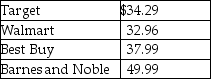 Explain whether the information in this table contradicts the law of one price.
 (Essay)
4.8/5  (73)
(73) Consider the following pricing strategies:
a. perfect price discrimination
b. charging different prices to different groups of customers
c. optimal two-part tariff
d. single-price monopoly pricing
Which of the pricing strategies leads to the economically efficient output level?
(Multiple Choice)
4.8/5 (82)
(82) What is the difference between price discrimination and other forms of discrimination?
(Essay)
4.9/5 (96)
(96) If a firm charges different consumers different prices for the same product and the difference cannot be attributed to cost variations, then it is engaging in
(Multiple Choice)
4.8/5 (73)
(73) In a perfectly competitive market, in the long run, arbitrage profits will be bid away.
(True/False)
4.8/5 (77)
(77) Movie theaters often charge higher ticket prices for evening showings than for afternoon showings. Why is this the case?
(Multiple Choice)
4.9/5 (82)
(82) Table 16-2
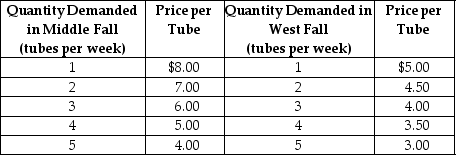 Neem Products sells its Ayurvedic Neem toothpaste in two completely isolated markets with demand schedules as shown in Table 16-2. The average cost of production is constant at $2 per tube.
-Refer to Table 16-2. What is the total revenue received from both markets combined?
Neem Products sells its Ayurvedic Neem toothpaste in two completely isolated markets with demand schedules as shown in Table 16-2. The average cost of production is constant at $2 per tube.
-Refer to Table 16-2. What is the total revenue received from both markets combined? (Multiple Choice)
4.8/5 (91)
(91) The practice of continually adjusting prices to take into account fluctuations in demand is called "yield management".
(True/False)
4.8/5 (73)
(73) If a monopolist engages in first-degree price discrimination, it will produce the same output level as a perfectly competitive industry.
(True/False)
4.8/5 (87)
(87) Figure 16-5  -Refer to Figure 16-5. Suppose the firm represented in the diagram decides to practice perfect price discrimination. What is the profit-maximizing quantity?
 (Multiple Choice)
4.9/5 (83)
(83) Publishers practice price discrimination when they sell books at high prices to
(Multiple Choice)
4.8/5 (79)
(79) Table 16-1
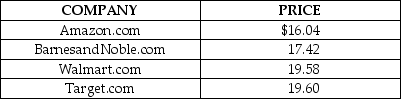 Table 16-1 shows the price for the hardcover version of the novel Into the Water by Paula Hawkins at four online bookstores.
-Refer to Table 16-1. Which of the following can one conclude from the data above?
Table 16-1 shows the price for the hardcover version of the novel Into the Water by Paula Hawkins at four online bookstores.
-Refer to Table 16-1. Which of the following can one conclude from the data above? (Multiple Choice)
4.8/5 (92)
(92) Lou buys a Star Wars: The Force Awakens poster at a garage sale for $30 and resells it on eBay to Kyle for $60. Which of the following statements is true?
(Multiple Choice)
5.0/5 (92)
(92) Bubba's Hula Shack Bar and Bistro has begun giving customers who can show proof that they arrived at the establishment by public transportation a 10 percent discount on their total bill. This is an example of
(Multiple Choice)
4.9/5 (78)
(78) Under what circumstances will the law of one price hold, and when might it not hold?
(Essay)
4.8/5 (82)
(82) Charging different prices to different consumers for the same product when the price differences are not due to differences in cost is called arbitrage.
(True/False)
5.0/5 (69)
(69) Toot Sweets Bakery sells freshly baked muffins from 6.30 am at $1.20 per muffin. By 4 pm, the remaining muffins are marked down to $0.60 each. Which of the following statements is true?
(Multiple Choice)
4.8/5 (79)
(79) Buying at a low price in one market and reselling at a higher price in another market will
(Multiple Choice)
4.8/5 (86)
(86) Consider a discount retailer such as Costco which uses a two-part tariff pricing strategy. The Costco membership fee
(Multiple Choice)
4.8/5 (86)
(86) The antitrust law that prohibits price discrimination on grounds that it reduces competition is
(Multiple Choice)
4.8/5 (81)
(81) 
Filters
- Essay(0)
- Multiple Choice(0)
- Short Answer(0)
- True False(0)
- Matching(0)