



 Chat with AI
Exam 20: Unemployment and Inflation

Exam 1: Economics: Foundations and Models459 Questions
Exam 2: Trade-Offs, Comparative Advantage, and the Market System492 Questions
Exam 3: Where Prices Come From: the Interaction of Demand and Supply476 Questions
Exam 4: Economic Efficiency, Government Price Setting, and Taxes420 Questions
Exam 5: Externalities, Environmental Policy, and Public Goods262 Questions
Exam 6: Elasticity: the Responsiveness of Demand and Supply293 Questions
Exam 7: The Economics of Health Care337 Questions
Exam 8: Firms, the Stock Market, and Corporate Governance512 Questions
Exam 9: Comparative Advantage and the Gains From International Trade377 Questions
Exam 10: Consumer Choice and Behavioral Economics304 Questions
Exam 11: Technology, Production, and Costs326 Questions
Exam 12: Firms in Perfectly Competitive Markets296 Questions
Exam 13: Monopolistic Competition: the Competitive Model in a More Realistic Setting272 Questions
Exam 14: Oligopoly: Firms in Less Competitive Markets256 Questions
Exam 15: Monopoly and Antitrust Policy279 Questions
Exam 16: Pricing Strategy258 Questions
Exam 17: The Markets for Labor and Other Factors of Production279 Questions
Exam 18: Public Choice, Taxes, and the Distribution of Income258 Questions
Exam 19: Gdp: Measuring Total Production and Income260 Questions
Exam 20: Unemployment and Inflation290 Questions
Exam 21: Economic Growth, the Financial System, and Business Cycles251 Questions
Exam 22: Long-Run Economic Growth: Sources and Policies261 Questions
Exam 23: Aggregate Expenditure and Output in the Short Run305 Questions
Exam 24: Aggregate Demand and Aggregate Supply Analysis286 Questions
Exam 25: Money, Banks, and the Federal Reserve System278 Questions
Exam 26: Monetary Policy280 Questions
Exam 27: Fiscal Policy313 Questions
Exam 28: Inflation, Unemployment, and Federal Reserve Policy257 Questions
Exam 29: Macroeconomics in an Open Economy277 Questions
Exam 30: The International Financial System258 Questions
Select questions type


If the nominal interest rate is 6% and the inflation rate is 2%, then the real interest rate is
(Multiple Choice)
4.7/5  (77)
(77) Mike has been unemployed for over a year. He hasn't looked for a job in the last three months, but he's just started looking for work again. Because Mike started looking for a new job
(Multiple Choice)
4.9/5 (75)
(75) The producer price index tracks the prices firms receive for goods and services at all stages of production.
(True/False)
4.8/5 (87)
(87) If you want to earn a real interest rate of 3% on money you lend and you expect that inflation will be 2%, what nominal rate of interest will you charge?
(Multiple Choice)
4.8/5 (86)
(86) You borrow $10,000 from a bank for one year at a nominal interest rate of 5%. If inflation over the year is 2%, what is the real interest rate you are paying?
(Multiple Choice)
5.0/5 (76)
(76) Table 20-5
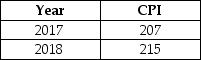 -Refer to Table 20-5. Consider the following values of the consumer price index for 2017 and 2018. The inflation rate for 2018 was equal to
 (Multiple Choice)
4.8/5 (64)
(64) Figure 20-1  -Refer to Figure 20-1. Based on the graph of the labor market above, if a minimum wage of $8 per hour is imposed, which of the following will result?
 (Multiple Choice)
4.8/5 (85)
(85) Suppose you lend $1,000 at an interest rate of 10 percent over the next year. If the expected real interest rate at the beginning of the loan contract is 4 percent, then what rate of inflation over the upcoming year would be most beneficial to you as the lender? An inflation rate
(Multiple Choice)
4.9/5 (79)
(79) Which of the following is true about the consumer price index?
(Multiple Choice)
4.9/5 (68)
(68) Explain what economists mean by full employment and why this rate of unemployment is not zero.
(Essay)
4.8/5 (80)
(80) The nominal interest rate will be less than the real interest rate when
(Multiple Choice)
4.8/5 (82)
(82) The Bureau of Labor Statistics has taken several steps to reduce the bias in the consumer price index. Which of the following is not one of the steps taken to reduce the bias?
(Multiple Choice)
4.9/5 (79)
(79) Using a broader measure of the unemployment rate where discouraged workers and part-time workers who wished to work full time were counted as unemployed, the BLS estimates the unemployment rate in April 2017 would have ________ compared to the measured unemployment rate.
(Multiple Choice)
4.8/5 (83)
(83) Suppose that in 2018, all prices in the economy double and that all wages and salaries also double. In 2018 you
(Multiple Choice)
4.8/5 (80)
(80) Table 20-15
 -Refer to Table 20-15. Looking at the table above, real average hourly earnings were equal to ________ in 2017.
 (Multiple Choice)
4.8/5 (80)
(80) If the number of unemployed workers is 200 million, the number of employed workers is 300 million, and the working-age population is 800 million, what is the labor force participation rate?
(Multiple Choice)
5.0/5 (75)
(75) When an economy is at its natural rate of unemployment, which of the following will be true?
(Multiple Choice)
4.8/5 (84)
(84) Table 20-18
 -Refer to Table 20-18. Looking at the table above, what is the rate of growth of real average hourly earnings from 2017 to 2018?
 (Multiple Choice)
4.9/5 (81)
(81) 
Filters
- Essay(0)
- Multiple Choice(0)
- Short Answer(0)
- True False(0)
- Matching(0)