



 Chat with AI
Exam 20: Unemployment and Inflation

Exam 1: Economics: Foundations and Models459 Questions
Exam 2: Trade-Offs, Comparative Advantage, and the Market System492 Questions
Exam 3: Where Prices Come From: the Interaction of Demand and Supply476 Questions
Exam 4: Economic Efficiency, Government Price Setting, and Taxes420 Questions
Exam 5: Externalities, Environmental Policy, and Public Goods262 Questions
Exam 6: Elasticity: the Responsiveness of Demand and Supply293 Questions
Exam 7: The Economics of Health Care337 Questions
Exam 8: Firms, the Stock Market, and Corporate Governance512 Questions
Exam 9: Comparative Advantage and the Gains From International Trade377 Questions
Exam 10: Consumer Choice and Behavioral Economics304 Questions
Exam 11: Technology, Production, and Costs326 Questions
Exam 12: Firms in Perfectly Competitive Markets296 Questions
Exam 13: Monopolistic Competition: the Competitive Model in a More Realistic Setting272 Questions
Exam 14: Oligopoly: Firms in Less Competitive Markets256 Questions
Exam 15: Monopoly and Antitrust Policy279 Questions
Exam 16: Pricing Strategy258 Questions
Exam 17: The Markets for Labor and Other Factors of Production279 Questions
Exam 18: Public Choice, Taxes, and the Distribution of Income258 Questions
Exam 19: Gdp: Measuring Total Production and Income260 Questions
Exam 20: Unemployment and Inflation290 Questions
Exam 21: Economic Growth, the Financial System, and Business Cycles251 Questions
Exam 22: Long-Run Economic Growth: Sources and Policies261 Questions
Exam 23: Aggregate Expenditure and Output in the Short Run305 Questions
Exam 24: Aggregate Demand and Aggregate Supply Analysis286 Questions
Exam 25: Money, Banks, and the Federal Reserve System278 Questions
Exam 26: Monetary Policy280 Questions
Exam 27: Fiscal Policy313 Questions
Exam 28: Inflation, Unemployment, and Federal Reserve Policy257 Questions
Exam 29: Macroeconomics in an Open Economy277 Questions
Exam 30: The International Financial System258 Questions
Select questions type


If the number of unemployed workers is 200 million, and the number in the labor force is 500 million, what is the unemployment rate?
(Multiple Choice)
4.8/5  (99)
(99) Which of the following would be the best measure of the cost of living?
(Multiple Choice)
5.0/5 (77)
(77) Which of the following would decrease the unemployment rate?
(Multiple Choice)
4.8/5 (98)
(98) If the nominal rate of interest is 6.5% and the inflation rate is 3.0%, what is the real rate of interest?
(Multiple Choice)
4.7/5 (82)
(82) Table 20-1
 Consider the data above for a simple economy.
-Refer to Table 20-1. The unemployment rate for this simple economy equals
Consider the data above for a simple economy.
-Refer to Table 20-1. The unemployment rate for this simple economy equals (Multiple Choice)
4.8/5 (92)
(92) Which of the following cause the unemployment rate as measured by the Bureau of Labor Statistics to understate the true extent of joblessness?
(Multiple Choice)
4.8/5 (89)
(89) Table 20-10
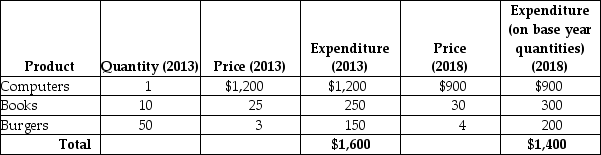 -Refer to Table 20-10. Suppose an economy has only three goods and the typical family purchases the amounts given in the table above. If 2013 is the base year, then what is the CPI for 2018?
 (Multiple Choice)
4.7/5 (86)
(86) According to the text, economists consider full employment to occur when
(Multiple Choice)
4.9/5 (68)
(68) The unemployment rate is higher with a minimum wage law than it would be without a minimum wage law.
(True/False)
4.9/5 (86)
(86) Counting part-time workers who are looking for full-time work as employed overstates the degree of joblessness in the economy.
(True/False)
4.9/5 (72)
(72) Upon your graduation from college, you find that the economy is in recession and the unemployment rate is relatively high. Nonetheless, most Americans in this situation would continue along their career paths looking for a new job because
(Multiple Choice)
4.8/5 (81)
(81) Nominal income is equal to real income if the CPI is less than 100.
(True/False)
4.8/5 (78)
(78) The consumer price index implicitly assumes that the demand curve for each good and service in the representative market basket is
(Multiple Choice)
4.9/5 (71)
(71) The inflation rate measures the percentage increase in the price level from one year to the next.
(True/False)
4.9/5 (74)
(74) Which of the following policies would reduce frictional unemployment?
(Multiple Choice)
4.8/5 (70)
(70) Which of the following would be a consequence of substitution bias in the CPI?
(Multiple Choice)
4.9/5 (91)
(91) 
Filters
- Essay(0)
- Multiple Choice(0)
- Short Answer(0)
- True False(0)
- Matching(0)