



 Chat with AI
Exam 20: Unemployment and Inflation

Exam 1: Economics: Foundations and Models459 Questions
Exam 2: Trade-Offs, Comparative Advantage, and the Market System492 Questions
Exam 3: Where Prices Come From: the Interaction of Demand and Supply476 Questions
Exam 4: Economic Efficiency, Government Price Setting, and Taxes420 Questions
Exam 5: Externalities, Environmental Policy, and Public Goods262 Questions
Exam 6: Elasticity: the Responsiveness of Demand and Supply293 Questions
Exam 7: The Economics of Health Care337 Questions
Exam 8: Firms, the Stock Market, and Corporate Governance512 Questions
Exam 9: Comparative Advantage and the Gains From International Trade377 Questions
Exam 10: Consumer Choice and Behavioral Economics304 Questions
Exam 11: Technology, Production, and Costs326 Questions
Exam 12: Firms in Perfectly Competitive Markets296 Questions
Exam 13: Monopolistic Competition: the Competitive Model in a More Realistic Setting272 Questions
Exam 14: Oligopoly: Firms in Less Competitive Markets256 Questions
Exam 15: Monopoly and Antitrust Policy279 Questions
Exam 16: Pricing Strategy258 Questions
Exam 17: The Markets for Labor and Other Factors of Production279 Questions
Exam 18: Public Choice, Taxes, and the Distribution of Income258 Questions
Exam 19: Gdp: Measuring Total Production and Income260 Questions
Exam 20: Unemployment and Inflation290 Questions
Exam 21: Economic Growth, the Financial System, and Business Cycles251 Questions
Exam 22: Long-Run Economic Growth: Sources and Policies261 Questions
Exam 23: Aggregate Expenditure and Output in the Short Run305 Questions
Exam 24: Aggregate Demand and Aggregate Supply Analysis286 Questions
Exam 25: Money, Banks, and the Federal Reserve System278 Questions
Exam 26: Monetary Policy280 Questions
Exam 27: Fiscal Policy313 Questions
Exam 28: Inflation, Unemployment, and Federal Reserve Policy257 Questions
Exam 29: Macroeconomics in an Open Economy277 Questions
Exam 30: The International Financial System258 Questions
Select questions type


Imagine that you borrow $5,000 for one year and at the end of the year you repay the $5,000 plus $600 of interest. If the inflation rate was 4%, what was the real interest rate you paid?
(Multiple Choice)
4.8/5  (82)
(82) Discuss the likely impact of each of the following on the unemployment rate:
a. The length of time workers are eligible to receive unemployment insurance payments is cut in half.
b. The government passes a law making labor unions illegal.
c. The minimum wage is raised by 50 percent.
d. The government funds an Internet site where companies can post job openings at no charge.
(Essay)
4.9/5 (77)
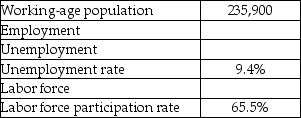
(77) Fill in the missing values in the table of data collected in the household survey for November, 2009. The working-age population, employment, unemployment, and labor force are measured in thousands. Show your work.
(Essay)
4.8/5 (83)
(83) If the price level rose in three consecutive years from 100 to 120 to 140, then the annual inflation rate over those years would
(Multiple Choice)
4.9/5 (78)
(78) The increase in quality bias in the consumer price index refers to the idea that price increases in the CPI reflect pure inflation, but ________ quality increases. This causes the CPI to ________ the cost of the market basket.
(Multiple Choice)
4.8/5 (82)
(82) The average price of goods and services in the economy is also known as
(Multiple Choice)
4.9/5 (87)
(87) If the number of unemployed workers is 19 million, the number in the working-age population is 500 million, and the unemployment rate is 4%, what is the labor force participation rate?
(Multiple Choice)
4.9/5 (62)
(62) Jack just told his boss that he thinks his boss is an idiot. It is likely that Jack will be experiencing ________ unemployment in the near future.
(Multiple Choice)
4.7/5 (72)
(72) With the exception of during recessions, workers in Canada are eligible for unemployment benefits for about twice as long a period of time as workers in the United States. As a result
(Multiple Choice)
4.7/5 (84)
(84) A lumberjack loses his job because timber cutting restrictions were imposed by the EPA to protect the spotted owl habitat. This lumberjack would be
(Multiple Choice)
4.9/5 (92)
(92) Which of the following would increase the unemployment rate?
(Multiple Choice)
4.8/5 (83)
(83) Article Summary
According to the President's Council of Economic Advisors, the labor force participation rate has significantly declined since the year 2000, due primarily to retiring baby boomers and the severity of the 2007-2009 recession. However, over the past couple of years, the labor force participation rate has held fairly steady, indicating that previously discouraged workers may be reentering the labor market. In June 2017, the labor force participation rate was 62.8%, roughly the same as it was a month earlier.
-Refer to the Article Summary. What is the labor force participation rate? What are discouraged workers? Explain how discouraged workers reentering the labor market would stop the decline of the labor force participation rate.
(Essay)
4.8/5 (87)
(87) In 2006, before the start of the recession, the employment-population ratio was 63.4 percent. In April 2017, more than six years after the end of the recession, the ratio
(Multiple Choice)
4.9/5 (75)
(75) If inflation is higher than expected, this helps borrowers (by reducing the real interest rate they pay) and hurts lenders (by reducing the real interest rate they receive).
(True/False)
4.9/5 (77)
(77) Jack was unemployed two weeks ago but just started a new job. As a result of this increase in the number of employed workers, which of the following occurred?
(Multiple Choice)
4.7/5 (78)
(78) The real wage equals the nominal wage ________ the CPI, all times 100.
(Multiple Choice)
5.0/5 (81)
(81) The "new product bias" in the consumer price index refers to the idea that
(Multiple Choice)
4.8/5 (74)
(74) A consumer price index of 160 in 1996 with a base year of 1982-1984 would mean that the cost of the market basket
(Multiple Choice)
4.9/5 (87)
(87) 
Filters
- Essay(0)
- Multiple Choice(0)
- Short Answer(0)
- True False(0)
- Matching(0)