



 Chat with AI
Exam 20: Unemployment and Inflation

Exam 1: Economics: Foundations and Models459 Questions
Exam 2: Trade-Offs, Comparative Advantage, and the Market System492 Questions
Exam 3: Where Prices Come From: the Interaction of Demand and Supply476 Questions
Exam 4: Economic Efficiency, Government Price Setting, and Taxes420 Questions
Exam 5: Externalities, Environmental Policy, and Public Goods262 Questions
Exam 6: Elasticity: the Responsiveness of Demand and Supply293 Questions
Exam 7: The Economics of Health Care337 Questions
Exam 8: Firms, the Stock Market, and Corporate Governance512 Questions
Exam 9: Comparative Advantage and the Gains From International Trade377 Questions
Exam 10: Consumer Choice and Behavioral Economics304 Questions
Exam 11: Technology, Production, and Costs326 Questions
Exam 12: Firms in Perfectly Competitive Markets296 Questions
Exam 13: Monopolistic Competition: the Competitive Model in a More Realistic Setting272 Questions
Exam 14: Oligopoly: Firms in Less Competitive Markets256 Questions
Exam 15: Monopoly and Antitrust Policy279 Questions
Exam 16: Pricing Strategy258 Questions
Exam 17: The Markets for Labor and Other Factors of Production279 Questions
Exam 18: Public Choice, Taxes, and the Distribution of Income258 Questions
Exam 19: Gdp: Measuring Total Production and Income260 Questions
Exam 20: Unemployment and Inflation290 Questions
Exam 21: Economic Growth, the Financial System, and Business Cycles251 Questions
Exam 22: Long-Run Economic Growth: Sources and Policies261 Questions
Exam 23: Aggregate Expenditure and Output in the Short Run305 Questions
Exam 24: Aggregate Demand and Aggregate Supply Analysis286 Questions
Exam 25: Money, Banks, and the Federal Reserve System278 Questions
Exam 26: Monetary Policy280 Questions
Exam 27: Fiscal Policy313 Questions
Exam 28: Inflation, Unemployment, and Federal Reserve Policy257 Questions
Exam 29: Macroeconomics in an Open Economy277 Questions
Exam 30: The International Financial System258 Questions
Select questions type


Which of the following would reduce the labor force participation rate, all else equal?
(Multiple Choice)
4.8/5  (68)
(68) If the federal government implements programs so that the unemployed are more quickly matched with jobs, then
(Multiple Choice)
4.8/5 (72)
(72) Labor unions cause unemployment because the union contract wage is set
(Multiple Choice)
4.8/5 (79)
(79) Monthly expenditures for a family of 4 in 2017 averaged $1,400. In 2018, the cost of the same purchases was $1,500. If 2017 is the base year, what was the CPI in 2018?
(Multiple Choice)
4.9/5 (74)
(74) Establishing a state employment agency that speeds up the process of matching unemployed workers with unfilled jobs is an attempt to lower
(Multiple Choice)
5.0/5 (73)
(73) The advice to "keep searching, there are plenty of jobs around here for which you are qualified," would be most appropriate for which of the following types of unemployment?
(Multiple Choice)
4.8/5 (69)
(69) Inflation redistributes income to a greater extent when the inflation is unanticipated compared to when the inflation is anticipated.
(True/False)
4.7/5 (84)
(84) Table 20-15
 -Refer to Table 20-15. Looking at the table above, real average hourly earnings in 2016 were
 (Multiple Choice)
4.9/5 (92)
(92) Table 20-1
 Consider the data above for a simple economy.
-Refer to Table 20-1. The labor force participation rate for this simple economy equals
Consider the data above for a simple economy.
-Refer to Table 20-1. The labor force participation rate for this simple economy equals (Multiple Choice)
4.9/5 (79)
(79) Table 20-21
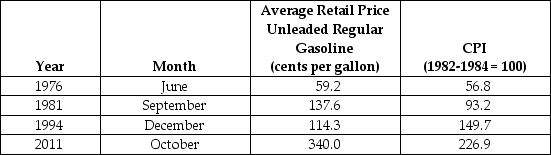 Source: Energy Information Administration
-Refer to Table 20-21. The table above reports the consumer price index and the average U.S. retail price for unleaded regular gasoline for four different periods since 1976. Note that the gasoline prices are in cents per gallon.
Calculate the real average retail price of unleaded regular gasoline in 1982-1984 dollars. In which period were gasoline prices the highest in real terms? Also, calculate the real average retail price of unleaded regular gasoline in 2011 dollars.
Source: Energy Information Administration
-Refer to Table 20-21. The table above reports the consumer price index and the average U.S. retail price for unleaded regular gasoline for four different periods since 1976. Note that the gasoline prices are in cents per gallon.
Calculate the real average retail price of unleaded regular gasoline in 1982-1984 dollars. In which period were gasoline prices the highest in real terms? Also, calculate the real average retail price of unleaded regular gasoline in 2011 dollars. (Essay)
4.8/5 (80)
(80) Table 20-2
 -Refer to Table 20-2. Assume the market basket for the consumer price index has two products-bread and milk-with the following values in 2013 and 2018 for price and quantity: The Consumer Price Index for 2018 equals
 (Multiple Choice)
4.9/5 (69)
(69) Which of the following is the smallest portion of the market basket of goods that makes up the CPI?
(Multiple Choice)
4.8/5 (77)
(77) An advantage of the household survey over the establishment survey of the labor market is that the household survey
(Multiple Choice)
4.9/5 (81)
(81) Emma is a road construction worker. During the winter months, Emma finds it more difficult to get work. The unemployment Emma experiences in the winter is
(Multiple Choice)
4.8/5 (72)
(72) The CPI in 1990 was 131, and the CPI in 2010 was 218. If you earned a salary of $40,000 in 1990, what would be a salary with equivalent purchasing power in 2010?
(Multiple Choice)
4.8/5 (80)
(80) Explain whether you agree or disagree with the following statement: "The reason that inflation is bad is because it increases the cost of living-the costs of goods and services we buy-without increasing income in general."
(Essay)
4.9/5 (78)
(78) 
Filters
- Essay(0)
- Multiple Choice(0)
- Short Answer(0)
- True False(0)
- Matching(0)