



 Chat with AI
Exam 12: Infrared Spectroscopy

Exam 1: Covalent Bonding and Shapes of Molecules118 Questions
Exam 2: Alkanes and Cycloalkanes101 Questions
Exam 3: Stereoisomerism and Chirality95 Questions
Exam 4: Acids and Bases94 Questions
Exam 5: Alkenes: Bonding, Nomenclature, and Properties88 Questions
Exam 6: Reactions of Alkenes97 Questions
Exam 7: Alkynes100 Questions
Exam 8: Haloalkanes, Halogenation, and Radical Reactions75 Questions
Exam 9: Nucleophilic Substitution and Beta-Elimination104 Questions
Exam 10: Alcohols102 Questions
Exam 11: Ethers, Epoxides, and Sulfides102 Questions
Exam 12: Infrared Spectroscopy74 Questions
Exam 13: Nuclear Magnetic Resonance Spectroscopy99 Questions
Exam 14: Mass Spectrometry75 Questions
Exam 15: An Introduction to Organometallic Compounds73 Questions
Exam 16: Aldehydes and Ketones122 Questions
Exam 17: Carboxylic Acids76 Questions
Exam 18: Functional Derivatives of Carboxylic Acids117 Questions
Exam 19: Enolate Anions and Enamines96 Questions
Exam 20: Dienes, Conjugated Systems, and Pericyclic Reactions75 Questions
Exam 21: Benzene and the Concept of Aromaticity77 Questions
Exam 22: Reactions of Benzene and Its Derivatives109 Questions
Exam 23: Amines92 Questions
Exam 24: Catalytic Carbon-Carbon Bond Formation84 Questions
Exam 25: Carbohydrates69 Questions
Exam 26: Lipids65 Questions
Exam 27: Amino Acids and Proteins77 Questions
Exam 28: Nucleic Acids58 Questions
Exam 29: Organic Polymer Chemistry68 Questions
Select questions type


he amount of energy in infrared light corresponds to the amount of energy needed to increase certain molecular motions, such as bond vibrations, in organic molecules.
(True/False)
4.8/5  (70)
(70) Which of the following compounds gives a carbonyl bond absorption at the highest frequency? 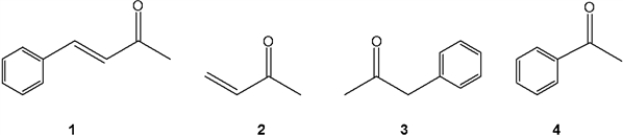
(Multiple Choice)
5.0/5 (71)
(71) Which of the following compounds gives an infrared spectrum with peaks at 3300 cm−1 (sharp peak) and 2150 cm−1 (sharp peak)? 
(Multiple Choice)
4.8/5 (95)
(95) Which of the following regions in the electromagnetic spectrum corresponds to the radiation with the highest energy?
(Multiple Choice)
4.8/5 (79)
(79) Which of the following bonds gives the weakest peak in the infrared spectrum for a stretching vibration? 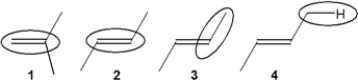
(Multiple Choice)
5.0/5 (84)
(84) What is the energy of a photon moving with a frequency of 10.0 × 10¹⁰ s−1? (Planck's constant = 6.626 × 10⁻³⁴ J s)
(Multiple Choice)
4.9/5 (87)
(87) Cyclohexene and 2-hexyne both have the molecular formula C6H10. Any of the following regions of an IR spectrum could be used to distinguish these two compounds.
3020-3100 cm−1
2100-2260 cm−1
1650-1670 cm−1
(True/False)
4.9/5 (80)
(80) An IR spectrum of an unknown organic molecule having the formula which contains carbon, hydrogen, and oxygen reveals a strong absorption at 1715-1725 cm-1. This molecule is most likely an ether.
(True/False)
4.8/5 (85)
(85) Label three peaks in the following spectrum with the bond that gives rise to them, and identify the functional group that is present in the compound (the compound has a formula of C5H10O2)?
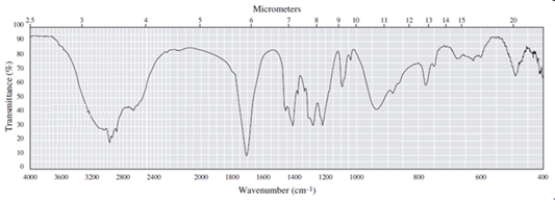
(Essay)
4.8/5 (87)
(87) Which of the following compounds gives an infrared spectrum with peaks at 1000-1250 cm−1 (strong), but does not have peaks at 3200-3650 or 1630-1820 cm−1 (sharp, weak peak)? 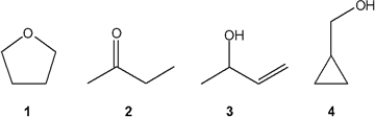
(Multiple Choice)
4.7/5 (80)
(80) What is the frequency of a radiation with a wavelength of 3.0 × 10⁻⁵ m? (Speed of light = 3.0 × 10⁸ m/s)
(Multiple Choice)
4.9/5 (75)
(75) Which of the following bonds gives rise to an absorbance at approximately 2700-3300 cm−1 in the infrared spectrum?
(Multiple Choice)
4.9/5 (75)
(75) Which of the following compounds gives a carbonyl bond absorption at the lowest frequency? 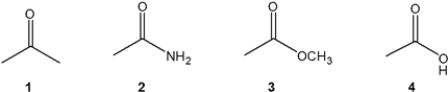
(Multiple Choice)
4.7/5 (76)
(76) Which of the following relationships is not valid as applied to infrared spectroscopy?
(Multiple Choice)
4.8/5 (83)
(83) 
Filters
- Essay(0)
- Multiple Choice(0)
- Short Answer(0)
- True False(0)
- Matching(0)