



 Chat with AI
Exam 27: Amino Acids and Proteins

Exam 1: Covalent Bonding and Shapes of Molecules118 Questions
Exam 2: Alkanes and Cycloalkanes101 Questions
Exam 3: Stereoisomerism and Chirality95 Questions
Exam 4: Acids and Bases94 Questions
Exam 5: Alkenes: Bonding, Nomenclature, and Properties88 Questions
Exam 6: Reactions of Alkenes97 Questions
Exam 7: Alkynes100 Questions
Exam 8: Haloalkanes, Halogenation, and Radical Reactions75 Questions
Exam 9: Nucleophilic Substitution and Beta-Elimination104 Questions
Exam 10: Alcohols102 Questions
Exam 11: Ethers, Epoxides, and Sulfides102 Questions
Exam 12: Infrared Spectroscopy74 Questions
Exam 13: Nuclear Magnetic Resonance Spectroscopy99 Questions
Exam 14: Mass Spectrometry75 Questions
Exam 15: An Introduction to Organometallic Compounds73 Questions
Exam 16: Aldehydes and Ketones122 Questions
Exam 17: Carboxylic Acids76 Questions
Exam 18: Functional Derivatives of Carboxylic Acids117 Questions
Exam 19: Enolate Anions and Enamines96 Questions
Exam 20: Dienes, Conjugated Systems, and Pericyclic Reactions75 Questions
Exam 21: Benzene and the Concept of Aromaticity77 Questions
Exam 22: Reactions of Benzene and Its Derivatives109 Questions
Exam 23: Amines92 Questions
Exam 24: Catalytic Carbon-Carbon Bond Formation84 Questions
Exam 25: Carbohydrates69 Questions
Exam 26: Lipids65 Questions
Exam 27: Amino Acids and Proteins77 Questions
Exam 28: Nucleic Acids58 Questions
Exam 29: Organic Polymer Chemistry68 Questions
Select questions type


Which of the following tripeptides is not hydrolyzed by trypsin?

Free
(Multiple Choice)
4.9/5  (78)
(78) Correct Answer: Verified
C
Provide the major organic product of the following reaction that is used in the chemical synthesis of peptides. 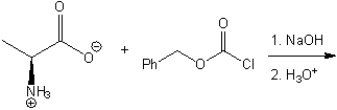
Free
(Essay)
4.8/5 (77)
(77) Correct Answer:Verified
Verified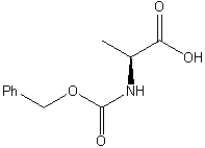
Which of the following amino acids contains two stereocenters?
Free
(Multiple Choice)
4.8/5 (88)
(88) Correct Answer:Verified
VerifiedA
To what structural feature does the term "primary structure" refer?
(Multiple Choice)
4.8/5 (69)
(69) 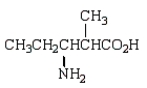
MATCH a structure from the list below to each of the following terms. Place the letter of the structure in the blank to the left of the term which it describes.
-_____ is a carboxyl-protected amino acid.
(Multiple Choice)
4.9/5 (72)
(72) Which of the following amino acids has an aromatic side chain?
(Multiple Choice)
4.7/5 (81)
(81) How does phenyl isothiocyanate, Ph−N=C=S, react with a peptide in the Edman degradation?
(Multiple Choice)
4.9/5 (79)
(79) Which of the following amino acids migrates to the negative electrode on paper electrophoresis at a pH of 7.0?
(Multiple Choice)
4.9/5 (85)
(85) MATCH a structure from the list below to each of the following terms. Place the letter of the structure in the blank to the left of the term which it describes.
-_____ is the product of an Edman degradation.
(Multiple Choice)
4.9/5 (88)
(88) The combination of the two sidechains of the given compounds leads to the formation of a special bond. Identify the type of bond formed. 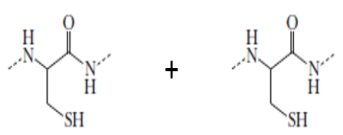
(Multiple Choice)
4.9/5 (88)
(88) Which of the following amino acids has a non-polar side chain?
(Multiple Choice)
4.9/5 (87)
(87) What is the isoelectric point of glutamic acid (pKa of α-CO2H, 2.10; pKa of β-CO2H, 4.07; pH of α-NH2, 9.47)?
(Multiple Choice)
4.7/5 (70)
(70) Which of the bonds in the following structure is cleaved by cyanogen bromide? 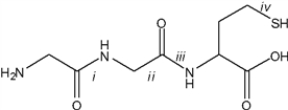
(Multiple Choice)
5.0/5 (78)
(78) Structure _____ (shown below) will migrate toward the positive electrode in an electrophoresis experiment. | | | I II III
(Short Answer)
4.8/5 (79)
(79) To what structural feature does the term "quaternary structure" refer?
(Multiple Choice)
4.9/5 (70)
(70) 
Filters
- Essay(0)
- Multiple Choice(0)
- Short Answer(0)
- True False(0)
- Matching(0)